Tree of Thought (ToT) prompting (original) (raw)
Last Updated : 7 May, 2026
Tree of Thought (ToT) prompts give reasoning as a branching tree, allowing the model to explore multiple paths and choose the best solution, similar to human problem-solving.
- Explores multiple reasoning paths instead of following a single solution.
- Evaluates intermediate steps to choose the most promising direction.
- Refines and improves reasoning by comparing different paths.
- Mimics human thinking by considering alternatives and eliminating weak options.
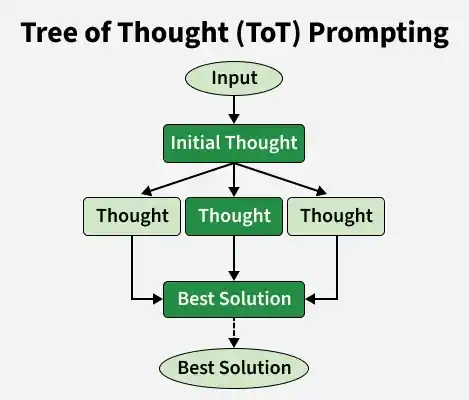
Tree of Thoughts
Working of Tree of Thought Prompting
It uses a structured approach where the model explores multiple reasoning paths, evaluates them and focuses on the best ones to reach an optimal solution.
**1. Branching Reasoning Structure
- The model decomposes a complex problem into intermediate steps, called "thoughts."
- Each thought is a node in the tree, representing a partial solution or an intermediate idea.
- From each node, the model generates multiple possible continuations (branches), exploring diverse lines of reasoning.
**2. Exploration and Backtracking
- Unlike linear methods like chain-of-thought, ToT allows the model to pursue several paths simultaneously.
- If a path leads to a dead end or suboptimal result, the model can backtrack and explore alternative branches similar to how humans reconsider decisions when initial attempts fail.
**3. Evaluation and Pruning
- At each stage, the model evaluates the generated thoughts using heuristics or value prompts.
- Less promising branches are pruned, focusing computational resources on the most viable paths.
- This iterative process continues until an optimal or satisfactory solution is found.
**Example of Solving a Puzzle
This example shows how Tree of Thought prompting solves a problem by exploring multiple solution paths step by step.
- **Step 1: The model generates several possible first moves (e.g., different equations or approaches).
- **Step 2: For each move, it generates several possible next steps, creating a branching tree of solutions.
- **Step 3: At each node, the model evaluates progress toward the final answer, pruning dead ends.
- **Step 4: The process continues, with the model backtracking and trying new branches as needed, until it finds the correct solution.
Applications
- Solves complex mathematical and logical problems using multiple reasoning paths
- Helps in puzzles and decision-making tasks by evaluating different possibilities
- Supports creative writing by generating and refining multiple ideas
- Useful in planning and strategy tasks where multiple outcomes must be considered
- Improves performance in tasks requiring exploration rather than fixed steps
Advantages
- Explores multiple reasoning paths, increasing chances of better solutions
- Allows backtracking to avoid incorrect or weak approaches
- Produces more flexible and robust problem-solving strategies
- Mimics human decision-making by evaluating alternatives
- Useful for both structured (math, logic) and open-ended tasks
Limitations
- Computationally expensive due to multiple reasoning paths
- Slower compared to linear approaches like Chain of Thought
- Requires careful control to avoid excessive branching
- May generate redundant or irrelevant paths if not guided properly