Types of Environments in AI (original) (raw)
Last Updated : 11 Jun, 2026
An environment in artificial intelligence refers to the external world in which an agent operates and interacts. The behavior of an environment depends on how much information the agent can access and how the state changes over time.
- The agent perceives information from the environment using sensors and performs actions through actuators.
- Environments are categorized based on interaction style, uncertainty, and structure of decision-making.
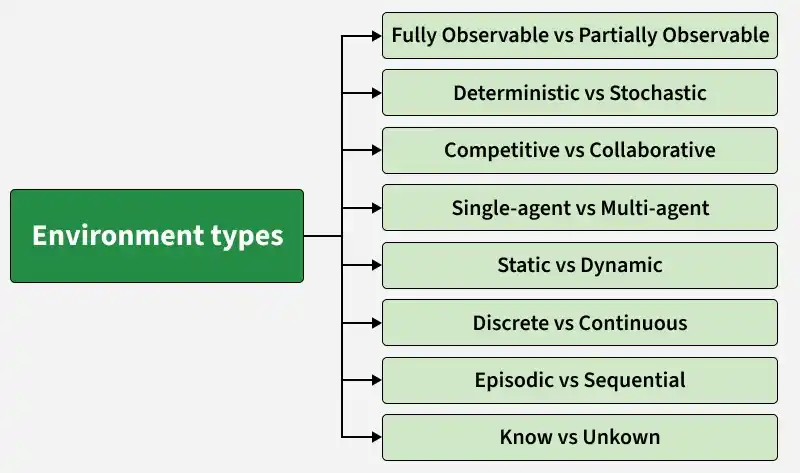
Types of Environments
**1. Fully Observable vs Partially Observable
In a fully observable environment, the agent can access the complete state at any given time, while in a partially observable environment, only partial information is available. Fully observable systems do not require maintaining historical data, whereas partially observable systems depend on memory of past states.
**Examples:
- Chess - The board is fully observable, and so are the opponent's moves.
- Driving - The environment is partially observable because what's around the corner is not known
**2. Deterministic vs Stochastic
When a uniqueness in the agent's current state completely determines the next state of the agent, the environment is said to be deterministic. The stochastic environment is random in nature which is not unique and cannot be completely determined by the agent.
**Examples:
- Chess - There would be only a few possible moves for a chess piece at the current state and these moves can be determined.
- Self-Driving Cars- The actions of a self-driving car are not unique, it varies time to time.
**3. Competitive vs Collaborative
In a competitive environment, agents compete against each other to optimize their individual outcomes. An agent is said to be in a collaborative environment when multiple agents cooperate to produce the desired output.
**Examples:
- Chess - Each agent competes to defeat the opponent and win the match.
- Self-Driving Cars - Vehicles coordinate with each other to ensure safe travel and avoid collisions.
**4. Single-agent vs Multi-agent
An environment consisting of only one agent is said to be a single-agent environment. A multi-agent environment involves more than one agent interacting within the same environment.
**Examples:
- Maze solving – One agent navigates to find the exit.
- Football – Multiple players from both teams interact to play the game.
**5. Dynamic vs Static
A dynamic environment keeps changing while the agent is performing actions or interacting with it. A static environment remains unchanged while the agent is acting on it.
**Examples:
- Roller coaster ride – The state keeps changing continuously during motion.
- Empty house – Surroundings do not change when an agent enters.
**6. Discrete vs Continuous
If an environment consists of a finite number of actions that can be deliberated in the environment to obtain the output, it is said to be a discrete environment. A continuous environment has uncountable or infinitely varying actions and states.
**Examples:
- Chess – It has a limited number of possible moves in any given position.
- Self-driving cars – Actions like steering and acceleration vary continuously and cannot be counted.
**7. Episodic vs Sequential
An episodic environment consists of independent tasks where each action is separate and does not depend on previous actions. A sequential environment involves dependent actions where current decisions affect future outcomes.
**Examples:
- Pick and place robot – Each item is checked independently on a conveyor belt.
- Checkers – Each move influences all subsequent moves in the game.
**8. Known vs Unknown
A known environment is one where the outcomes of all possible actions are already known to the agent. An unknown environment is one where the agent does not know the outcomes and must learn or explore to understand them.
**Examples:
- Route planning in a GPS navigation system – Outcomes of paths are already known.
- Exploring an unfamiliar maze – The agent must discover paths and outcomes while navigating.