What is AI Model ? (original) (raw)
Last Updated : 15 Apr, 2026
In today's digital age, "artificial intelligence" (AI) has become widely known, often bringing to mind thoughts of futuristic robots and highly automated systems. However, at the heart of AI lies a fundamental concept: The AI model. But What exactly is an AI model, and how does it function? In this article, we delve into the intricacies of AI models, exploring their definition, creation process, components, applications, and future directions.
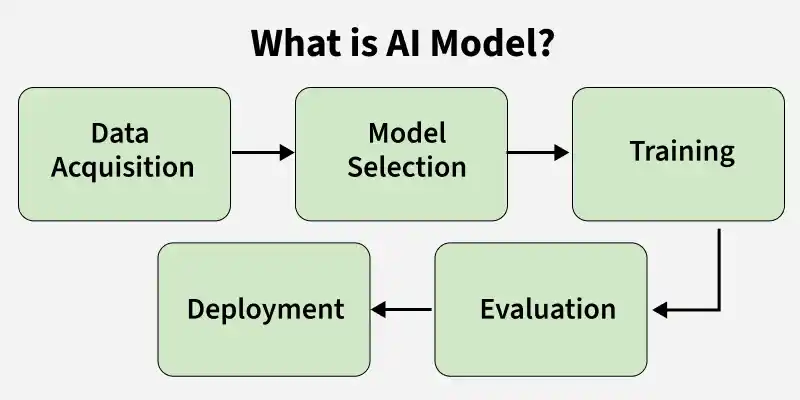
AI Model
What is Artificial Intelligence(AI)?
**Artificial intelligence (AI) is a wide-ranging branch of computer science concerned with building smart machines capable of performing tasks that typically require human intelligence. An Artificial intelligence (AI) system that is trained with varying amounts of predefined and undefined data as examples.
What are AI Models?
AI programs primarily recognize patterns and provide results based on having previously reviewed examples of the patterns that deal with the topic (voice recognition, machine vision, etc.). AI models use neural network architectures to learn and produce results. AI models are complex mathematical and computational techniques to process vast amounts of data and extract meaningful insights. The term AI model encompasses a wide range of techniques and approaches used in artificial intelligence that include machine learning, deep learning , and neural networks. These models are trained on diverse dataset to learn from examples and derive patterns that enable them to perform specific tasks.
How Does AI Models Works?
AI models are like students who excel at finding patterns from information they are given. This information, the **data, is the foundation of everything an AI model does.
There are two main types of data used in AI models:
- **Training data: This is the massive dataset the model is fed during the training process. It can include text, images, videos, numbers, or any other format relevant to the task the model is designed for. The quality and quantity of training data heavily influence the model's performance.
- **Input data: Once trained, the model is presented with new, unseen data. This data format should be similar to the training data. Based on the patterns learned during training, the model analyzes the input data and generates an output, such as a prediction or a decision.
AI Model Training Process
The training process is where the AI model transforms from a blank slate into a pattern-recognition master. Here's a breakdown:
- **Data Preparation: The training data goes through a cleaning and pre-processing stage to ensure consistency and usability for the model.
- **Feeding the Model: The prepared data is fed into the AI model through a specific algorithm. Think of it like feeding problems and solutions to a student.
- **Pattern Recognition: The algorithm analyzes the data, searching for underlying patterns and relationships between different data points. Imagine the student noticing patterns in how to solve the problems.
- **Adjusting the Model: Based on the analysis, the model adjusts its internal parameters to better represent the discovered patterns. This is like the student refining their approach based on their understanding.
- **Iteration and Refinement: Steps 2-4 are repeated numerous times with different batches of training data. With each iteration, the model becomes more skilled at recognizing the patterns. This is similar to the student practicing and improving over time.
Components of an AI Model
An AI model can be thought of as having three main components:
- **Algorithms: These are the mathematical formulas and rules that define the model's behavior and how it processes information.
- **Data: The training data provides the raw material for the model to learn from and build its predictive abilities.
- **Parameters: These are adjustable elements within the model that are fine-tuned during training to optimize its performance.
Applications of AI Models
The **applications of AI models are vast and ever-growing, impacting various aspects of our lives. Here are a few examples:
- **Image and video recognition: From unlocking your phone with your face to self-driving cars navigating the streets, AI models power image and video recognition.
- **Natural language processing (NLP): Powers chatbots that answer your questions, machine translation that breaks down language barriers, and sentiment analysis in social media.
- **Recommender systems: Whether it's suggesting movies you might enjoy or recommending products you might need, AI models power the personalized recommendations we encounter online and in stores.
- **Predictive maintenance: By analyzing sensor data, AI models can predict equipment failure in factories or power grids, preventing costly downtime.
- **Fraud detection: AI models can help identify suspicious financial transactions and protect against cybercrime by analyzing vast amounts of data in real-time.
Challenges and Considerations in AI Models
While AI models offer immense potential, they also come with challenges:
- **Bias: AI models can inherit bias from the data they are trained on, leading to discriminatory outcomes. Mitigating bias requires careful data selection and training techniques.
- **Explainability: Understanding how an AI model arrives at a decision can be complex, making it difficult to trust its results in critical applications.
- **Security and privacy: AI models that handle sensitive data raise concerns about security breaches and privacy violations. Robust security measures are essential.
How to maintain data privacy in AI Models?
Data privacy is a major concern in AI/ML models, as these models rely heavily on data to function. Here are some key strategies to maintain data privacy:
**1. Data Minimization and Anonymization:
- **Minimize data collection: Only collect the data necessary for the specific task at hand. Avoid collecting extraneous information that isn't vital for the model's function.
- **Anonymization: Remove personally identifiable information (PII) from the data before training the model. Techniques like k-anonymity ensure a data point cannot be linked back to a specific individual.
**2. Secure Data Storage and Processing:
- **Encryption: Encrypt data at rest (stored) and in transit (being transferred) to minimize the risk of unauthorized access.
- **Access control: Implement strict access control mechanisms to limit who can access and use the training data.
**3. Privacy-Preserving Techniques:
- **Differential Privacy: This technique adds controlled noise to the data during training, making it statistically impossible to determine if a specific individual's data point is included in the model.
- **Federated Learning: This approach trains the model on decentralized devices without sharing the raw data. The devices only share model updates, protecting individual data privacy.
- **Homomorphic Encryption: This allows computations to be performed on encrypted data, eliminating the need to decrypt sensitive information during training.
**4. Transparency and User Control:
- **Explainability: Strive to develop models that are interpretable, allowing users to understand how the model arrives at its decisions. This builds trust and helps identify potential biases.
- **User consent: Be transparent about how data is collected and used for AI models. Obtain informed consent from users whenever possible.
**5. Model Security:
- **Adversarial attacks: These attacks attempt to manipulate the model's output by feeding it specially crafted data. Implement robust security measures to prevent such attacks.
- **Regular monitoring: Continuously monitor the model's performance and identify potential privacy risks or biases that may emerge over time.