Artificial General Intelligence (AGI) Definition, Examples, Challenges (original) (raw)
Last Updated : 15 Jul, 2025
Artificial General Intelligence (AGI) refers to a level of artificial intelligence that matches human intelligence in understanding, learning, and problem-solving. Unlike narrow AI, which excels at specific tasks like facial recognition or language translation, AGI possesses the ability to perform a wide range of cognitive tasks with adaptability and versatility. Its development aims to replicate the dynamic and flexible problem-solving capabilities of the human mind, opening new horizons for innovation.
**Key Characteristics of Artificial General Intelligence (AGI)
- **Versatility: AGI transcends the limitations of narrow AI by excelling at multiple tasks, from playing chess and composing music to conducting scientific research and interpreting human emotions. It mirrors the diverse intellectual abilities of humans.
- **Adaptability: A defining trait of AGI is its ability to learn from past experiences and apply that knowledge to unfamiliar scenarios. This adaptability enables it to navigate and solve complex challenges efficiently.
- **Self-Improvement: AGI has the capacity for autonomous enhancement. It can identify its strengths and weaknesses, refine its strategies, and even innovate new approaches to problem-solving without human intervention.
- **General Understanding: Unlike narrow AI systems confined to predefined parameters, AGI comprehends and interacts with the world in a flexible, human-like manner, processing and interpreting data across diverse contexts.
What an AI needs to become Artificial General Intelligence (AGI)?
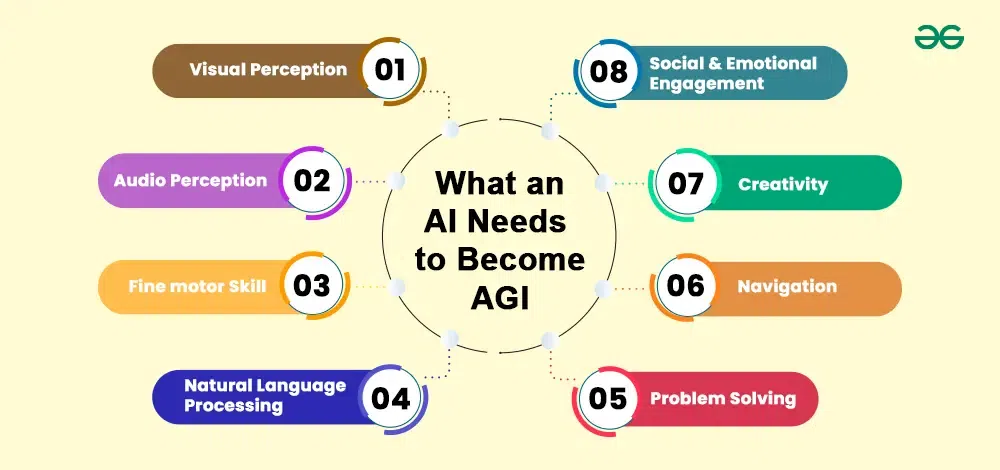
Some of the crucial areas for AI to develop true Artificial General Intelligence (AGI). Here's what is need and why each is essential:
- **Visual Perception****:** Current AI is good at recognizing objects but it usually has a hard time in dealing with the context depth and unseen of objects. AGI would have to be able to recognize the real world to understand the subtle visual cues and to interact with objects in an effective way that is similar to humans.
- **Audio Perception: Just like vision AI can cope with speech as well but the interpretation of intent, tone and background noises is still a problem. Artificial General Intelligence would have to process audio like humans, the elimination of the unneeded noise and the comprehension of the speech with the subtle variations would be its tasks.
- **Fine Motor Skills: Today, the robots are great yet their movements look clumsy and are not so accurate as the human hands. AGI would need the ability to handle the physical things, do the fine tasks, and fit into our environment without any trouble.
- **Natural Language Processing (NLP)****:** This is an important aspect of the growth. NLP is the process that makes AI able to grab and answer human language. AGI is a perfect example that the near-perfect NLP is required to communicate with humans and to deal with the complexities of the human language.
- **Problem Solving: Although AI is able to solve some problems, it is not as creative as humans and it cannot approach new problems the way humans do. Artificial General Intelligence would need to have advanced problem-solving capabilities to deal with the unexpected situations and make decisions through the complex issues, and adapt to the changing environment.
- **Navigation: AI can manage in the controlled environments, however, the real world that is very dynamic and unpredictable is another story. AGI would have to be a navigational expert, planning the route, avoiding the obstacles and adapting to the surroundings changes.
- **Creativity: The human brain is impressed by the creativity. The AI can create new text formats, but it usually does not grab the deep meaning and come up with new ones. Artificial General Intelligence would have some degree of creativity so that it could think beyond the box, invent new solutions and be able to create art.
- **Social and Emotional Engagement: Social skills are the key elements of human intelligence. The comprehension of emotions and the ability to react to the ones and the success of the relationships are all the main parts of the social interaction. Although some AI systems are able to imitate the simple emotions, the social and emotional interaction with humans is a challenge that AGI has to face to become fully integrated with human society.
Challenges of AGI
Despite these advancements, several challenges remain:
- **Common Sense Reasoning: The biggest obstacle is the issue of giving machines the common sense reasoning which humans so easily apply in their life.
- **Transfer Learning****:** The thought of AI systems learning from one domain and applying it to another is a big hurdle to overcome.
- **Interpretability and Explainability: The AGI's decisions are understandable and explainable which is important for gaining trust and ensuring safety.
Ethical Implications and Future Directions
The development of AGI brings with it profound ethical and societal implications. Some key considerations include:
- **Job Displacement: AGI might be able to do tasks that presently are performed by humans, which causes a great change in the job market. Preparing for this so-called "transition" is inevitably important in order to decrease the economic and social consequences.
- **Security Risks: AGI systems must not only to deal with misuse, cyber-attacks, and the unintended consequences but also be designed in such a way to are not vulnerable to these problems. The main objective of this task is to protect these systems from the security threats and to make sure that they follow the human values.
- **Existential Risks: There are the issues of the possibility of AGI to surpass the human intelligence thus, a situation where humans could no longer manage the superintelligent machines would be created. The AGI development should be directed towards the positive results of humanity as one of the major priorities.
Examples of Artificial General Intelligence (AGI)
Artificial General Intelligence (AGI) represents the pinnacle of artificial intelligence, possessing the ability to understand, learn, and apply knowledge across a wide range of tasks at a level comparable to human intelligence.
**Personal Assistant Systems
Today's personal assistant systems like Siri, Alexa, and Google Assistant have some features of the Artificial General Intelligence . These systems are able to interpret natural language process queries and extract information from huge datasets and carry out different tasks such as setting reminders, sending messages, or giving weather updates. Although their abilities are still not as advanced as human intelligence, they show the way towards Artificial General Intelligence by combining several tasks and adapting to user preferences over a period of time.
**Self-Driving Cars
Self-driving cars rely on complex AI algorithms to perceive their environment, make decisions and navigate safely without human intervention. Artificial General Intelligence principles are seen in their capacity to be able to interpret real-time data from the sensors to recognize the objects, to predict the traffic patterns, and to react to the dynamic road conditions
**Virtual Assistants in Healthcare
Virtual assistants that are created for healthcare purposes are AGI-like in that they can comprehend medical queries, analyze patient data, and make personalized recommendations. These systems use the natural language processing, machine learning, and domain-specific knowledge to help healthcare professionals in diagnosis, treatment planning, and patient management.
Creative AI in Art and Music
Creative AI algorithms for instance, deep learning-based generative models have been used to create art, music, and literature by themselves. These systems can create new compositions, paintings, or stories that are creative and aesthetically appealing just like human creations.
General Game Playing AI
General game playing AI, such as AlphaGo and OpenAI's Data 2 bots, show the AGI-like abilities of the systems in playing complex strategic games. These systems use the latest technology to study the game states, forecast the opponent's moves and devise the long-term strategies. Through mastering several games that have various rules and dynamics, they demonstrate the adaptability and general problem-solving ability similar to human intelligence.