Auscultation (original) (raw)
Last Updated : 23 Jul, 2025
The auscultation method is a medical technique that doctors and nurses perform to the internal body sounds of a patient using a stethoscope. This method is the main tool in the detection of various diseases, mainly related to the heart, lungs, and gastrointestinal system. In this article, we will cover auscultation in detail.**
Table of Content
A**uscultation Meaning
Auscultation is a medical technique used by doctors to listen to the sounds made by internal organs, primarily the heart and lungs, to assess their condition. Using a stethoscope, healthcare providers can detect normal and abnormal sounds, such as heartbeats, breath sounds, and bowel noises.
The doctor puts the stethoscope on the patient's body and listens to certain places for the characteristic sounds. This method helps diagnose various conditions, like heart murmurs, lung infections, and digestive issues. By interpreting these sounds, doctors can identify potential health problems early and provide appropriate treatment.
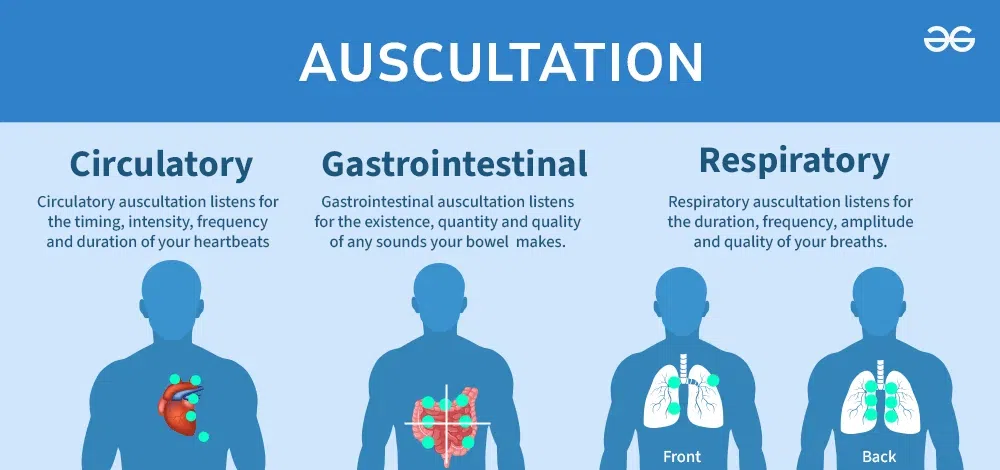
Auscultation
Auscultation of Heart
Auscultation of the heart involves listening to the sounds produced by the heart during each heartbeat. Healthcare providers use a stethoscope to detect normal heart sounds, such as the lub-dub rhythm, as well as abnormal sounds like murmurs, clicks, or extra heartbeats. This examination helps diagnose heart conditions.
Normal Heart Sounds
**S1 (First Heart Sound): "**Lub" sound is caused by the closing of the mitral and tricuspid valves at the beginning of ventricular systole. As the ventricles contract, these valves shut to prevent blood from flowing back into the atria.
**S2 (Second Heart Sound): "**Dub" sound is caused by the closing of the aortic and pulmonary valves at the beginning of ventricular diastole. As the ventricles relax, these valves shut to prevent blood from flowing back into the ventricles from the aorta and pulmonary artery.
Abnormal Heart Sounds
Some of the abnormal heart sounds are:
- **Murmurs: That is the hissing or whispering sound caused by the disturbed blood flow either in or around the heart. They can be classified based on when they occur in the heartbeat cycle:
- **Systolic Murmurs: Heard during the heart muscle contraction phase (systole).
- **Diastolic Murmurs: Heard between heartbeats, during the relaxation phase (diastole).
- **Gallops: These are extra heart sounds that can sometimes be heard in addition to the regular S1 and S2 sounds. They can indicate specific heart conditions.
- **Clicks and Snaps: These are short, high-pitched sounds that can sometimes be heard during a heartbeat. They can be a sign of a heart valve problem.
- **Ejection Click: This click may be associated with aortic or pulmonic valve stenosis (narrowing).
- **Opening Snap: This click can be a sign of a narrowed mitral valve.
Auscultation of Lung
Auscultation of the lungs uses a stethoscope to listen to the sounds produced by the lungs during breathing. By placing the stethoscope on different areas of the chest, healthcare professionals can assess the airflow, detect any abnormal sounds such as wheezing or crackles. This diagnostic technique helps in identifying respiratory conditions like pneumonia, asthma, or chronic obstructive pulmonary disease (COPD), helping in accurate diagnosis and treatment planning
Normal Lung Sounds
- **Vesicular Breath Sounds: These are soft, rustling sounds heard over most lung areas. They arise from air moving through small airways (alveoli) during respiration.
- **Bronchovesicular Breath Sounds: These are breath sounds with characteristics of both vesicular and bronchial sounds. They are heard over larger airways (bronchi) like those between the shoulder blades (scapulae) or at the mid-chest.
- **Bronchial Breath Sounds: These are loud, high-pitched sounds normally heard only over the trachea (windpipe) in the front of the neck.
**Abnormal Lung Sounds
Some of the abnormal lung sounds are:
- **Crackles (Rales): These are popping or crackling sounds caused by air entering or leaving fluid-filled alveoli.
- **Fine Crackles: High-pitched, crackling sounds heard during inspiration (breathing in) can indicate fluid in the lungs (e.g., pneumonia, heart failure).
- **Coarse Crackles: Low-pitched, crackling sounds heard during both inhalation and exhalation can indicate fluid or secretions in larger airways (e.g., bronchitis, pneumonia).
- **Wheezes: These are high-pitched whistling sounds caused by narrowed airways. They can be heard during inhalation, exhalation, or both. Wheezes are associated with conditions like asthma, COPD, and bronchitis.
- **Rhonchi: These are low-pitched, rumbling or snoring sounds caused by airway obstruction due to mucus, secretions, or other factors. They are often worse during exhalation. Rhonchi can be a sign of chronic obstructive pulmonary disease (COPD) or other obstructive lung conditions.
- **Stridor: This is a harsh, high-pitched sound caused by severe upper airway obstruction. It can be a medical emergency and requires immediate attention. Stridor can be associated with croup, epiglottitis, and foreign body blockage in the airways.
- **Pleural Rub: This is a grating or squeaking sound caused by inflammation of the pleura (the lining around the lungs). It's usually heard during inhalation or exhalation. A pleural rub can be a sign of pleurisy, pneumonia, or pulmonary embolism.
**Also Read: Inspiration and Expiration
Auscultation of Abdomen
Abdominal auscultation is an essential diagnostic technique through which the condition of the gastrointestinal (GI) system can be assessed by the activity of bowel sounds in the abdomen.
Normal Bowel Sounds
- **Characteristics: These are gurgling or rumbling sounds caused by gas and fluid moving through the intestines.
- **Frequency: They occur at regular intervals, typically every 5-15 seconds.
- **Duration: The sounds may vary in length and intensity, and can sometimes be absent for short periods.
Abnormal Bowel Sounds
Some of the abnormal sounds are:
**Hyperactive Bowel Sounds
- **Characteristics: These are loud, high-pitched rumbling or gurgling sounds that occur more frequently than normal.
- **Associated with: Diarrhea, gastroenteritis, early bowel obstruction, or increased motility in the gastrointestinal tract.
**Hypoactive Bowel Sounds
- **Characteristics: These are faint, low-pitched rumbling or gurgling sounds that occur less frequently than normal, or may be absent altogether.
- **Associated with: Peritonitis, late-stage bowel obstruction, or after abdominal surgery.
**Absent Bowel Sounds
- **Characteristics: No bowel sounds are heard after listening for several minutes.
- **Associated with: Severe conditions such as ileus (paralysis of the intestines), complete bowel obstruction, or perforation (a hole in the intestine).
**Borborygmi
- **Characteristics: These are loud gurgling or growling sounds caused by gas moving through the intestines.
- **Associated with: They are a common occurrence, especially when hungry, but can also be associated with early bowel obstruction.
Conclusion - Auscultation
Auscultation is still a crucial diagnostic tool in clinical practice, thus, healthcare professionals can observe and monitor the conditions that are affected by the sounds of the body. Proficiency in auscultation is a result of learning, practice, and a good knowledge of the normal and abnormal sounds of different body systems.
**Also Read: