Binomial Nomenclature (original) (raw)
Last Updated : 11 Nov, 2025
**Binomial Nomenclature is a scientific system for naming living organisms using two words — the **genus and the **species. Introduced by **Carl Linnaeus, it gives every organism a unique and universally accepted name to avoid confusion from common names.
All living organisms, including plants, animals, birds, and even microorganisms, have unique scientific names.
- The scientific name of a **tiger is _Panthera tigris, where _Panthera denotes the genus and _tigris specifies the species.
- The scientific name of humans is _Homo sapiens, where _Homo indicates the genus and _sapiens refers to the species.
- The scientific name of the **mango is _Mangifera indica, where _Mangifera indicates the genus and _indica refers to the species.
Rules of Binomial Nomenclature
The name of an organism known in the whole world is assigned by the rules of binomial nomenclature. Nomenclature and classification with an example are shown below:
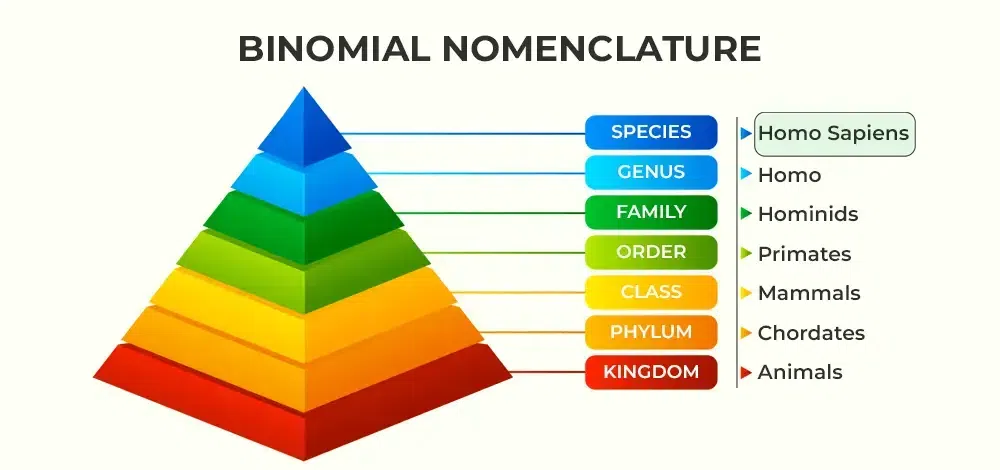
The rules of binomial nomenclature are listed below:
Both codes make sure that each organism gets a specific name.
The naming follows certain conventions. Each scientific name has two parts
- Generic name
- Specific epithet
All the scientific names of organisms are usually Latin. Hence, they are written in italics.
Two parts to the name of an organism. The first word identifies the genus, and the second word identifies the species.
When the names are handwritten, they are underlined or italicized if typed. This is done to specify its Latin origin.
The name of the genus starts with a capital letter, and the name of the species starts with a small letter.
The International Code of Botanical Nomenclature (ICBN): ICBN with the biological nomenclature of plants.
The International Code of Zoological Nomenclature (ICZN): ICZN with the biological nomenclature of animals.
Why is Binomial Nomenclature Important?
There are millions of species of organisms present throughout the world. The same organisms are known by various names around the world, and this can be confusing when trying to identify or classify them. Binomial nomenclature was seen as a viable solution to this problem.
Drawbacks of Binomial Nomenclature
The following are the primary drawbacks of binomial nomenclature:
- If two or more names are currently in use, according to the law of priority, the correct name will be the one used first, and the others end up being synonyms, as validity is the senior synonym. Providing stability in the naming and classification of organisms must be emphasized.
- The names used before those included in the “Systema Naturae”, by Linnaeus, are not recognized.