Biogeochemical Cycles (original) (raw)
Last Updated : 9 Apr, 2026
Biogeochemical cycles are the natural pathways through which important elements (like water, carbon, nitrogen, oxygen, and phosphorus) move through the living world, the earth, and chemical processes. Biogeochemical cycles describe how essential substances keep moving and getting reused in nature.
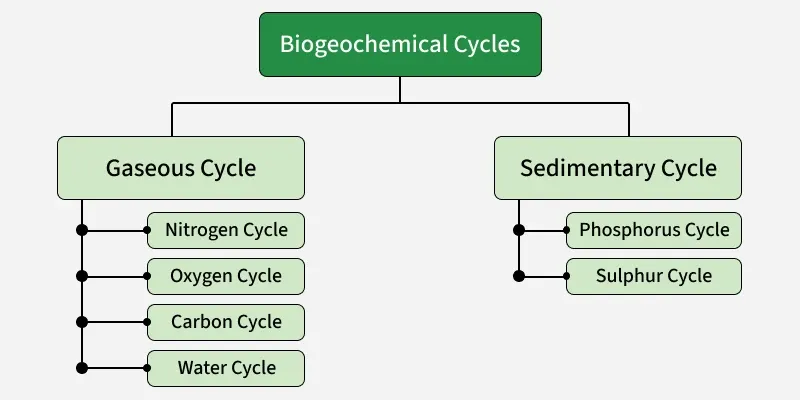
Two types of biogeochemical cycles are given below:
**Sedimentary Cycles
Sedimentary cycles are a type of biogeochemical cycle in which the reservoir is Earth’s crust. The phosphorus and sulphur cycles fall under sedimentary cycles.
**1. Phosphorus Cycle
The phosphorus cycle is a natural phenomenon by which phosphorus cycles through the three components of the biosphere, which are the hydrosphere, lithosphere, and atmosphere. The phosphorus cycle steps include weathering, release of phosphates into soil and water, plant uptake, consumption by animals, and return to the soil through decomposition and waste.
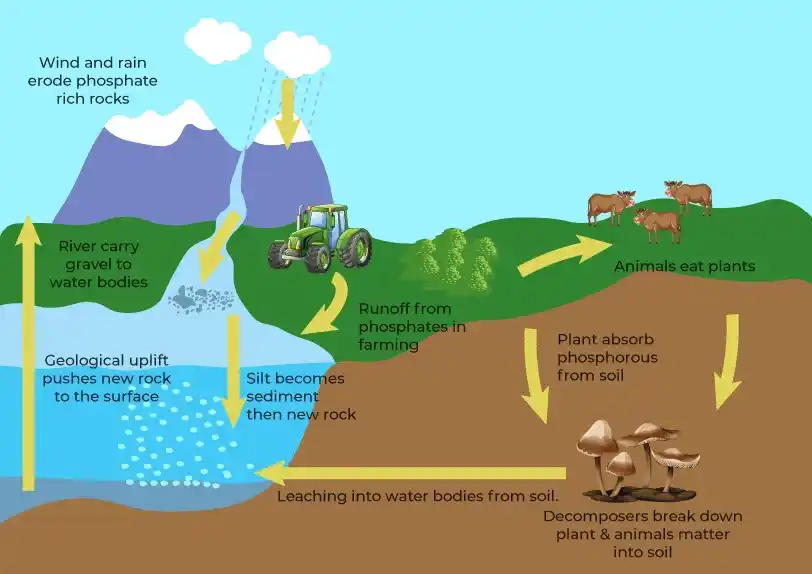
The process of the Phosphorus cycle is given below:
- Phosphorus is separated by the erosion of rocks.
- Plants and creatures get this phosphorus through the dirt and water and develop.
- Because of downpours and disintegration, phosphorus is washed away in the dirt and water bodies.
- At the point when the plants and creatures kick the bucket, they disintegrate, and the stored phosphorus is returned to the dirt and water bodies, which are again replenished by plants and creatures, and the cycle proceeds.
- At the point when the plants and creatures die, they are disintegrated by microorganisms. During this cycle, the natural type of phosphorus is converted into the inorganic structure, which is reused in soil and water.
- Soil and water will wind up in residue and rocks, which will again deliver phosphorus by enduring. Accordingly, the phosphorus cycle begins once again.
**2. Sulphur Cycle
The Sulphur cycleis a biogeochemical cycle that describes the movement of sulphur through different reservoirs in the Earth's atmosphere, lithosphere, hydrosphere, and biosphere. It starts with the weathering of rocks, which releases sulphur compounds into the soil.
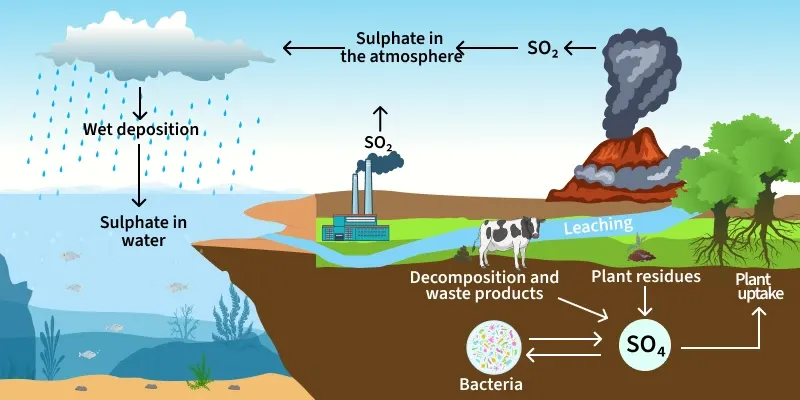
Features of the Sulphur cycle are given below:
- The sulphur cycle, as a rule, alludes to the progression of sulphur-based parts among the lithosphere, hydrosphere, and atmosphere.
- Amino acids present in living creatures contain sulphur. Inorganic sulphur is plentiful on the Earth's surface.
- This sulphur is diminished to sulphates through oxidation and is delivered into the atmosphere. The sulphates are subsequently changed into natural mixtures by microorganisms and plants.
- At the point when Hydrogen Sulphide reacts with water, Sulphuric acid is formed, causing corrosive downpours.
- At the point when creatures consume plants, they integrate natural sulphur compounds into their bodies. The deterioration of living beings discharges sulphur once more into the dirt.
**Gaseous Cycles
Gaseous cycles are a type of biogeochemical cycle in which the reservoir is the atmosphere. These cycles incorporate the exchange of nitrogen, oxygen, carbon, and water.
**1. Nitrogen Cycle
The arrangement where nitrogen passes from the environment to the dirt and living beings, and afterwards is ultimately delivered once again into the air, is known as the nitrogen cycle. Nitrogen makes up 78% of the world's climate.
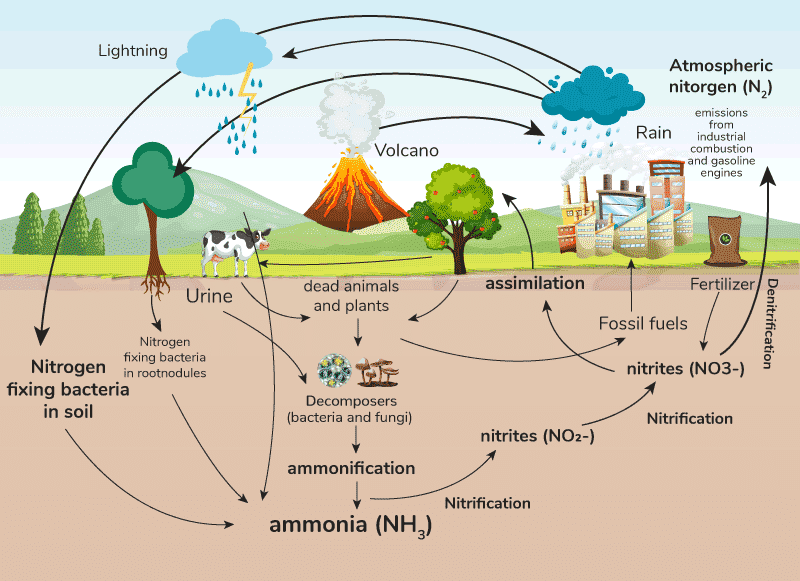
Features of the Nitrogen cycle are given below:
- The level of nitrogen in the climate is maintained by the nitrogen cycle.
- Plants and creatures can't use environmental nitrogen promptly. It must be fixed by certain creatures called nitrogen fixers.
- Nitrogen is a fundamental constituent of proteins, nucleic acids like DNA and RNA, nutrients, and chlorophyll.
- Nitrogen-fixing microbes alongside free-living microorganisms in the dirt accomplish 90% of nitrogen fixation.
- Nitrogen-fixing microbes like Rhizobium live in a harmonious relationship in the root knobs of specific leguminous plants. These microbes convert atmospheric nitrogen into smelling salts, which are promptly used by plants.
- Nitrates and nitrites break down in the water and are promptly utilised by sea-going plants and creatures.
- Lightning plays a significant part in nitrogen fixation. When lightning happens, the high temperature and tension break down nitrogen and water into nitrates and nitrites.
**2. Oxygen Cycle
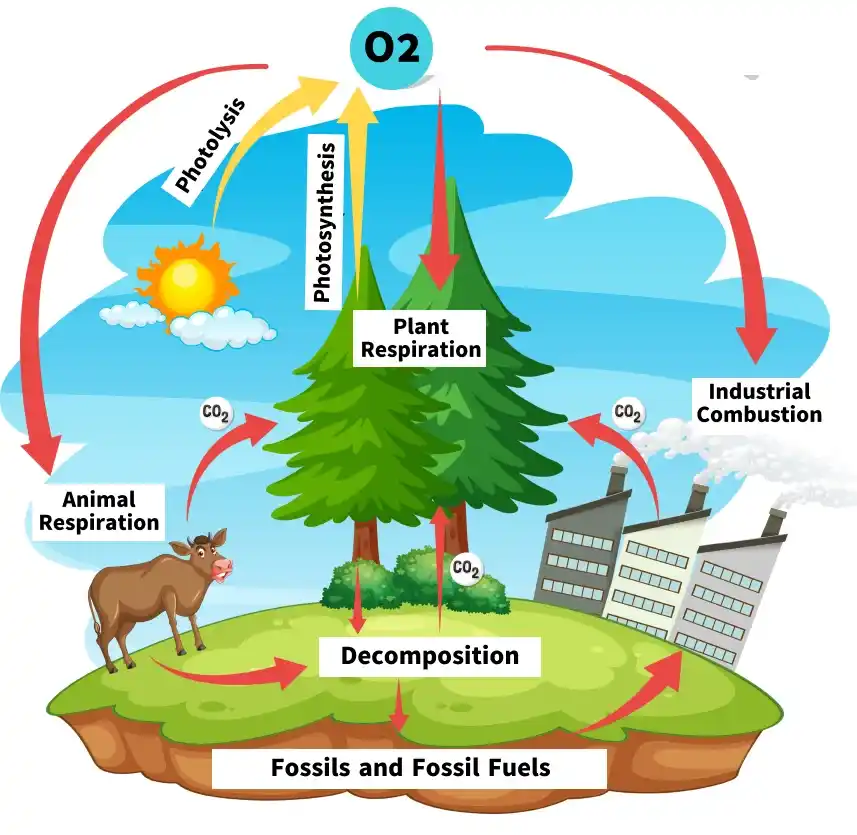
The succession where oxygen from the climate is utilised by life forms and ultimately delivered once more into the air through photosynthesis is called the oxygen cycle.
Features of the Oxygen cycle are given below:
- Oxygen is tracked down in the air, in joined structure as carbon dioxide, and in the world's covering as carbonates, sulphates, and nitrates.
- Plants and creatures utilise environmental oxygen during respiration and deliver the equivalent during photosynthesis.
- The ozone layer keeps destructive radiation from arriving at the world's surface, where it could harm living things.
- Non-renewable energy sources require oxygen for burning. The ozone layer is available in the stratosphere, one of the layers of the environment. Every particle of ozone is comprised of three oxygen ions.
- The environment is the layer of gases present over the world's surface. The amount of Earth's biological systems makes a biosphere. The lithosphere is the strong external layer covering the Earth, and it is the biggest source of oxygen.
- The oxygen cycle, alongside the carbon cycle and nitrogen cycle, plays a fundamental role in the presence of life on Earth.
- The oxygen cycle is a natural cycle that assists in keeping up with the oxygen by evening out by travelling through three principal circles of the earth, which are: Atmosphere, Lithosphere, Biosphere
**3. Carbon Cycle
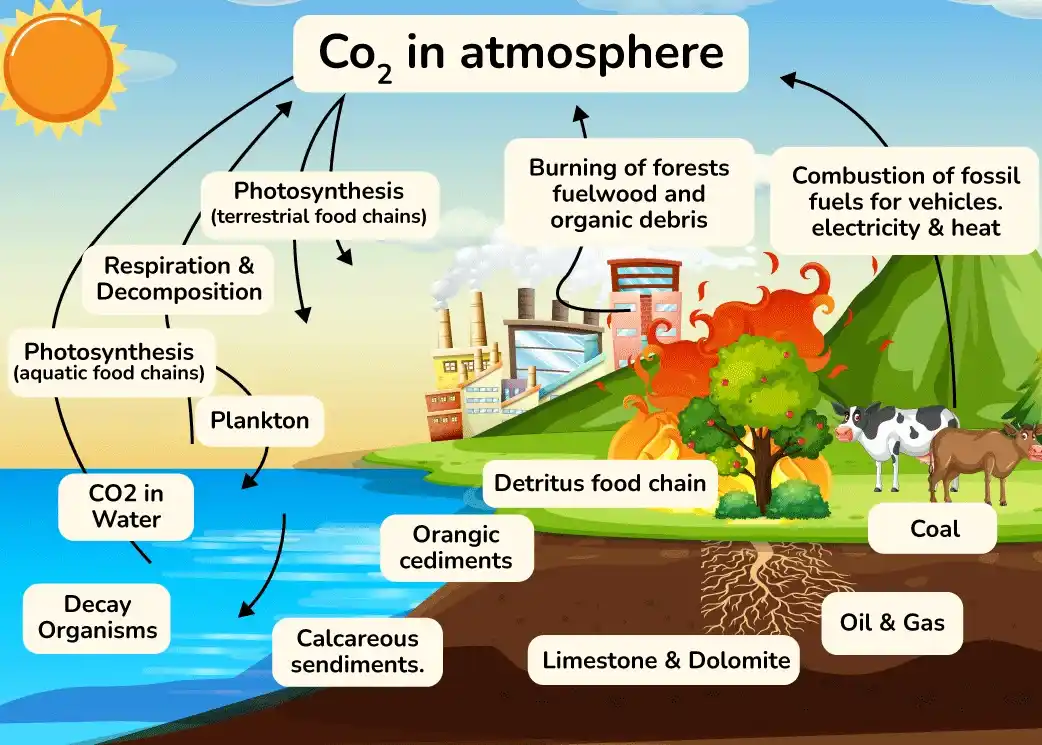
The carbon cycle represents the transportation of carbon in its elemental and mixed states throughout the planet. Carbon exists as carbonates in minerals and as carbon dioxide gas in the atmosphere in its combined state as diamond and graphite.
Features of the Carbon cycle are given below:
- This cycle is liable for keeping up with the equilibrium of the component carbon in the environment. Carbon is available in different structures on the Earth's surface.
- Carbon moves from plants and creatures to soils. At the point when plants and creatures die, their bodies, wood, and leaves rot, carrying the carbon into the ground. Some are covered and will become petroleum products in a great many years.
- In the climate, it is available as Carbon Dioxide, alongside that it likewise happens as carbonates and bicarbonate salts in minerals. The endoskeletons and exoskeletons of different oceanic creatures are likewise framed from carbonate salts.
- Carbon is considered a fundamental piece of supplements of starches, fats, proteins, nucleic acids, and nutrients. Carbon cycles help in keeping up with how much carbon is in the climate.
- Carbon moves from the environment to plants. In the environment, carbon is connected to oxygen in a gas called carbon dioxide (CO2).
- Through the course of photosynthesis, carbon dioxide is pulled from the air to create food produced using carbon for plant development.
**4. Water Cycle
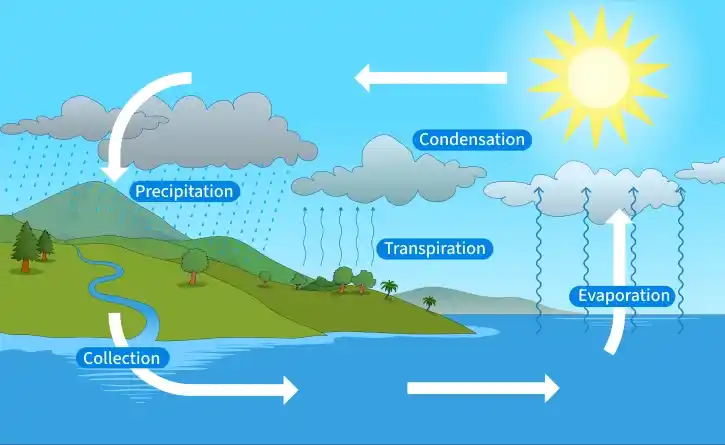
The water cycle, or hydrologic cycle, is a continuous and natural process that circulates water between the surface of the Earth, the atmosphere, and back again. The water cycle sustains life by replenishing water sources and maintains hydrological balance on Earth.
Features of the Water cycle are given below:
- This biogeochemical cycle is responsible for keeping up with atmospheric conditions. The water in its different structures collaborates with the environmental elements and changes the temperature and tension of the air.
- The water vapour in the climate condenses and brings about precipitation. The water then enters the earthbound and marine environments. Some measure of water enters the dirt and is put away as groundwater.
- The hydrological cycle refers to the course of water in nature. Daylight expands the temperature of water bodies and converts them into water vapour.
- Mugginess and the progression of wind influence this course of dissipation. Sublimation additionally adds water vapour to the air from ice. Leaves will generally deliver water through stomata, and this cycle is known as evapotranspiration.
- The rest either dissipates once again into the climate or accumulates in the sea as an overflow. In the cooler districts, water is changed over into icy masses which soften with climbing temperatures, and the cycle proceeds.
**Importance of Biogeochemical Cycles
- It is essential to grasp these cycles to become familiar with their impact on living elements. A few exercises of people upset a couple of these regular cycles and, in this way, influence related biological systems.
- A more intensive gander at these systems can help us limit and stop their hazardous effects.
- These cycles move the fundamental components for life to support. They are essential as they reuse components and store them as well, and manage the fundamental components through the actual features.
- These cycles portray the relationship between the living and non-living things in the biological systems and empower the consistent endurance of environments.
- These cycles exhibit the manner in which the energy is utilised.