Bryophyta (original) (raw)
Last Updated : 16 Feb, 2026
Bryophyta is a division of green plants that belongs to the group of embryophytes and includes some of the earliest land plants. These plants are non-vascular and have about 20,000 species worldwide. Unlike higher plants, bryophytes do not produce flowers or seeds; instead, they reproduce through specialized structures called gametangia and sporangia.
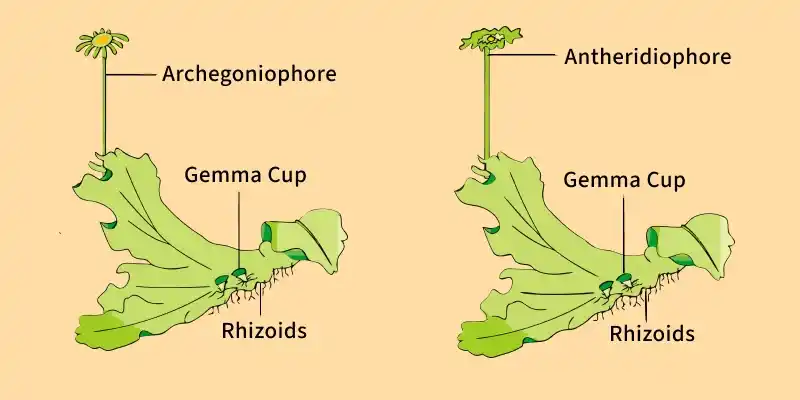
Bryophytes are known as the amphibians of the plant kingdom because they grow on land but need water for sexual reproduction. They reproduce through spores instead of flowers or seeds. Their body is thallus-like and may be prostrate or erect, with rhizoids that help them attach to the surface. A key feature of bryophytes is the absence of true vascular tissue.
**Characteristics of Bryophyta
The characteristic traits that distinguish Bryophyta from other plant groups are listed below:
- The plant body is thallus-like, meaning it can be prostrate or erect. They lack true vegetative structure and have a root-like, stem-like, and leaf-like structure.
- Rhizoids, which can be unicellular or multicellular, adhere to it.
- Plants do not have a vascular system (xylem, phloem), and plants grow in damp and shady environments.
- The haploid gametophyte is the dominant part of the plant body.
- The three parts of the thalloid gametophyte are rhizoids, axis, and leaves.
- The photosynthetic gametophyte has multicellular sex organs. The antheridium produces flagellated antherozoids.
- The zygote becomes a multicellular sporophyte. A semi-parasitic organism that feeds on the gametophyte is the sporophyte.
- Sporophyte cells undergo meiosis to form haploid gametes that form a gametophyte. Protonema is the name given to the juvenile gametophyte.
- An archegonium is shaped like a flask and produces one egg. Antherozoids combine with eggs to form a zygote.
Examples of Bryophyta
There are about 20,000 plant species in the bryophyte kingdom. The three subgroups of bryophytes are mosses, hornworts, and liverworts. Typical examples include:
- **Liverworts: Calobryum, Marchantia, Riccia, Pellia, and Porella.
- **Mosses: Sphagnum, Funaria, and Polytrichum.
- **Hornworts: Anthoceros, Notothylas, and Megaceros.
Habitat of Bryophyta
Bryophytes are capable of surviving in a wide range of environments, including varying altitudes, temperatures, and moisture conditions. Their ability to thrive in such habitats is due to certain adaptive features, which are described below.
- In harsh and varied ecosystems like the Arctic and desert regions, they can be seen growing in shady and moist conditions.
- It does not rely on roots to get nutrients from the soil; it can thrive in places where vascularized plants cannot.
- Some bryophytes have an extraordinary ability to endure extended periods of freezing and dryness, and when moisture is restored, photosynthesis is resumed.
- Many bryophytes thrive on the soil, the living or decaying materials of other plants, and the persistent residues of their own growth.
- A few are aquatic in nature, while others grow on the exposed rock surface.
**Classification of Bryophyta
Bryophyta is classified into three main classes based on differences in their structure and reproductive features:

**1. Anthocerotopsida (Hornworts)
- The gametophytic body is a simple, flat, dorsiventral thalloid with no internal differentiation.
- Dorsally embedded in the thallus are sex organs. Each cell has one chloroplast that contains a pyrenoid.
- The sporophyte is divided into three parts: the foot, the meristematic zone, and the capsule.
- Amphithecium gives rise to sporogenous tissues. Rhizoids have smooth-walled cells.
- The columella is found in the capsule, which is made up of endothecium. The capsule contains pseudocraters.
**2. Hepaticopsida (Liverworts)
- A gametophyte plant can be thalloid or foliose.
- Dorsiventral, lobed, and dichotomously branched thalloid forms
- Sex organs are carried dorsally within gametophytic tissues.
- The sporophyte is made up of only the capsule (in Riccia) or the foot, seta, and capsule (in Marchantia).
- Rhizoids are septate, branched, and unicellular.
- Endothecium gives rise to sporogenous tissues, and the capsule lacks a columella.
- Example: Riccia, Sphaerocarpos, Calobryum, Pellia, and Marchantia.
**3. Bryopsida (Mosses)
- The gametophyte is classified as a protonema or foliose gametophore. Foliose plants have a stem as an axis and leaves without a midrib.
- Rhizoids have multicellular structures with oblique septa.
- Elaters are absent, and the sex organs are carried apically on the stem.
- The sporophyte is classified into three types: foot, seta, and capsule.
- Endothecium gives rise to sporogenous tissues.
- The capsule dehisces due to the separation of the lid, and Columella is present.