Population Growth CBSE Class 12 (original) (raw)
Last Updated : 23 Jul, 2025
Population Growth: Population growth refers to the increase in the number of people in a given area in a particular period of time. It is the main cause of this world because the population of human beings is not a static factor. Population growth depends on various factors such as weather, food availability, and predation pressure. The density of population changes during a given period due to changes in four basic processes two of which natality and immigration contribute to an increase in population and the other two mortality and emigration contribute to the decrease in population.
Organisms
Organisms are living beings that are capable of functioning on their own.
They collectively form a population. They exist in a given environment that has the ability to maintain their structure. A population is formed by the combination of a group of organisms of the same species. Population forms a community that is responsible for the operation of the ecosystem. The ecosystem consists of biotic and abiotic components. Plants, animals, bacteria, humans, and fungi are included in a group of organisms that forms a population.
Populations
A population has different attributes whereas an individual organism does not. An individual may have birth and deaths but a population has birth rates and death rates. In population, these rates refer to per capita births and deaths. These rates are the change in numbers that increases or decreases with respect to the member of a population. Another attribute feature of a population is the sex ratio. An individual is male or female but a population has a sex ratio. The population is composed of individuals of different age groups. If age distribution is plotted for the population the structure is known as the age pyramid. For the human population, the age pyramid shows age distribution among males and females.
Population and Attributes
- The gender ratio refers to the total number of men and women per 1000 individuals.
- The birth rate refers to the total number of individuals born in a certain period of time.
- Death rate refers to the total number of deaths in a certain period of time.
- A plot showing age distribution is known as an age pyramid.
Population Growth
The size of a population of a species keeps on changing from time to time depending on various factors such as weather, food availability, and predation pressure. Therefore the density of the population changes during a given period due to changes in four basic processes two of which (natality and immigration) contribute to an increase in population and the other two (mortality and emigration) contribute to the decrease in population.
- Natality: It refers to the number of birth rates during a given period in the population that are added to the initial density. The birth rate is also known as Natality. It is the rate of birth, germination, or vegetative propagation of an individual.
Natality = Number of births per year / Number of population per year * 1000
- Immigration: It refers to the number of people of the same species has shifted into the habitat from elsewhere during the time period under consideration. It leads to an increase in the size of the population rate. It is an inward movement. Thus, it contributes to population explosion.
- Mortality: It is defined as the death rate per thousand people in the population during a given period or per year. It leads to a decrease in the population size. It is calculated on the basis of the deaths in a particular area. The death rate is also known as Mortality.
- Emigration: It indicates the number of people of the same species who left the habitat and went elsewhere from the population during the time period under consideration. It leads to a decrease in the size of the population rate. It is an outward movement. Thus, it helps to prevent a population explosion.
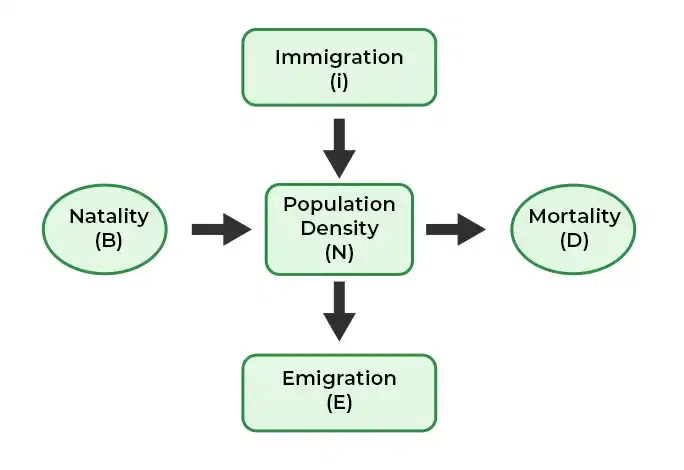
N is the population density at time t, then density at time t+1 is
Nt+1 = Nt + [(B + I) - (D + E)]
Population Density will increase if the number of birth plus the number of immigrants (B + I) is more than the death plus the number of emigrants (D + E).
Population Growth Models
Growth of population occurs according to the availability of food, habitat, and other biotic and abiotic factors. The different growth models are used to represent population dynamics. There are two different types of growth models:

Exponential Growth
This kind of growth occurs when space and food are available sufficiently. The population grows in a geometric and exponential fashion. Let the population of size N, birth rate as 'b', and death rate as 'd'. Then increase and decrease in N during the unit period time 't' will be
dN / dt = (b - d) * N
let (b - d ) = r, then
dN / dt = rN
where r = intrinsic rate of natural increase,
This equation is represented in a graph that features a J-shaped curve.
According to calculus,
Nt = N0ert
where Nt = Population density at time t,
N0 = Population density at time zero,
e = base of natural logarithms,
r = intrinsic rate of natural increase.
Logistic Growth
Logistic growth occurs between the individuals of a population for food and space. This type of growth shows a leg phase followed by acceleration and de-acceleration.
dN / dt = rN * ((K -N)/ K)
where r = Intrinsic rate of natural increase,
N = Population density at time t,
K = carrying capacity,
The growth of the population is finite these logistic growth models are more 'realistic'.