Cranial Nerves : Function, Anatomy and Location (original) (raw)
Last Updated : 28 Jul, 2023
**Cranial Nerves: Function, Anatomy, and Location: Cranial nerves are a group of nerves that arises from the brain. Cranial nerves are mainly of two types of conducting nerves; cranial nerves which arise from the brain and spinal nerves which arises from the spinal cord. They are mainly part of the peripheral nervous system i.e. helps in the transmission of information from the brain.
**What are the Cranial Nerves?
The 12 pairs of nerves arise from the brain and brain stem that carries signals from the brain to different parts of the body mainly to the head and neck. They emerge from the foramina and fissure of the cranium or skull. These 12 nerves are numbered from I to XII using Roman numerals according to the order in which they emerge from the front of the brain to the back of the brain. The cranial nerve I and II are considered to be the part of central nervous system whereas the rest i.e. III to XII are considered to be part of the peripheral nervous system. They can be sensory, motor, or both based on their function. The 12 cranial nerves are; Olfactory (I), optic (II), oculomotor (III), trochlear (IV), trigeminal (V), abducens (VI), facial (VII), vestibulocochlear nerve (VIII), glossopharyngeal (XI), vagus (X), accessory (XI), and hypoglossal (XII).
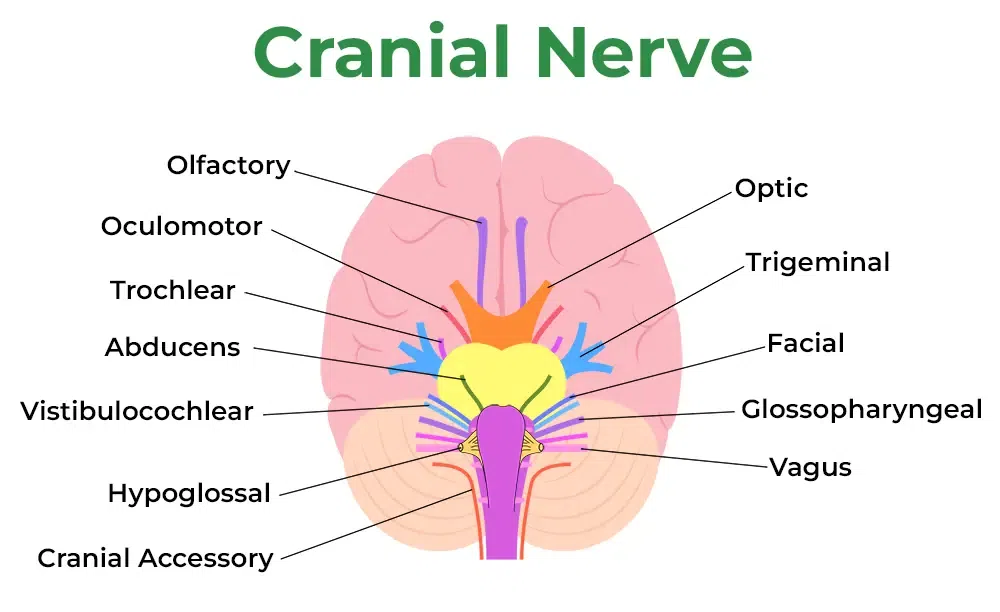
**Origin of the Cranial Nerves
Here, we will look into the origin point of each of the cranial nerves.
| **Nerve No. | **Name | **Origin |
|---|---|---|
| I | Olfactory | Olfactory lobe or the bulb of the cerebrum |
| II | Optic | Optic lobe of the cerebrum |
| III | Oculomotor | Floor of midbrain |
| IV | Trochlear | Floor of midbrain |
| V | Trigeminal | Pons |
| VI | Abducens | Pons |
| VII | Facial | Pons |
| VIII | Auditory (acoustic/vestibulocochlear) | Pons |
| IX | Glossopharyngeal | Side of medulla |
| X | Vagus (pneumogastric) | Side of medulla |
| XI | Accessory (spinal) | Side of medulla |
| XII | Hypoglossal | Side of medulla |
**Distribution of the Cranial Nerves
Here, we will look into the distribution of the cranial nerves.
| **Nerve No. | **Name | **Distribution |
|---|---|---|
| I | Olfactory | Olfactory epithelium |
| II | Optic | Retina of eyeball |
| III | Oculomotor | Eye, and its four muscles i.e. extraocular muscles, intraocular muscles, protractor, and retractors. |
| IV | Trochlear | Superior oblique muscle of eyeball. |
| V | Trigeminal | Head, face, jaws, and teeth. |
| VI | Abducens | Lateral rectus of the eyeball. |
| VII | Facial | Salivary glands, taste buds of the anterior two-thirds of the tongue, facial muscles, muscles of the neck, and chewing. |
| VIII | Auditory (acoustic/vestibulocochlear) | Organ of Corti, and vestibular receptors of the internal ear. |
| IX | Glossopharyngeal | Taste buds of the posterior one-third of the tongue, mucous membrane, parotid glands, and muscles of the pharynx. |
| X | Vagus (pneumogastric) | Pharyngeal muscles, vocal cords, lungs, heart, esophagus, stomach, and intestines. |
| XI | Accessory (spinal) | Palatine muscles, larynx, vocal cords, neck, and shoulder. |
| XII | Hypoglossal | Muscles of tongue, and neck. |
**Nature of the cranial nerves
Here, we will look into the nature of the cranial nerves i.e. whether they are sensory, motor, or both.
| **Nerve No. | **Name | **Nature |
|---|---|---|
| I | Olfactory | Sensory |
| II | Optic | Sensory |
| III | Oculomotor | Motor |
| IV | Trochlear | Motor |
| V | Trigeminal | Sensory + motor |
| VI | Abducens | Motor |
| VII | Facial | Sensory + motor |
| VIII | Auditory (acoustic/vestibulocochlear) | Sensory |
| IX | Glossopharyngeal | Sensory + motor |
| X | Vagus (pneumogastric) | Sensory + motor |
| XI | Accessory (spinal) | Motor |
| XII | Hypoglossal | Motor |
**Function of the Cranial Nerves
Here, we will look into the functioning of the cranial nerves.
| **Nerve No. | **Name | **Function |
|---|---|---|
| **I | **Olfactory | Helps in the detection of smell. |
| **II | **Optic | Helps in sight. |
| **III | **Oculomotor | Helps in the movement of the eyeball, constriction of the pupil, and its accommodation. |
| **IV | **Trochlear | Helps in the rotation of the eyeball. |
| **V | **Trigeminal | The sensory part helps in the sensation of the forehead, scalp, upper eyelid, side of the nose, and teeth. The motor part helps in the movement of the tongue, and jaw muscles for chewing. |
| **VI | **Abducens | Helps in the rotation of the eyeball. |
| **VII | **Facial | The sensory part helps with taste. The motor part helps in facial expression, chewing, and movement of the neck. |
| **VIII | **Auditory (acoustic/vestibulocochlear) | Helps in hearing and maintaining equilibrium. |
| **IX | **Glossopharyngeal | The sensory part helps with taste and touch. The motor part helps in the movement of the pharynx. |
| **X | **Vagus (pneumogastric) | The sensory part helps in the sensation of the throat, larynx, thorax, and abdomen. The motor part helps in swallowing, voice, peristalsis, secretion of gastric glands, and slowing of the heart. |
| **XI | **Accessory (spinal) | Helps in the movement of the muscle in the pharynx, larynx, neck, and shoulder. |
| **XII | **Hypoglossal | Helps in the movement of the tongue. |