Crop Variety Improvement (original) (raw)
Last Updated : 11 Mar, 2026
Crop variety improvement refers to the development of new and improved crop varieties that give higher yield, better quality, and greater resistance to diseases and environmental stresses. It plays an important role in increasing food production to meet the needs of the growing population. Crop variety improvement is essential for achieving food security and sustainable agriculture.
Crop improvement refers to techniques for creating and breeding crop varieties that are superior to the characteristics of the current types.
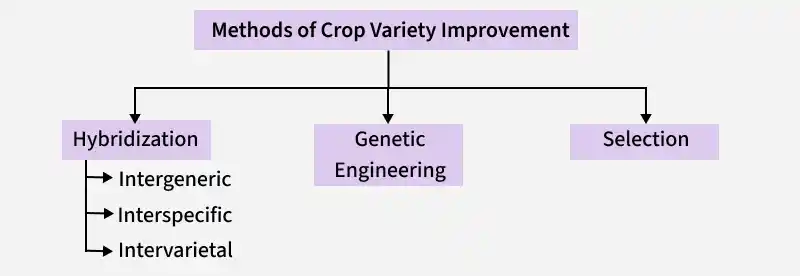
1. Hybridisation
- Hybridization is the act of breeding plants with different genetic compositions.
- This hybridization could be interspecific, intervarietal, and intergeneric.
- Interspecific Hybridization: Between two different species of the same genus.
- Intervarietal Hybridization: Between different variations.
- Intergeneric Hybridization: Between different genera.
2. Genetic Engineering
- This process confers the desired traits and produces genetically modified crops.
- Weather, soil quality, and water availability all affect crop output and cultivation techniques.
- The variety that may be grown in many climatic circumstances is crucial since weather conditions like drought and flood scenarios are unpredictable.
3. Selection
- Selection involves choosing plants with desirable traits from a mixed population and growing them over generations to develop improved varieties.
- Selection process is the simplest and oldest method of crop variety improvement.
**Objectives
- **A higher yield: To raise crop productivity per acre.
- **Better quality: Different crops produce different crop products with varying quality. For instance, the protein quality of pulses, the oil quality of oilseeds, and the fruit and vegetable preservation quality are all crucial.
- **Biotic and abiotic resistance: Abiotic factors such as drought, salinity, waterlogging, heat, cold, and frost are impacting crop productivity. Biotic factors include diseases, insects, and nematodes. To increase crop yield, it is possible to enhance strains that are resistant to certain elements (or stressors).
- **Modification in crop maturity duration: Crops with shorter maturation times are more economically viable since they require less labor to produce. The harvesting process is made simple, and losses are decreased by uniform ripeness.
**Importance of Crop Variety Improvement
- Crop improvement aims to boost yield because these specially produced crop types by breeders can produce a lot of crops on a given amount of land. This amount is expressed in kg/ha; for example, a high-yield tomato plant can produce up to 800 kg/ha of tomatoes.
- Crop improvement's main goal is to raise the standard of farm products because higher standards increase their value and utility. Crops' flavor, color, size, nutritional value, and fiber content can all be enhanced by plant breeders.
- Crop improvement's goal is to satisfy producers' needs. Certain traits of plants may become more desirable to producers as a result of advancements in farming techniques. For instance, rather than towering varieties of maize that can only be harvested by hand, many growers would prefer short varieties that can be gathered by machines.
- Crop improvement's goal is to satisfy the demands of consumers (processors or business owners): Food processors' and other consumers' needs put pressure on manufacturers to build new, higher-quality operations. For instance, higher-quality agricultural products, such as maize with high protein content, will improve people's health.