Diagram of the Human Ear (original) (raw)
Last Updated : 23 Jul, 2025
The human ear is an essential sense organ that helps us hear and maintain balance. It works by collecting sound waves through the outer ear, which then travel through the ear canal to reach the eardrum. The sound waves make the eardrum vibrate, and these vibrations are converted into electrical signals that our brain processes as sound.
For students, especially those in Class 10 and 12, knowing the structure of the ear and its labelled diagram is important as it is commonly asked in exams. Below is a simple description of the human ear, along with a well-labelled diagram for better clarity.
Diagram of the Human Ear
The diagram of the human ear provides a clear visual representation of how sound travels through the ear and is processed by the brain. It helps us identify the different parts of the ear and their functions, which are essential for hearing and balance. Below is a description of the key components of the ear, explained with the help of a labelled diagram.
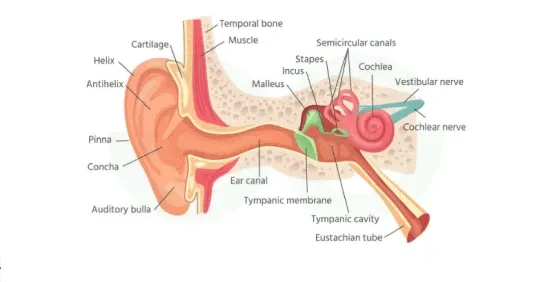
Human Ear
- **Outer Ear: This includes the visible part called the **pinna and the **ear canal. The outer ear captures sound waves and directs them towards the eardrum.
- **Eardrum (Tympanic Membrane): A thin membrane that vibrates when sound waves reach it. These vibrations are passed to the middle ear.
- **Middle Ear: Contains three tiny bones that are the **malleus, incus, and stapes also known as the ossicles. These bones amplify the vibrations from the eardrum and transfer them to the inner ear.
- **Inner Ear: Includes the cochlea, which converts sound vibrations into electrical signals that the brain can understand. It also contains the vestibular system, which helps maintain balance.
- **Auditory Nerve: Carries the electrical signals from the cochlea to the brain, where they are interpreted as sound.
- **Eustachian Tube: Connects the middle ear to the throat, helping to equalize pressure inside the ear.
**Do You Know?
- Your ears constantly pick up sound, even while you are sleeping.
- The Human ear can hear sounds as low as **0 decibels, which is close to the movement of air molecules.
Functions of Human Ear
The human ear is not only responsible for hearing but also plays a important role in maintaining balance. It captures sound, amplifies it, and converts it into signals that the brain can understand. Along with hearing, the ear helps with spatial orientation and balance, which are essential for everyday movement and coordination. Here are the primary functions of the human ear:
- The ear captures sound waves from the environment, using the outer ear to funnel them into the ear canal toward the eardrum.
- The vibrations from the eardrum are transmitted through tiny bones in the middle ear, amplifying the sound and sending it to the inner ear.
- In the inner ear, the cochlea converts the vibrations into electrical signals that are sent to the brain through the auditory nerve, where they are interpreted as sound.
- The vestibular system in the inner ear helps detect changes in head position, contributing to balance and spatial awareness.
- The ear helps us detect the direction and distance of sounds, allowing us to locate where sounds are coming from.
- The ear regulates body position in space, aiding in activities like walking, standing, and maintaining balance without visual cues.
These combined functions allow us to interact with the world through sound and motion, keeping us connected to our environment.
Conclusion
The ear is a sensitive organ in the human body primarily responsible for detecting, transmitting, and converting sound. It plays a important role in how we perceive the world around us by allowing us to hear and respond to sound signals. Beyond hearing, the ear also helps with balance by detecting changes in head position, ensuring that we stay steady and coordinated in our movements.