Flower (original) (raw)
Last Updated : 8 May, 2026
The flower is the reproductive unit in angiosperms, comprising four distinct whorls arranged successively on the swollen end of the pedicle known as the thalamus. These whorls are the calyx, corolla, androecium, and gynoecium. While the calyx and corolla serve as accessory organs, the androecium and gynoecium function as reproductive organs. In certain flowers like the lily, the calyx and corolla are distinct and collectively referred to as the perianth.

The flower can be classified into two categories: complete and incomplete. A complete flower contains all the essential parts for reproduction, including sepals, petals, stamens, and pistils. In contrast, an incomplete flower is missing one or more of these fundamental structures.
Parts of Flower
The flower is composed of four distinct whorls of modified leaves, each playing an important role in the plant's reproduction. These whorls include the calyx, corolla, androecium, and gynoecium, with each whorl housing specific flower parts. The various components of a flower are listed below:
**Vegetative Parts of a Flower
This part consists of the non-reproductive elements, such as the sepals and petals, which protect and attract pollinators.
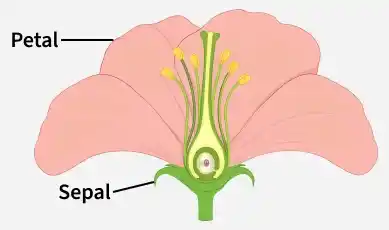
The vegetative components of a flower include the following:
- **Petals: Petals are the petals of a flower that attract pollinators like bees, butterflies, and hummingbirds. Their shape, size, and colour can vary between flowers, and they help with pollination. Some flowers also have fragrant petals to attract more pollinators.
- **Sepals: Sepals are the green parts that protect the flower bud before it opens. They act like a shield, keeping the flower safe. In some flowers, sepals are joined together, while in others, they are separate.
Reproductive Parts of a Flower
The reproductive parts of a flower are responsible for producing seeds. The number of petals, sepals, stamens, and pistils can vary between different plants, helping to classify a flower as complete or incomplete. The main reproductive parts are the stamen (male) and the pistil (female). Some flowers have only male parts, only female parts, or both, which is necessary for pollination and fruit to occur.
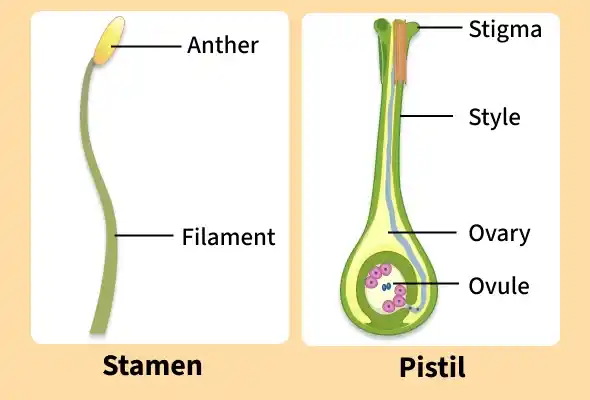
The reproductive parts of a flower are responsible for producing seeds and ensuring the continuation of the plant species.The main reproductive parts are:
**Stamen (Male)
The stamen, also referred to as the androecium, is the male reproductive organ of the flower. It is made up of two main parts: the anther and the filament.
- **Anther: This is a sac-like structure, typically yellow in colour, responsible for producing and storing pollen, which contains the male gametes.
- **Filament: A thin, thread-like stalk that holds the anther in place, ensuring it is positioned to release pollen effectively during pollination.
**Pistil (Female)
The pistil is the central female reproductive organ of a flower and consists of three key parts: the stigma, style, and ovary.
- **Stigma: The stigma is the uppermost, sticky portion of the pistil, designed to capture and hold pollen during pollination. It is the receptive surface where pollen grains land.
- **Style: The style is a slender, tube-like structure that connects the stigma to the ovary. It serves as a pathway for the pollen to travel down to reach the ovary.
- **Ovary: The ovary is the bulbous, basal part of the pistil. It contains the ovules, which are the plant's eggs. After fertilisation, the ovary develops into a fruit, and the ovules turn into seeds.
Classification of Flowers
Flowers are classified based on symmetry as actinomorphic or zygomorphic, and based on reproductive organs as bisexual or unisexual. They also differ in ovary position, being hypogynous (superior), perigynous (half-superior), or epigynous (inferior).
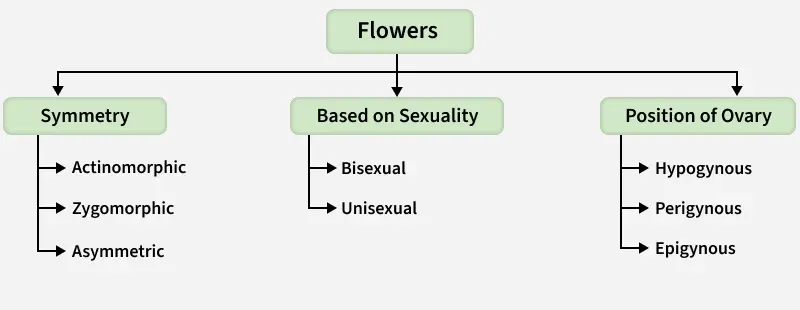
**1. Based on Symmetry
Flower symmetry refers to how a flower can be divided into equal halves. It reflects uniformity in shape and arrangement of floral parts.
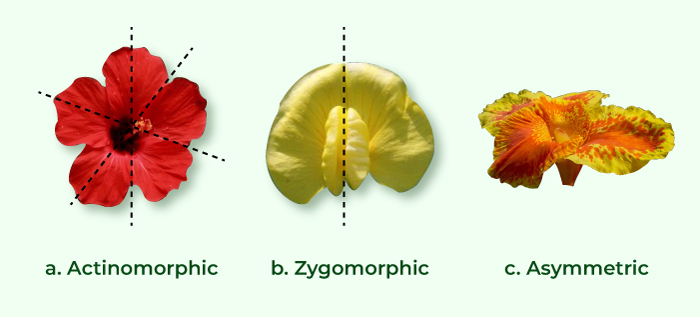
Based on symmetry, flowers are of two types:
- **Actinomorphic flowers can be divided into two equal radial halves in any plane passing through the centre, such as the chilli flower.
- **Zygomorphic flowers can only be divided into two similar halves in one particular vertical plane, exemplified by the bean flower. Floral appendages may occur in multiples of 3, 4, or 5, resulting in trimerous, tetramerous, or pentamerous configurations, respectively.
**2. Based on the Sexuality of the Flower
Flowers may vary in the type of reproductive structures they bear. Some contain both male and female organs, while others carry only one.
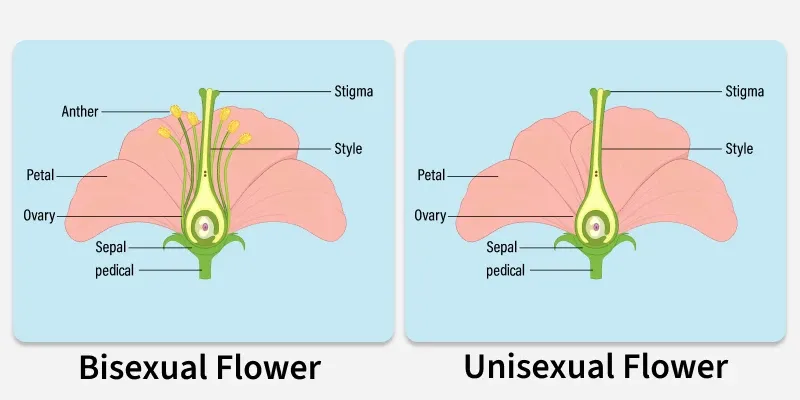
Based on Sexuality, flowers are classified into:
- **Unisexual Flowers: When a flower possesses only stamens or only pistil, it is considered unisexual.
- **Bisexual Flowers: When a flower possesses both androecium and a gynoecium, it is termed bisexual.
**3. Based on the Position of the Ovary
The relative position of the ovary to other floral parts (sepals, petals, stamens) is an important taxonomic feature. It helps distinguish the superior and inferior ovaries.

Based on the position of the ovary, flowers are of two types:
- ****Hypogynous flower:**In this flower gynoecium is situated at a higher position, and the remaining parts are positioned below it. This type of ovary is considered superior, e.g., Mustard, China rose.
- **Perigynous flower_: In this flower gynoecium is located in the center and the remaining parts of the flower are positioned on the thalamus rim more or less at the same position. Here, the ovary is considered half inferior, e.g., Peach, Plum, Rose.
- **Epigynous flower_: In this flower, the thalamus margin grows upward surrounding the ovary totally, and, getting merged with it, the remaining floral parts arise over the ovary. Thus, the ovary is considered inferior eg-Sunflower ray florets, the flowers of guava, and the cucumber.
**Inflorescence
Inflorescence refers to the arrangement of flowers on the plant. At the axis of a plant, flowers are formed, which are a modified part of the seed plant. Variations in proportions, compressions, phyllotaxis, and internode length can all be included in the modification of plants.

The two main types of inflorescence are as follows:
- **Racemose Inflorescence: Here, the flowers are arranged in an acropetal succession, which means that new flowers are added on the top and the old flowers are found at the bottom. The main axis continues to grow as there is no flower at its tip.
- **Cymose inflorescence: Here, the flowers are arranged in a basipetal succession, which means that old flowers are present above the new flowers. New flowers are added in the downward direction. The main axis terminates in a flower and hence does not freely grow.
**Aestivation
In plants, it happens in summer, more or less; it is similar to hibernation and animal dormancy, where plants are inactive, and the metabolic rate is also decreased. The mode of arrangement of sepals and petals in a flower with respect to the other members of the same whorl is known as aestivation.
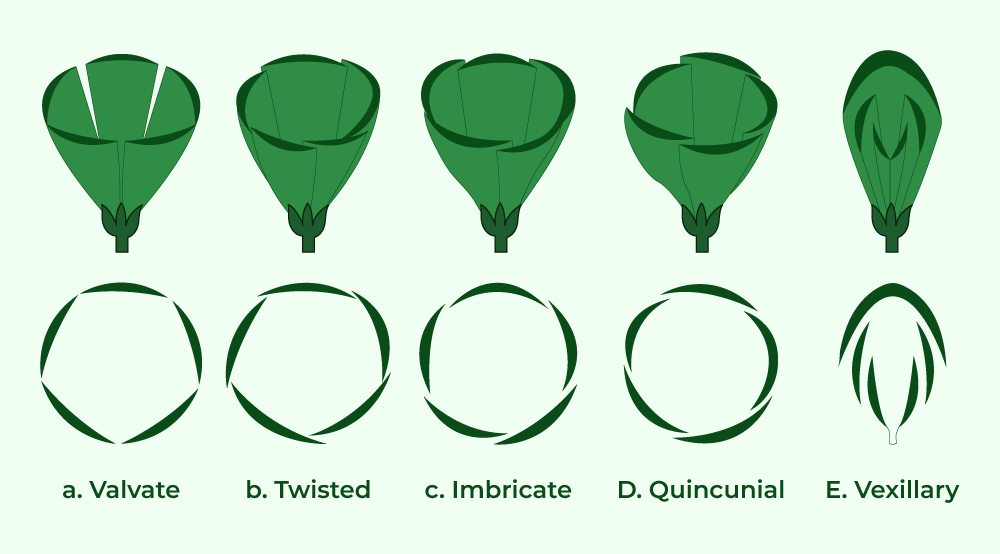
Five types of Aestivation are given below:
- **Valvate: Here, the sepals/petals just touch one another at the margin without overlapping. Eg: Calotropis.
- **Twisted: Here, one margin of the appendage overlaps the other. Eg: China rose, Cotton, Lady's finger.
- **Imbricate: Here, the margins of sepals/petals overlap one another but not in any particular direction, as in Cassia, Gulmohar.
- **Quincuncial: It is the type of Aestivation where one outer sepal or petal covers two interior sepals or petals, while the other outer sepals or petals are partially covered by two inner sepals or petals. This type of arrangement can be seen in the Flowers of Delonix, Cassia Flowers, etc.
- **Vexillary: Here, the largest petal, the standard, overlaps the two lateral petals called the wings, which in turn overlap the two smallest anterior petals called the keel. Eg: Pea, Bean.
**Placentation
The arrangement of the ovules within the ovary is called placentation. The nutrients from maternal tissue are provided to the developing embryo by the placenta. It also removes waste from the embryo, just like the function of the placenta in humans.
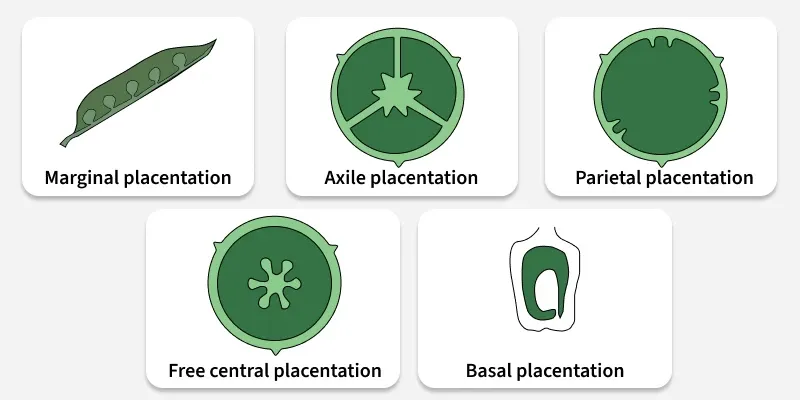
Its types are as follows:
- **Marginal: Here, the placenta forms a ridge along the ventral suture of the ovary, and the ovules are borne on this ridge, forming two rows. Eg: Pea.
- **Axile: Here, the placenta is axial, and the ovules are attached to it in a multilocular ovary. Eg: Lemon, Tomato, China rose.
- **Parietal: Here, the ovules develop on the inner wall of the ovary or on the peripheral part. e.g., Mustard, Argemone.
- **Free central: Here, the ovules are borne on the central axis, and septa are absent. Eg: Primrose, Dianthus.
- **Basal: Here, the placenta develops at the base of the ovary, and a single ovule is attached to it. Eg: Marigold, Sunflower.
Functions of a Flower
The key functions of flowers are listed below:
- Flowers are where gametes (reproductive cells) develop for reproduction.
- Some flowers can produce seeds without needing fertilisation, allowing them to reproduce asexually.
- After fertilisation, the ovary turns into a fruit that holds seeds for the next generation.
- The main job of flowers is reproduction, as they help male and female cells join to make seeds.p
- Flowers give nectar to attract insects and birds, which help move pollen from one flower to another.
- Flowers can either self-pollinate (where the same flower’s sperm and eggs meet) or cross-pollinate (where sperm and eggs come from different flowers), which helps plants stay strong and diverse.