Structure of Kidney (original) (raw)
Last Updated : 9 Jun, 2026
The kidneys are a pair of bean-shaped organs that serve as the principal excretory organs of the human body. They filter blood, remove metabolic wastes, regulate water and electrolyte balance, and produce urine. Each kidney contains millions of microscopic functional units called nephrons, which carry out the process of blood filtration. Understanding the structure of the kidney is essential for explaining urine formation and the maintenance of the body's internal balance.
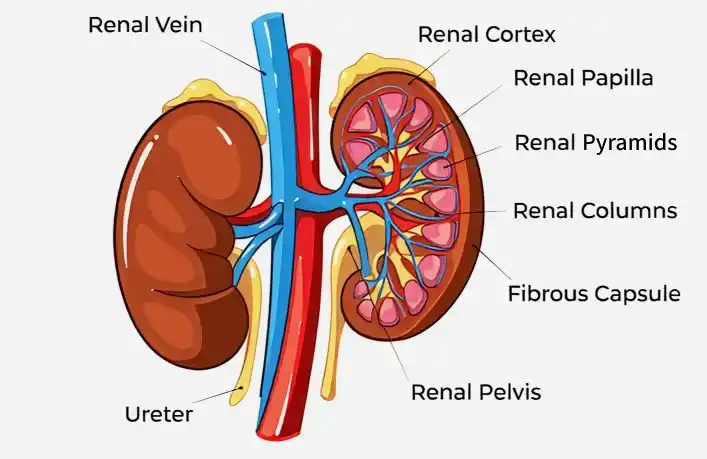
External Structure of the Kidney
The kidneys are reddish-brown, bean-shaped organs with a smooth outer surface.
- **Renal Capsule: Each kidney is enclosed by a thin, tough, fibrous connective tissue covering called the renal capsule. This capsule protects the kidney from mechanical injury and infections while helping maintain its shape.
- **Hilum: A characteristic indentation is present on the medial side of each kidney, known as the hilum. The hilum serves as the entry and exit point for blood vessels, nerves, lymphatic vessels, and the ureter. The renal artery, renal vein, ureter, nerves, and lymphatic vessels are the structures that pass through the hilum
- **Adipose Tissue: A layer of adipose tissue surrounds each kidney and acts as a protective cushion that helps maintain the position of the kidney and protects it from physical shocks.
Internal Structure of the Kidney
When a kidney is cut longitudinally, three distinct regions can be observed:
1. Renal Cortex
- The renal cortex is the outer, granular region of the kidney located immediately beneath the renal capsule.
- The cortex contains renal corpuscles, proximal convoluted tubules, distal convoluted tubules, and blood vessels.
- The renal corpuscles present in the cortex are responsible for the filtration of blood and the formation of glomerular filtrate.
- The cortex extends inward between the medullary pyramids in the form of extensions known as renal columns or Columns of Bertin.
2. Renal Medulla
- The renal medulla is the inner region of the kidney and appears darker than the cortex. The medulla consists of several cone-shaped structures known as renal pyramids.
- Usually, each kidney contains approximately 8–18 renal pyramids. The renal pyramids contain Loops of Henle, collecting ducts, and Blood vessels.
- The medulla plays a crucial role in concentrating urine and maintaining water balance in the body.
- The narrow apex of each renal pyramid is called the renal papilla. The collecting ducts open at the renal papilla and release urine into the minor calyces.
- **Calyces: The renal papilla projects into cup-shaped structures called minor calyces. Several minor calyces unite to form larger structures called major calyces. The calyces collect urine produced by the nephrons and transport it toward the renal pelvis.
- **Minor Calyces: These are small cup-like structures that receive urine directly from the renal papillae.
- **Major Calyces: Two or three minor calyces unite to form a major calyx. The major calyces serve as channels that carry urine toward the renal pelvis.
3. Renal Pelvis
- The major calyces join together to form a funnel-shaped cavity known as the renal pelvis.
- The renal pelvis acts as a collecting chamber for urine before it enters the ureter.
- Urine formed in the nephrons passes through the collecting ducts, renal papillae, calyces, and renal pelvis before entering the ureter.
Blood Supply of the Kidney
The kidneys receive a rich blood supply because they continuously filter blood.
- **Renal Artery: Each kidney receives oxygenated blood through a renal artery, which arises from the abdominal aorta. The renal artery enters the kidney through the hilum and divides into smaller branches that supply blood to different regions of the kidney.
- **Renal Vein: After filtration, purified blood leaves the kidney through the renal vein, which drains into the inferior vena cava. Approximately one-fourth of the total cardiac output passes through the kidneys, highlighting their importance in maintaining body homeostasis.
Functions of the Kidney
The kidneys perform several essential functions:
- Removal of metabolic waste products
- Formation and excretion of urine
- Regulation of water balance
- Maintenance of electrolyte balance
- Regulation of blood pressure
- Maintenance of acid-base balance
- Production of hormones such as erythropoietin and renin
- Activation of vitamin D