Difference Between Compact And Spongy Bones (original) (raw)
Last Updated : 4 Jul, 2025
**Compact and **Spongy Bone are two primary types of bone tissue. Compact bone forms the outer layer of long bones and provides strength, support, and protection. On the other hand, spongy bone forms the inner layer of flat and irregular bones and contributes to shock absorption, reducing weight, and facilitating metabolic exchange. These bone structure differences are the reason for the classification.
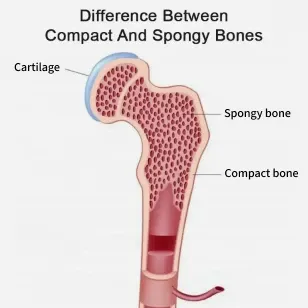
**The main features which highlight the difference between Compact and Spongy bone are given below:-
| **Features | **Compact Bone | **Spongy Bone |
|---|---|---|
| **Other Name | Cortical Bone | Cancellous/ Trabecular Bone |
| **Location | The outer layer of long bones | The inner layer of flat and irregular bones |
| **Structure | Dense, solid, and compact | Soft, Porous, and honeycomb-like structure |
| **Weight | Heavier due to denser structure | Lighter since it is porous |
| **Lamellae | Composed of concentric layers of matrix | Composed of thin, branching bony plates (trabeculae) |
| **Canals | Contains Haversian and Volkmann canals | Does not contain Haversian and Volkmann canals |
| **Vascularity | Highly vascularized | **Limited blood supply compared to compact bone |
| **Function | Provides strength, support, and protection | Facilitates shock absorption, reduces weight, and enables the metabolic exchange |
| **Bone Marrow | Contains **Yellow bone marrow (contains adipose tissue) | Contains **Red marrow (contains stem cells for hemopoiesis) |
| **Location in Long bones | Forms the **Diaphysis (shaft) of long bones | Forms the **Epiphysis (ends) of long bones |
What is Compact Bone?
Compact bone, also known as cortical bone, forms the outer layer of long bones. It is dense, solid, heavy, tough, and compact in nature. Bones are able to sustain mechanical stress, support weight, and resist bending or breaking because of the strength and stiffness that come from being compact. Few of its characteristics are listed below:-
- It is composed of concentric layers of matrix known as lamellae.
- It contains the Haversian (longitudinal) and Volkmann (transverse) canals which allow blood vessels and nerves to travel through them.
- It contains yellow bone marrow which stores adipose tissue or white fat. It forms the diaphysis or shaft of long bones.
What is Spongy Bone?
Spongy bone, also called cancellous or trabecular bone, forms the inner layer of flat and irregular bones, such as the vertebrae and sternum. Few of its characteristics are listed below:
- It has a porous and honeycomb-like structure, with interconnecting spaces filled with bone marrow.
- Trabeculae, a network of interconnecting, thin bony struts or plates, are found in porous, flexible bone.
- Its primary function is to provide shock absorption, reduce the weight of bones, and facilitate metabolic exchange between bone cells and the surrounding tissue.
- It contains red marrow, which contains stem cells for Hemopoiesis i.e. formation of blood cells.
Conclusion
Compact bone and spongy bone are the two main types of bone tissue, differing mainly in structure and density. Compact bone is dense and forms the hard outer layer of bones, offering strength and support. In contrast, spongy bone is lighter and porous, located inside bones, containing red marrow, and helping with shock absorption and weight reduction.