Difference Between DNA and RNA (original) (raw)
Last Updated : 23 Jul, 2025
The difference Between DNA and RNA lies in their structure, function, and location within cells, with DNA typically double-stranded, storing genetic information in the nucleus, while RNA is generally single-stranded, involved in protein synthesis, and present in various cellular compartments. DNA (Deoxyribonucleic acid) and RNA (Ribonucleic acid) differ in structure, function, and location. DNA is double-stranded, stores genetic information, and resides in the nucleus. RNA is single-stranded, involved in protein synthesis, and found in the nucleus, cytoplasm, and ribosomes. RNA contains ribose sugar while DNA contains deoxyribose.
DNA and RNA are both nucleic acids, differing in structure and function. DNA is double-stranded that contains deoxyribose sugar that stores genetic information while RNA is single-stranded that has ribose sugar and participates in protein synthesis and gene regulation. These distinctions define their roles in cellular processes. In this article, we will learn about the difference between DNA and RNA, their function, and structure.
Table of Content
- Difference Between DNA and RNA
- What is DNA?
- Structure of DNA
- Types of DNA
- What is RNA?
- Types of RNA
- Role of Protein
**Difference Between DNA and RNA
The difference between DNA and RNA are as follows:
| **Characteristics | DNA | RNA |
|---|---|---|
| **Abbreviation | (DNA) Deoxyribonucleic acid | (RNA) Ribonucleic acid |
| **Sugar | Deoxyribose sugar (2'OH) | Ribose sugar |
| **Bases | Adenine, Thymine, Guanine, Cytosine | Adenine, Uracil, Guanine, Cytosine |
| **Structure | Double-stranded | Usually single-stranded |
| **Location | Mostly in the nucleus and mitochondria of the cell. | Found in the nucleus, ribosome, and cytoplasm |
| **Stability | More stable and less prone to change | Less stable and more prone to change |
| **Length | Longer and can be up to millions of base pairs | Shorter and typically several hundred to a few thousand nucleotides long |
| **Types | There is only one type of DNA | RNA comes in a variety of forms, such as messenger RNA (mRNA), transfer RNA (tRNA), and ribosomal RNA (rRNA) |
| **Function | Stores genetic information | Acts as a template for protein synthesis |
| **Role in protein synthesis | DNA provides the genetic code, which is transcribed into mRNA | RNA serves as the template for protein synthesis (mRNA) and carries out protein synthesis (tRNA and rRNA) |
| **Examples | Found in chromosome. | Present in various types like mRNA, tRNA, and rRNA |
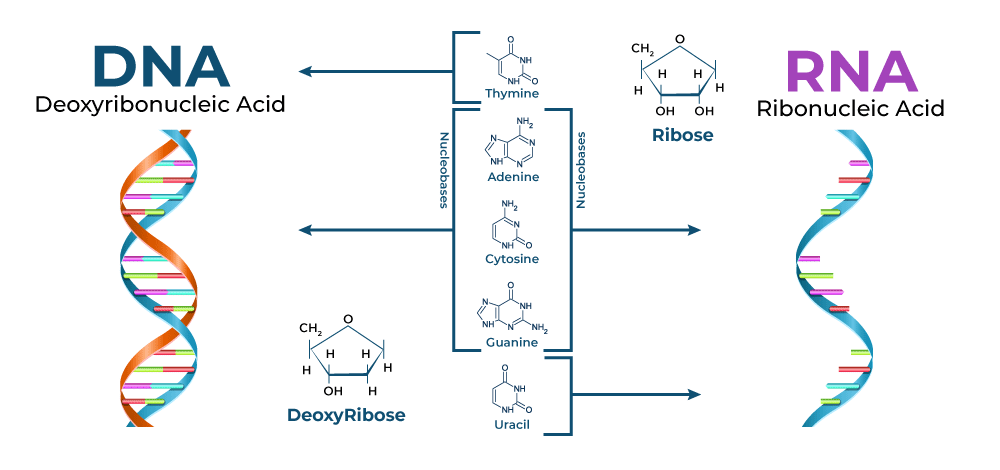
DNA vs RNA
DNA (Deoxyribonucleic acid) and RNA (Ribonucleic acid) are two types of nucleic acids present in the cell that stores and transfer the genetic information.
What is DNA?
DNA, or deoxyribonucleic acid, also known as 'genetic blue print' of organism is a molecule that carries the genetic instructions for the growth, development and reproduction of all living organisms. The two DNA strands composed of simpler monomeric units called nucleotides. Each nucleotide contains a deoxyribose sugar, a phosphate group, and one of four nitrogenous bases.
These base pairs are arranged in sequence along the DNA molecule that encodes the information for the synthesis of proteins and the regulation of various cellular processes. DNA is found in the nucleus of cell in eukaryotic organisms, where it is organized into structures called chromosomes. Every chromosome has a single DNA molecule. In humans, there are 23 pairs of chromosomes enclosed within the nucleus of the cells
Structure of DNA
The structure of the DNA is explained as follows:
- DNA consists of two strands that twist around each other, and resembles a twisted ladder, known as double helical structure.
- It is composed of nucleotides, with each consisting of a nitrogenous base, deoxyribose sugar, and a phosphate group.
- The nitrogenous bases are arranged in sequence and are made up of adenine (A), thymine (T), cytosine (C), and guanine (G). Between the two DNA strands they form complementary base pairs (A-T and C-G).
- The two DNA strands run in opposite directions, one strand in 5' to 3' direction and the other in 3' to 5' direction.
- Hydrogen bonds between the base pairs of the nucleotides hold the two chains together
- During cell division DNA can replicate to produce identical copies of itself, that ensures genetic continuity.
Types of DNA
The different types of DNA are described as follows:
**A-DNA
- Forms at 75% relative humidity or in high salt/ionic conditions or dehydration.
- Features 11 nucleotide pairs with a 2.56Å vertical rise per base pair.
- Has the widest helical diameter at 23Å and a right-handed helix with a 32.70-degree rotation per base pair.
**B-DNA
- Most common in DNA under neutral pH and physiological salt levels.
- Contains 10 base pairs per helical turn with a 3.4Å distance and a 20Å helical diameter.
- Watson-Crick's double helix model defines it as the B-form of DNA.
**C-DNA
- Observed at 66% relative humidity or with Lithium (Li+) ions.
- Contains approximately 9.33 base pairs per turn with a 19Å diameter.
- Right-handed helix with a vertical rise of 3.320 per base pair.
**D-DNA
- A rare variant with 8 base pairs tilting negatively from the helix axis.
- Exhibits an axial rise of about 3.03Å.
**Z-DNA
- Found in high salt environments.
- Features a left-handed helix with a zig-zag sugar-phosphate backbone.
- Consists of dinucleotide recurring monomers, unlike other forms with mononucleotides.
What is RNA?
RNA is a single-stranded molecule that plays a critical role in protein synthesis. RNA comes in a variety of forms, such as messenger RNA (mRNA), transfer RNA (tRNA), and ribosomal RNA (rRNA).
Types of RNA
RNA plays an important role in various cellular functions and gene expression. The various types of RNA are as follows:
- **Messenger RNA (mRNA): It carries genetic information to ribosomes from DNA for protein synthesis.
- **Transfer RNA (tRNA): It help in protein synthesis by transferring amino acids to the mRNA code.
- **Ribosomal RNA (rRNA): It is part of ribosomes, and help in synthesis by assembling different amino acids.
- **Small Nuclear RNA (snRNA): Takes part in processing while synthesis of protein.
Role of Protein
The protein plays diverse role that are as follows:
- Proteins act as enzymes, that speeds up the chemical reactions in cells.
- It provide structural support to cells, tissues, and organs, that helps in maintaining their shape and integrity.
- Protein form antibodies that help the immune system recognize and fight against infection or pathogens.
- Proteins takes part in cell signaling, transmitting signals between and within the cells.
DNA and RNA work together to ensure that there is accurate transmission of genetic information from one generation of cells to the next, that finally decides the traits and characteristics of an organism.