Moth vs Butterfly (original) (raw)
Last Updated : 27 May, 2026
Moths and butterflies are fascinating flying insects that belong to the order Lepidoptera, a group characterized by the presence of scale-covered wings. Although moths and butterflies share many similarities in structure, life cycle, and classification, they also show several noticeable differences in their appearance, behavior, habitat, and activity patterns. Both insects play important ecological roles as pollinators.
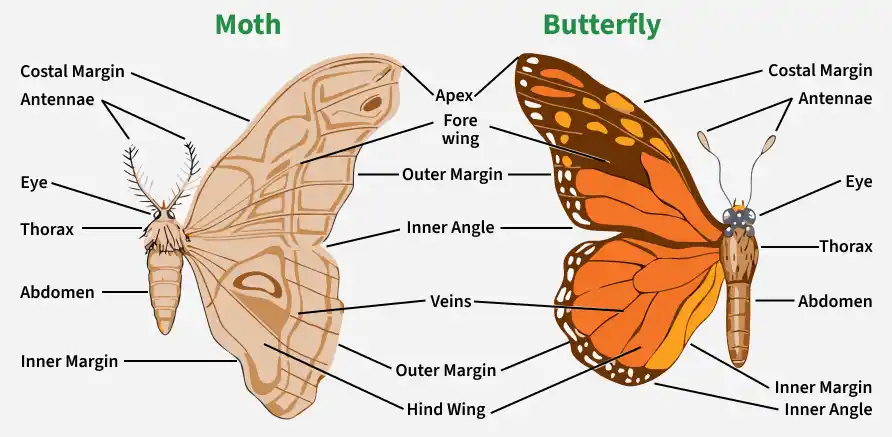
Moths
Moths are insects belonging to the order Lepidoptera and are closely related to butterflies. They are widely distributed throughout the world and can survive in a variety of habitats, including forests, grasslands, deserts, agricultural fields, and urban regions. Most moth species are nocturnal, meaning they are active during the night, although some species may also be active during the daytime.
- Moths play an important role in nature as pollinators, decomposers, and food sources for many organisms such as birds, bats, reptiles, and other insects.
- Certain moth species are economically important because they produce silk, while some species are considered agricultural pests because their larvae damage crops, stored grains, fabrics, and household materials.
- Moths reproduce sexually, and male moths are usually attracted to females by chemical substances called pheromones. Like butterflies, moths undergo complete metamorphosis, which includes four stages: egg, larva (caterpillar), pupa (usually enclosed in a cocoon), and adult moth.
- The caterpillar stage is mainly concerned with feeding and growth, whereas the adult stage focuses primarily on reproduction and dispersal.
**Physical Characteristics of Moths
Moths possess several characteristic features that distinguish them from butterflies.
- Moths generally have stout, thick, and hairy bodies.
- While many moths are dull or camouflaged for protection, some species are brightly coloured and highly decorative.
- Most moths possess feathery, comb-like, or filamentous antennae.
- They usually keep their wings spread flat against the surface while resting.
- Their flight pattern is often irregular and fluttering.
- Many moths are adapted for night activity and possess excellent sensory abilities.
Economic Importance of Moths
Moths have both beneficial and harmful importance in human life and ecosystems.
**Beneficial Importance
- Certain moths, such as the silkworm moth, are used in silk production.
- Some moth species help in the pollination of flowering plants.
- Several moth larvae act as natural biological control agents by feeding on harmful pests.
**Harmful Importance
- Some caterpillars damage crops and agricultural plants.
- Certain moth larvae spoil stored grains and food materials.
- Fabric moths damage clothes, wool, carpets, and textiles.
Butterflies
Butterflies are beautiful flying insects belonging to the order Lepidoptera. They are commonly found in gardens, forests, grasslands, meadows, and flowering regions. Butterflies are usually active during the daytime and are well known for their brightly colored wings and attractive flight movements.
- Butterflies are important pollinators and help in the reproduction of many flowering plants. They also serve as indicators of environmental health because their presence often reflects a balanced ecosystem.
- Many butterfly species depend on specific host plants for laying eggs, and their caterpillars feed only on those plants.
- Like moths, butterflies reproduce sexually and undergo complete metamorphosis consisting of egg, larva (caterpillar), pupa (chrysalis), and adult butterfly stages.
- The larval stage mainly involves feeding and growth, while the adult stage is associated with reproduction and migration.
**Physical Characteristics of Butterflies
Butterflies possess several features that make them different from moths.
- Butterflies generally have slender and smooth bodies.
- Their wings are brightly colored and beautifully patterned.
- They possess club-shaped or knobbed antennae.
- They usually keep their wings folded upright over the back while resting.
- Their flight is smooth, graceful, and more directed.
- Most butterflies are active during the daytime and rely heavily on vision.
Economic and Ecological Importance of Butterflies
Butterflies are highly valuable in ecosystems as well as in human culture.
**Ecological Importance
- Butterflies act as important pollinators of flowering plants.
- They contribute to biodiversity and ecological balance.
- They serve as food sources for birds, reptiles, and insects.
**Economic and Cultural Importance
- Butterflies enhance the beauty of gardens and natural landscapes.
- Butterfly watching promotes ecotourism in many regions.
- Butterflies are important symbols in art, culture, literature, and education.
- They are often used as indicator species in conservation studies.
Difference table of the both-
| Characteristics | Moths | Butterflies |
|---|---|---|
| Antennae | Usually feathery or comb-like | Usually club-shaped or knobbed |
| Activity | Mostly nocturnal | Mostly diurnal |
| Body Shape | Thick, stout, and hairy | Slender and smoother |
| Wing Colour | Generally dull or camouflaged | Usually brightly coloured |
| Resting Position | Wings spread flat | Wings folded upright |
| Flight Pattern | Irregular and fluttering | Smooth and graceful |
| Pupa Formation | Usually forms a cocoon | Usually forms a chrysalis |
| Habitat | Forests, fields, urban areas | Gardens, meadows, grassland |
| Economic Importance | Some are pests, some produce silk | Mostly beneficial pollinators |
| Sensory Adaptation | Strong sense of smell | Strong visual adaptation |