Difference Between Sperm and Ovum (original) (raw)
Last Updated : 23 Jul, 2025
The **difference between sperm and ovum lies in its size, structure, and function. Sperm and ovum are the two essential components that make sexual reproduction possible. Sperm are smaller, mobile, and responsible for fertilizing the ovum, which is larger and immobile. These two cells are very different from each other in their characteristics and functions, and understanding their differences is important in learning the process of sexual reproduction. In this article, we study the **difference between sperm and ovum.
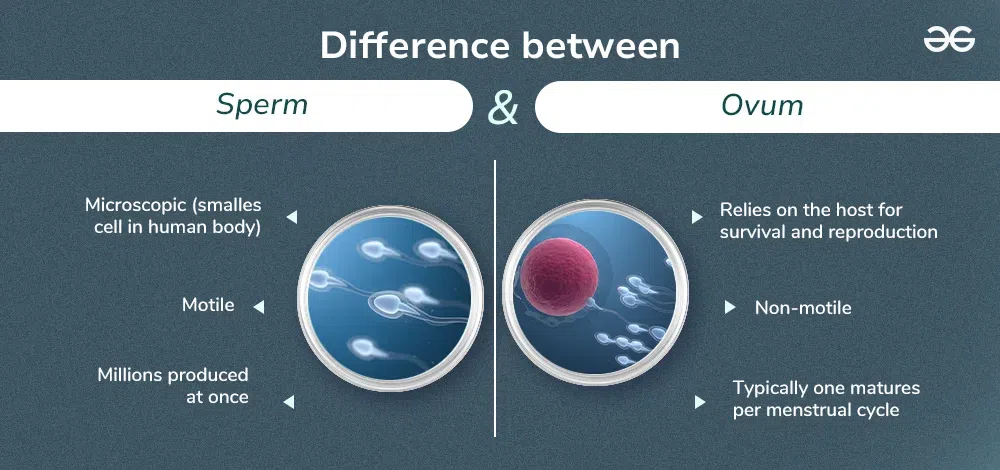
Table of Content
- Sperm
- Ovum
- Difference Between Sperm and Ovum
- Similarities Between Sperm and Ovum
- Conclusion - Difference Between Sperm and Ovum
What is Sperm?
The male reproductive cell or gamete produced in the testes of the male reproductive system is known as **sperm. They are microscopic and consist of a head, midpiece, and tail. Sperm are specialized for swimming through the female reproductive tract to fertilize the ovum, contributing genetic material to form a new individual.
- **Sperm production: From puberty until old age, males' testicles continuously generate sperm. The hypothalamus and pituitary gland in the brain release hormones that stimulate the testes to create and release sperm, which controls sperm production.
- **Function: The main job of sperm is to fertilize the female reproductive system's ovum or egg cell during sexual activity, creating a zygote that later turns into an embryo.
- **Lifespan: Sperm have a brief lifespan that normally lasts between a few hours and a few days after ejaculation.
Structure of Sperm
Sperm cells has a distinctive tail-like structure called a flagellum that pushes them along. Sperm cells are tiny, typically measuring 50–100 micrometers in length.
- **Head
- **Midpiece
- Contains mitochondria, providing energy for sperm movement through ATP production.
- Connects the head to the tail.
- **Tail
- Long, whip-like structure enabling sperm motility.
- Propels the sperm forward through fluid environments, facilitating its journey to fertilize the ovum.

**Also Read: Spermatogeneisis
What is Ovum?
The ovum, also known as the egg cell or oocyte, is the female reproductive cell produced in the ovaries. It is considerably larger than sperm and contains the maternal genetic material in the nucleus. The ovum is specialized for fertilization, serving as the recipient of sperm and contributing half of the genetic material necessary for the formation of a new individual.
- **Production: Unlike sperm, the ovum is not continuously produced in the ovaries; instead, it is cycled out once every menstrual cycle. Changes in the body's hormones, notably the rise in luteinizing hormone, cause the ovum to release (LH).
- **Function: The fundamental purpose of the ovum is to combine with the sperm during sexual activity in order to generate a zygote, which then matures into an embryo.
- **Lifespan: The ovum has a brief lifespan, often lasting 12 to 24 hours after ovulation.
Structure of Ovum
- **Cell Membrane: The outermost layer of the ovum providing structure and protection.
- **Cytoplasm: A gel-like substance containing organelles essential for the ovum's metabolic activities.
- **Nucleus: Contains the genetic material, including chromosomes, necessary for fertilization and embryo development.
- **Zona Pellucida: A thick glycoprotein layer surrounding the ovum, helping in fertilization and providing protection.
- **Corona Radiata: A layer of cells surrounding the zona pellucida, assisting in the ovum's passage through the female reproductive tract and interacting with sperm during fertilization.

Difference Between Sperm and Ovum
The difference between sperm and ovum is given below:
| | Sperm | Ovum | | | --------------------------- | ----------------------------------------------------------------------------------- | ---------------------------------------------------------------------- | | **Definition | Sperm are male reproductive cells or gamete | Ovum is female reproductive cells or gamete | | **Size | Small, typically measuring 50-100 micrometers | Large, typically measuring 100-150 micrometers | | **Shape | Long and narrow with a tail-like structure | Spherical | | **Genetic Material | Contains genetic material or DNA in the head | Contains genetic material or DNA in the nucleus | | **Protective Structure | Protected by a cap-like structure called the **acrosome | Surrounded by a protective layer called the **zona **pellucida | | **Production Regulation | Regulated by hormones released by the hypothalamus and pituitary gland in the brain | Released cyclically due to hormonal changes in the body |
**Similarities Between Sperm and Ovum
- Both are specialized gametes or reproductive cells.
- Both are made in the reproductive organs of the body, with the ovum being made in female ovaries and sperm in male testicles.
- Both have genetic material, or DNA, which when combined during fertilization results in the development of a new individual.
- Both are necessary for the survival of the species and sexual reproduction.
- Sperm live for a few hours to a few days after ejaculation, and the ovum lives for 12–24 hours following ovulation, making them rather short-lived
Conclusion - Difference Between Sperm and Ovum
In conclusion, sperm and ovum are integral to the process of sexual reproduction, each playing distinct roles in fertilization and embryo development. Sperm, produced continuously in the male reproductive system, are specialized for mobility and genetic contribution, while the larger and less frequently produced ovum from the female ovaries is equipped for fertilization and containing maternal genetic material. Understanding their structures, functions, and lifespans underscores their importance in species and facilitating the creation of new life.