Electron Transport System (ETS) And Oxidative Phosphorylation (original) (raw)
Last Updated : 3 Jun, 2026
The Electron Transport System (ETS) and oxidative phosphorylation are the final stages of aerobic respiration and play an important role in the production of cellular energy. These processes occur in the inner mitochondrial membrane of eukaryotic cells and in the plasma membrane of prokaryotic cells. During these reactions, the energy stored in NADH and FADH₂, which are produced during glycolysis and the Krebs cycle, is used for the synthesis of ATP, the main energy currency of the cell.
Electron Transport System (ETS)
The electron transport system is a chain of protein complexes and electron carriers through which electrons are transferred from one carrier to another in a stepwise manner. The ETC is located in the inner mitochondrial membrane of eukaryotic cells and the plasma membrane of prokaryotic cells.

The major components of the Electron Transport System are:
- **Complex I (NADH Dehydrogenase): Complex I accepts electrons from NADH and transfers them to ubiquinone (coenzyme Q). During this process, protons are pumped from the mitochondrial matrix into the intermembrane space.
- **Complex II (Succinate Dehydrogenase): Complex II accepts electrons from FADH₂ formed during the oxidation of succinate in the Krebs cycle. These electrons are also transferred to ubiquinone. Unlike Complex I, Complex II does not pump protons across the membrane.
- **Ubiquinone (Coenzyme Q): Ubiquinone is a mobile electron carrier present within the inner mitochondrial membrane. It transports electrons from Complex I and Complex II to Complex III.
- **Complex III (Cytochrome bc₁ Complex): Complex III transfers electrons from ubiquinone to cytochrome c. During this transfer, protons are pumped across the membrane, contributing to the proton gradient.
- **Cytochrome c: Cytochrome c is a small mobile protein attached to the outer surface of the inner mitochondrial membrane. It carries electrons from Complex III to Complex IV.
- **Complex IV ****(Cytochrome Oxidase):** Complex IV transfers electrons to oxygen, which acts as the final electron acceptor. Oxygen combines with electrons and hydrogen ions to form water (H₂O). This complex also pumps protons across the membrane.
- **Complex V (ATP Synthase): Complex V, also called ATP synthase, synthesises ATP using the proton gradient generated by the electron transport chain.
Mechanism of Electron Transport
- NADH produced during glycolysis and the Krebs cycle donates electrons to Complex I, while FADH₂ donates electrons to Complex II.
- These electrons move through a series of carriers including ubiquinone, Complex III, cytochrome c, and Complex IV. As electrons pass through the complexes, energy is released and used to pump protons from the mitochondrial matrix into the intermembrane space.
- This movement of protons creates a proton gradient and an electrochemical potential across the inner mitochondrial membrane. The concentration of protons becomes higher in the intermembrane space than in the matrix.
- Finally, oxygen accepts electrons and combines with hydrogen ions to form water. Since oxygen acts as the terminal electron acceptor, the process can continue only in the presence of oxygen.
Oxidative Phosphorylation
Oxidative phosphorylation is the process in which ATP is synthesised using the energy released during electron transport in the Electron Transport System. It is the final stage of aerobic respiration and is responsible for the formation of most ATP molecules in the cell. The ATP synthesis occurs through the F₀-F₁ ATP synthase complex present in the inner mitochondrial membrane.
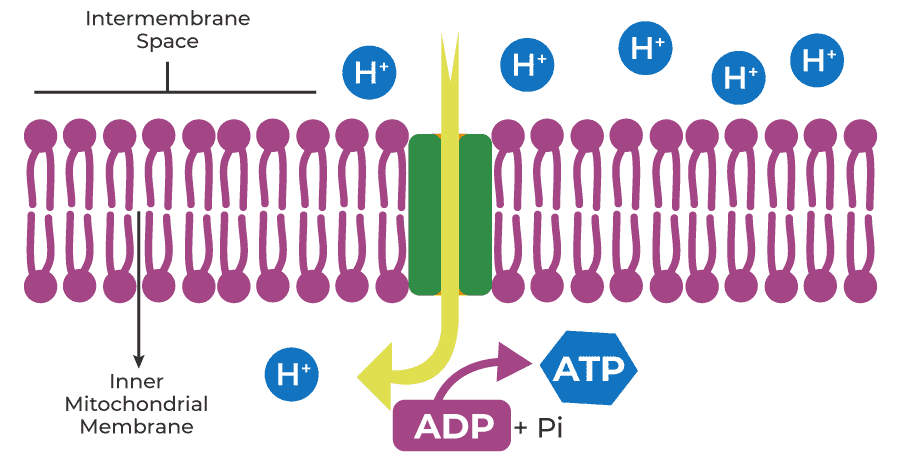
Structure of ATP Synthase
ATP synthase consists of two main parts:
- F₀ portion, which forms a channel for proton movement across the membrane.
- F₁ portion, which contains the catalytic site for ATP synthesis.
When protons flow back from the intermembrane space into the mitochondrial matrix through the F₀ portion, energy is released. This energy drives the F₁ portion to combine ADP and inorganic phosphate (Pi) to form ATP.
Steps of Oxidative Phosphorylation
- **Electron Donation: NADH and FADH₂ donate electrons to the electron transport chain.
- **Electron Transport: Electrons pass through the protein complexes of the ETC.
- **Proton Pumping: Energy released during electron transfer pumps protons across the membrane.
- **Formation of Proton Gradient: A high concentration of protons develops in the intermembrane space.
- **ATP Synthesis: Protons flow back through ATP synthase, and ATP is produced from ADP and inorganic phosphate.
- **Formation of Water: Oxygen accepts electrons and hydrogen ions to form water.
Importance of ETS and Oxidative Phosphorylation
The Electron Transport System and oxidative phosphorylation are extremely important because they:
- Produce most of the ATP required by the cell.
- Provide energy for cellular activities.
- Complete the oxidation of food molecules.
- Help maintain cellular metabolism.
- Produce water as a by-product.
- Support aerobic respiration in living organisms.