Epithelial Tissue Introduction, Characteristics, Types, Importance (original) (raw)
Last Updated : 11 Jun, 2026
Epithelial tissue is one of the four basic types of animal tissues and forms the protective covering of the body as well as the lining of internal organs and cavities. It consists of closely packed cells with very little intercellular space, arranged in continuous sheets. This tissue acts as a protective barrier and regulates the absorption, secretion, and exchange of substances. Due to its widespread distribution, epithelial tissue performs a variety of essential functions throughout the body.
Epithelial tissue is classified based on the shape of its cells, the number of layers present, and the specialised functions it performs.
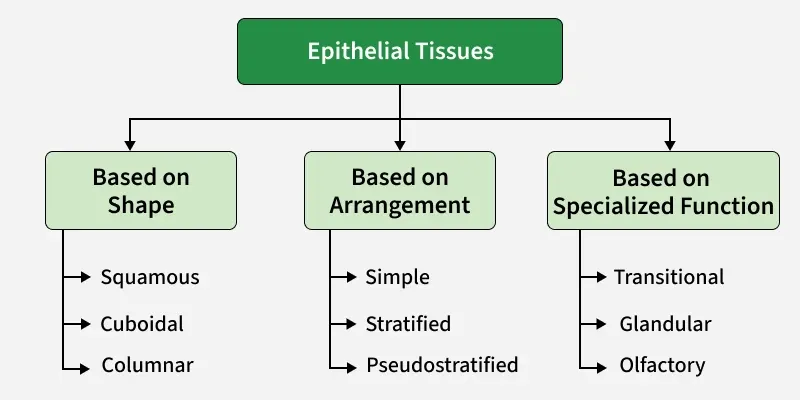
Classification Based on Cell Shape
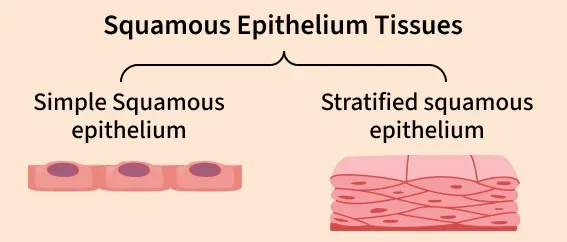
**1. Squamous Epithelium
- Squamous epithelium consists of thin, flat, scale-like cells that are arranged closely together. Because of their thin structure, these cells allow rapid diffusion and filtration of substances.
- This type of epithelium is found in the alveoli of the lungs, the lining of blood vessels, Bowman's capsule of the kidney, and various body cavities.
- Its main functions include diffusion, filtration, and protection.
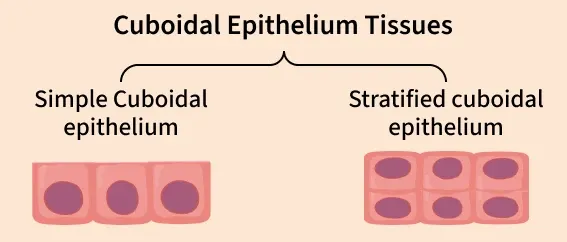
**2. Cuboidal Epithelium
- Cuboidal epithelium consists of cube-shaped cells with centrally placed spherical nuclei. The height and width of the cells are approximately equal.
- This type of epithelium is found in kidney tubules, thyroid follicles, and the ducts of many glands.
- Its primary functions include secretion, absorption, and excretion.
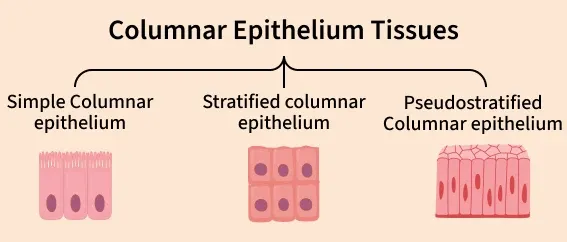
**3. Columnar Epithelium
- Columnar epithelium consists of tall, pillar-shaped cells that are taller than they are wide. The nuclei are usually elongated and located near the basal end of the cells.
- This tissue lines the stomach, intestines, gall bladder, and many glandular ducts.
- Its functions include absorption, secretion, and protection.
- Goblet cells are specialised columnar cells that secrete mucus to lubricate and protect internal surfaces.
Classification Based on Cell Arrangement
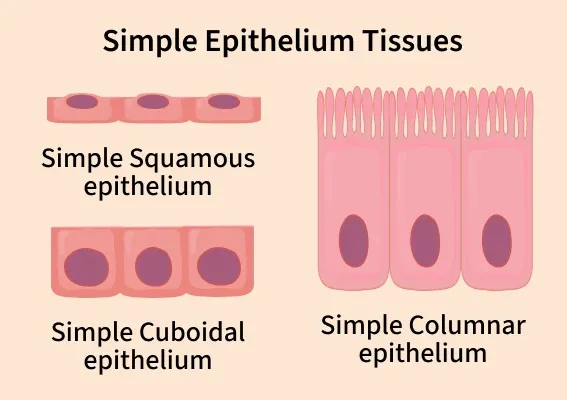
**1. Simple Epithelium
Simple epithelium consists of a single layer of cells resting on the basement membrane. It is generally found in areas where absorption, secretion, filtration, and diffusion occur.
- **Simple Squamous Epithelium: This consists of a single layer of flat cells and is found in lung alveoli, capillaries, and Bowman's capsule.
- **Simple Cuboidal Epithelium: This consists of a single layer of cube-shaped cells and is found in kidney tubules and glandular ducts.
- **Simple Columnar Epithelium: This consists of a single layer of tall cells and lines the stomach and intestines.
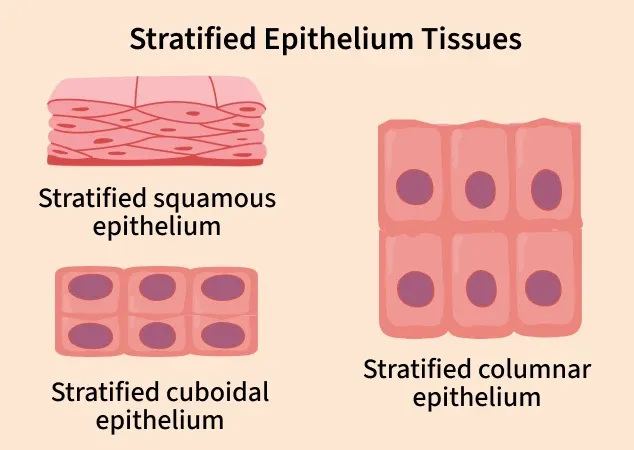
**2. Compound or Stratified Epithelium
Compound epithelium consists of two or more layers of cells. Its main function is protection against wear and tear.
- **Stratified Squamous Epithelium: This tissue consists of several layers of cells with flattened cells on the surface. It is found in the skin, mouth, pharynx, and oesophagus. Its primary function is protection against mechanical abrasion.
- **Stratified Cuboidal Epithelium: This tissue is found in the ducts of sweat glands and salivary glands. Its main function is protection.
- **Stratified Columnar Epithelium: This tissue is present in large ducts and certain regions of the urethra. It provides protection and secretion.
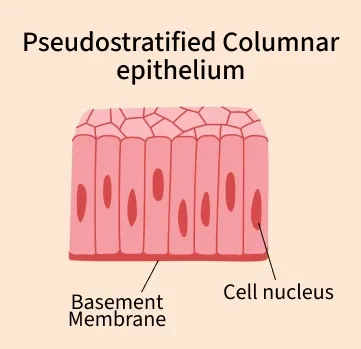
**3. Pseudostratified Epithelium
Pseudostratified epithelium appears to have multiple layers because the nuclei lie at different levels. However, all cells are attached to the basement membrane, making it a type of simple epithelium. It is commonly found in the trachea and bronchi. Its functions include protection, secretion, and movement of mucus.
**Classification Based on Specialised Function
- **Transitional Epithelium: Transitional epithelium is a specialised stratified epithelium whose cells can change shape when stretched. It lines the urinary bladder, ureters, and renal pelvis. This tissue allows these organs to expand and contract without damage.
- **Glandular Epithelium: Glandular epithelium is specialised for secretion and forms the secretory portion of glands. It may be unicellular, such as goblet cells, or multicellular, such as salivary glands, sweat glands, and endocrine glands. Its function is the production and secretion of substances such as mucus, enzymes, hormones, sweat, and digestive juices.
- **Olfactory Epithelium: Olfactory epithelium is a specialised sensory epithelium responsible for the sense of smell. It is located in the upper part of the nasal cavity and contains receptor cells that detect odour molecules present in the air.
Characteristics of Epithelial Tissue
- Epithelial tissue possesses several distinctive characteristics that differentiate it from other tissues of the body.
- The cells of epithelial tissue are tightly packed together and are arranged in one or more layers with almost no intercellular spaces between them.
- This close arrangement provides effective protection and creates a continuous barrier against external agents.
- Epithelial tissue rests upon a thin, non-cellular layer known as the basement membrane. This membrane supports the epithelial cells and separates them from the underlying connective tissue.
- One of the most important characteristics of epithelial tissue is that it is avascular, meaning that it does not contain blood vessels.
- Oxygen and nutrients reach the epithelial cells through diffusion from the blood vessels present in the underlying connective tissue.
- The epithelial cells exhibit polarity, which means that they have a free surface called the apical surface and an attached surface called the basal surface.
- The apical surface faces either the external environment or the cavity of an organ, while the basal surface is attached to the basement membrane.
- Epithelial tissue has a remarkable capacity for regeneration and repair. Damaged epithelial cells can be replaced rapidly through continuous cell division.
- Specialised cell junctions such as tight junctions, adhering junctions, desmosomes, and gap junctions are present between adjacent epithelial cells. These junctions provide mechanical strength and facilitate communication between cells.
Cell Junctions in Epithelial Tissue
The epithelial cells are connected by specialised junctions that maintain tissue integrity and facilitate communication.
- **Tight Junctions: Tight junctions seal adjacent cells and prevent the leakage of substances between them.
- **Adhering Junctions: These junctions cement neighbouring cells together and provide mechanical strength.
- **Gap Junctions: Gap junctions contain microscopic channels that allow ions and small molecules to pass directly between adjacent cells, thereby facilitating communication.
Functions of Epithelial Tissue
- One of the primary functions of epithelial tissue is protection. It forms a protective barrier that shields underlying tissues from mechanical injury, harmful chemicals, microorganisms, dehydration, and excessive heat or cold.
- Certain epithelial tissues are specialised for absorption. For example, the epithelial lining of the small intestine absorbs digested nutrients and transports them into the bloodstream.
- Many epithelial cells are specialised to produce and release various substances such as mucus, enzymes, hormones, sweat, saliva, and digestive juices. Such cells form glandular epithelium.
- Epithelial tissue present in the kidneys participates in the removal of metabolic wastes and helps in the formation of urine.
- Simple squamous epithelium found in structures such as Bowman's capsule of the kidney allows the filtration of blood plasma during urine formation.
- The thin epithelial lining of the alveoli in the lungs allows the rapid exchange of oxygen and carbon dioxide between the air and the blood.
- Specialised epithelial tissues contain sensory receptors that help detect stimuli such as smell, taste, touch, and sound.
- Ciliated epithelial tissues help transport substances along the surface of organs. For example, cilia present in the respiratory tract move mucus and trapped dust particles toward the throat, while cilia in the fallopian tubes help move the ovum toward the uterus.