Osmosis and Diffusion (original) (raw)
Last Updated : 24 Apr, 2026
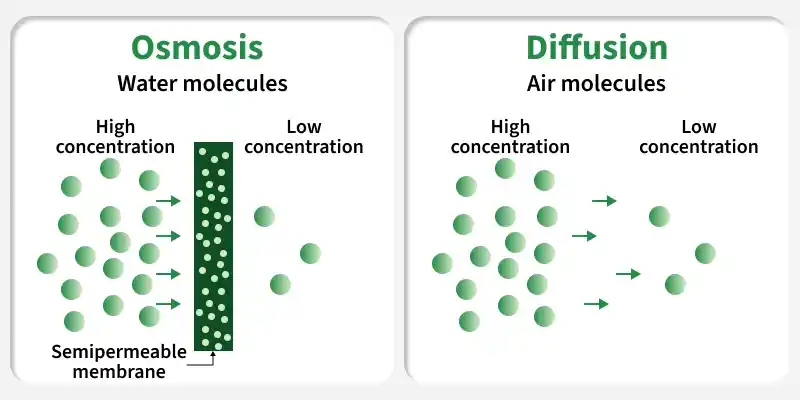
Living organisms constantly exchange substances with their surroundings to maintain life. Two important physical processes that help in this exchange are diffusion and osmosis. These processes are essential for respiration, nutrition, excretion, and the transport of materials in cells. Diffusion allows the movement of particles along a concentration gradient, and Osmosis regulates the movement of water across a semipermeable membrane.
Diffusion
Diffusion is the movement of particles (such as molecules, ions, or atoms) from an area of high concentration to an area of low concentration, driven by random thermal motion. This process occurs in gases, liquids, and solids. It is an important mechanism for many natural phenomena, including the movement of molecules in and out of cells, the spread of odours or pollutants through the air, and the mixing of solutes in a solution.
**Types of Diffusion
Diffusion can be classified mainly into two types: Simple and Facilitated Diffusion.
**Simple Diffusion
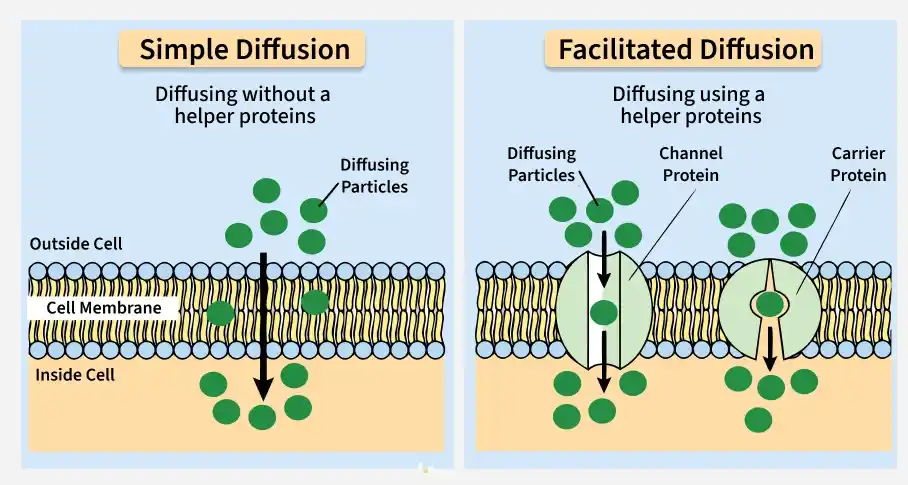
Simple diffusion is the movement of particles from a region of high concentration to a region of low concentration without the help of transport proteins. It mainly occurs for small, non-polar or lipid-soluble molecules such as oxygen and carbon dioxide.
**Facilitated Diffusion
Facilitated diffusion is defined as the substances moving through the semipermeable membrane from a region of higher concentration to a region of lower concentration with the help of transport proteins. These proteins form channels or carriers to allow the passage of the molecules.
Examples of Diffusion
- **The spreading of perfume or smoke through the air: When perfume is sprayed, the particles move from an area of high concentration (near the source) to an area of low concentration (farther away), driven by random thermal motion.
- **The dissolving of sugar in water: When sugar is added to water, the sugar particles move from an area of high concentration (the sugar crystal) to an area of low concentration (the surrounding water), resulting in a gradual mixing of the solutes.
- **The exchange of gases in the lungs: When we breathe, oxygen and carbon dioxide molecules move from areas of high concentration (in the air or blood) to areas of low concentration (in the lungs or blood), allowing for gas exchange to occur.
- **The movement of molecules in and out of cells: Nutrients, waste products, and other molecules move in and out of cells through diffusion, which can occur across the plasma membrane in response to concentration gradients.
Osmosis
Osmosis is the movement of water molecules through a semipermeable membrane from a region of lower solute concentration to a region of higher solute concentration. The osmosis process is essential for many biological processes, including the absorption of nutrients and the maintenance of the fluid balance in cells and organisms.
Types of Osmotic Solution
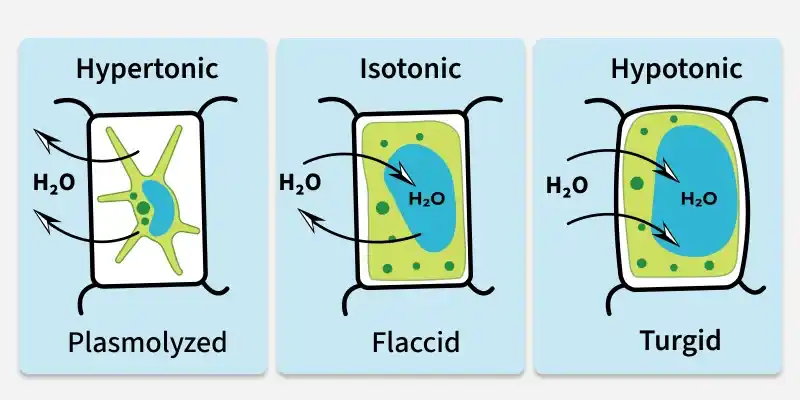
Osmotic solutions are solutions classified based on solute concentration relative to another solution. They determine the direction of water movement (osmosis) across a semipermeable membrane.
Three types of Osmotic Solution are given below:
- **Hypotonic Solution: A solution in which the solute concentration is lower in the surrounding medium than inside the cell, causing water to move into the cell by osmosis.
- **Hypertonic Solution: A solution in which solute concentration is higher in the surroundings than in the cell.
- **Isotonic Solution: A solution in which the solute concentration is equal both inside and in the surroundings.
Examples of Osmosis
- **The absorption of water by plant roots: Plant roots absorb water from the soil through osmosis, as water molecules move from areas of higher concentration in the soil to areas of lower concentration in the plant roots.
- **The regulation of blood pressure: Osmosis plays a role in regulating blood pressure by helping to balance the concentration of solutes in the blood and in the surrounding tissues. For example, if the concentration of solutes in the blood is too high, water will move out of the tissues and into the blood vessels through osmosis, helping to increase blood volume and pressure.
- **The preservation of food: Osmosis is often used to preserve food by creating an environment in which bacteria and other microorganisms cannot grow. For example, pickling or curing meat in salt causes water to move out of the cells of bacteria and other microorganisms, which can lead to their death.
- **Water reabsorption in the kidneys involves osmosis: The kidneys use osmosis to filter waste products from the blood and remove excess water from the body. The movement of water and solutes through the nephron of the kidney is controlled by the osmotic gradient between the blood and the surrounding tissues.