Human Circulatory System (original) (raw)
Last Updated : 29 Dec, 2025
The Human Circulatory System****,** also known as the cardiovascular system (cardio means heart, and vascular means blood vessels), is one of the very important organ systems of the human body that is responsible for transporting essential substances throughout the body and connecting all the systems.
The main purpose of the human circulatory system is to transport various essential substances that are required for the survival of the body.
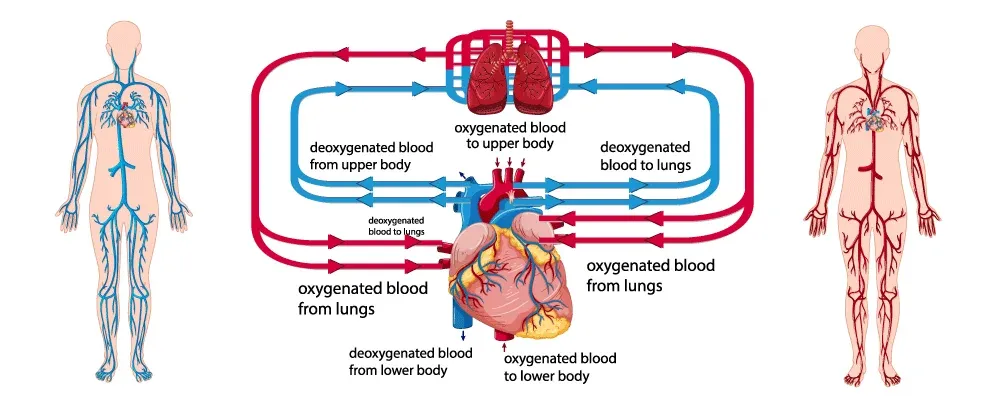
Working of the Human Circulatory System
The human circulatory system works in two loops, one for the oxygenated blood and the other for the deoxygenated blood, which is described below:
- For deoxygenated blood, the blood from tissue capillaries reaches the veins and then into the superior and inferior vena cava and flows into the right atrium, then to the right ventricle through the tricuspid valve. Then, through the pulmonary valve, it gets pumped into the pulmonary artery. Through the pulmonary artery, it reaches the capillaries of the lungs, where deoxygenated blood becomes oxygenated.
- For oxygenated blood, the blood from the lungs flows into the left atrium through the pulmonary veins, then into the left ventricle through the mitral valve. Then, through the aorta, it gets pumped into the aorta. Some amount of blood goes into the coronary circulation, and the rest reaches the tissue capillaries through the arteries, where the oxygenated blood becomes deoxygenated.
Organs of the Human Circulatory System
The human circulatory system consists of the heart, blood, blood vessels, and the lymphatic system.
Heart
The heart is the main blood-pumping organ of the circulatory system. The main function of the heart is to control the flow of blood throughout the body to each part. The structure of the heart is shown below:

**Features of the Human Heart are:
- It is a muscular organ made of cardiac tissues. It is almost the size of a closed fist.
- It is located in the thoracic cavity between the right and left lungs, with its apex slightly tilted towards the left side.
- The human heart has four chambers. It is covered by a protective covering called the pericardium.
- The chambers of the right side and left side are separated by the septum, whereas the atrium and ventricle are separated by the atrioventricular septum that has valves in it.
- The left side of the heart deals with the oxygenated blood, whereas the right side of the heart deals with the deoxygenated blood.
Blood
Blood is a fluid connective tissue that acts as the medium of transport in the body. Blood consists of blood cells and fluid plasma. Blood plasma is a straw-coloured fluid that consists of water and other substances. Blood cells include: red blood cells, white blood cells, and platelets, as shown below:
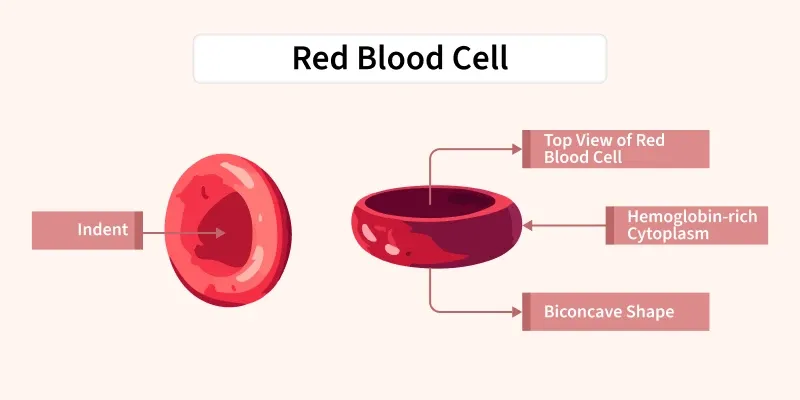
Types of Blood are described below:
- **Red Blood Cells: They are also known as erythrocytes, which lack a nucleus. These cells consist of haemoglobin, which is responsible for the transport of oxygen in the body and gives the red colour of the blood. These cells also consist of antigens that determine the blood group of the person.
- **White Blood Cells: They are also known as leukocytes, which are responsible for the body’s immune system. They are of the following types: lymphocytes, monocytes, neutrophils, eosinophils, and basophils.
- **Platelets: They are also known as thrombocytes, which are small, disk-shaped fragments produced in the bone marrow. They help in the clotting of blood during any injury.
Blood Vessels
Blood vessels are a network of pipelines that spreads throughout the body. These pipelines are responsible for the transport of blood throughout the body. Major differences between Arteries and Veins are shown below.

Blood vessels consist of arteries, veins, and capillaries as described below:
- **Arteries: These are thick and elastic blood vessels that are responsible for transporting high-pressure blood that is pumped by the heart. It is responsible for transporting oxygenated blood to the tissues of the body and deoxygenated blood to the lungs.
- **Veins: These are thin and less elastic blood vessels that are responsible for the transport of low-pressure blood to the heart. It is responsible for transporting deoxygenated blood to the heart and oxygenated blood to the lungs.
- **Blood Capillaries: These are very delicate one-celled thick blood vessels that are found deeply embedded in the tissues and are responsible for the exchange of materials between the blood and tissue (cells).
Lymphatic System
The Lymphatic System is part of the immune system and complementary to the circulatory system. It consists of a large network of lymphatic vessels, lymph nodes, lymphoid organs, lymphatic tissue and lymph.

**Features of the Lymphatic System are:
- Lymph is a body fluid derived from blood that appears pale yellow.
- It connects the blood circulatory system to tissues and acts as a transport medium between the two.
- It lacks red blood cells as it seeps out of the blood circulatory system and requires the help of lymphatic vessels to return to the blood circulatory system.
- Lymph nodes (components of the lymphatic system) help in detecting pathogens or antigens present in the body's tissue system.
Types of Blood Circulation
There are mainly two types of blood circulation that occur in the human body;
- Double circulation
- Coronary circulation
Double Circulation
Double circulationis a circulatory system where blood passes through the heart twice in one complete circuit. The double circulation mechanism ensures that oxygenated and deoxygenated blood flow in separate pathways within the heart. A diagram of Double Circulation is given below:

The flow of blood in two different circuits for oxygenated and deoxygenated blood is explained by double circulation. It includes;
- **The Systemic Circuit: It is the circuit of blood transport that occurs between the heart and the different tissues of the body. In this circuit, the oxygenated blood leaves the left ventricle and then, with the help of the aorta and arteries, reaches the capillaries where an exchange of gases takes place, and then the deoxygenated blood, with the help of the vein and vena cava, reaches the right atrium of the heart.
- **The Pulmonary Circuit: It is the circuit of blood transport that occurs between the heart and the lungs. In this circuit, the deoxygenated blood leaves the right ventricle and then, with the help of the pulmonary artery, reaches the capillaries near the alveoli of the lungs for gaseous exchange, after which the oxygenated blood, with the help of the pulmonary veins, will reach the left atrium of the heart.
Coronary Circulation
The flow of blood between the double circulatory system and the heart muscle (myocardium) is called coronary circulation. A diagram of the Coronary Circulation is given below:
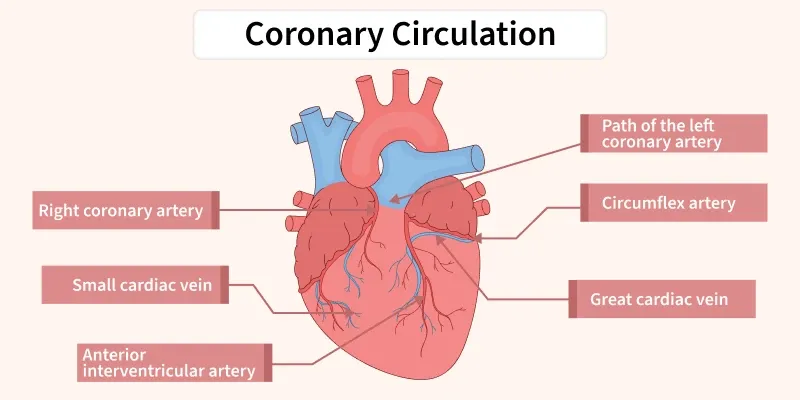
Coronary circulation includes both oxygenated and deoxygenated blood as described below:
- In this circulation, the coronary arteries from the aorta supply oxygenated blood to the heart muscle tissues, where the exchange of gases and other substances takes place.
- Then the deoxygenated blood is transported to the vena cava with the help of the coronary veins. This system ensures an uninterrupted supply of blood to the heart muscles.
Functions of the Circulatory System
The following are some of the functions of the circulatory system;
- Transport of oxygen and carbon dioxide.
- Transport of nutrients, waste, hormones, and other substances.
- Regulation of body temperature.
- Regulation of the body’s pH
- Provides immunity to the body.
- Helps in blood clotting during injury.
- Helps in the conduction of information between cells.