Human Digestive System (original) (raw)
Last Updated : 2 Dec, 2025
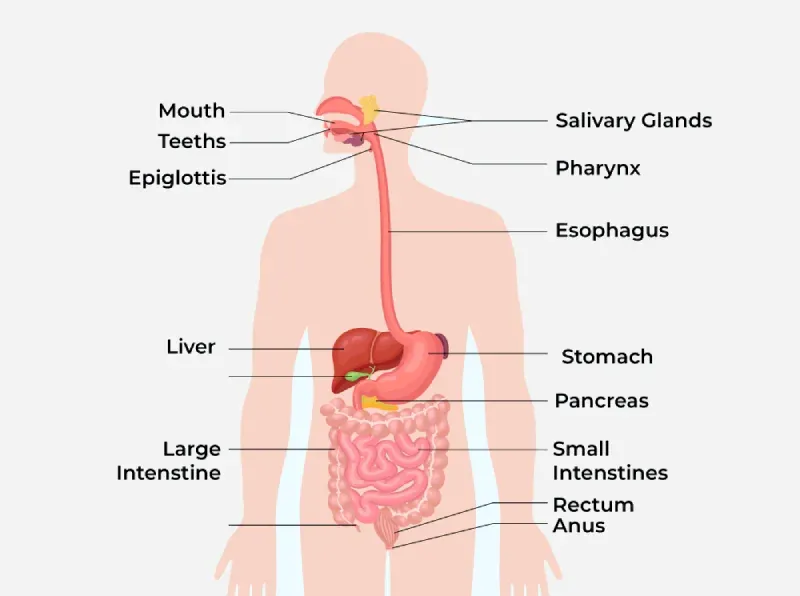
The Human Digestive System is comprised of the gastrointestinal system and different organs that help the body separate and assimilate food. The human digestive system is a long, winding cylinder that begins at the mouth and goes through the pharynx, oesophagus, stomach, small intestine, large intestine, rectum, and anus.
Characteristics of the Human Digestive System
- The human digestive system separates food into supplements like starches, fats, and proteins.
- They can then be absorbed in the circulatory system so the body can utilise them for energy, development, and fixing. Unused materials are disposed of as waste.
- Different organs that structure some portions of the human digestive system are the pancreas, liver, and gallbladder.
- The digestive system of humans is comprised of various organs that work together. Food is digested, and essential nutrients are absorbed in the body via the blood.
- Energy is generated via digesting food.
- The digestive system contains various organs, like the alimentary canal and digestive glands.
- The gastrointestinal tract includes various parts: the mouth, oesophagus, stomach, small intestine and large intestine, the rectum, and the anus.
- Digestion is an essential process that helps a living organism obtain energy from various sources.
- The complex food is converted into simple food and nutrients, which are later absorbed in the body and provide energy to the living organism.
Parts of the Human Digestive System
The digestive system includes various organs that work together to digest food. The following are the various organs involved in the human digestive system:
**1. Mouth
The mouth is the initial segment of the intestinal system. It is adjusted to get food by ingestion, break it into little particles by rumination, and blend it in with spit. The lips, cheeks, and sense of taste structure the limits. The oral cavity contains the teeth and tongue and receive the discharges from the salivary organs. It consists of Tongue, Teeth, and Salivary glands.
**Tongue
The tongue controls food in the mouth and is utilized in discourse. The surface is covered with papillae that give grating and contain the taste buds.

Functions of Tongue are:
- At the point when somebody eats, the teeth bite food into tiny pieces. Organs in the cheeks and under the tongue produce spit that covers the food, making it simpler to be bitten and gulped.
- Spit likewise contains proteins that begin to process the carbs in food.
**Teeth
The human mouth has three fundamental sorts of teeth: **incisors, **canines, **premolars, and **molars. Teeth are like bones, however, they are significantly more grounded.

**Function of Teeth
- Teeth helps in masticating the food
- They also help in in speech and correct pronunciation
- Teeth also responsible for the shape of face
**Salivary Gland
Salivary glands are primarily located in and around the mouth and throat. There are three main pairs of salivary glands: the **parotid glands, submandibular glands, and sublingual glands.
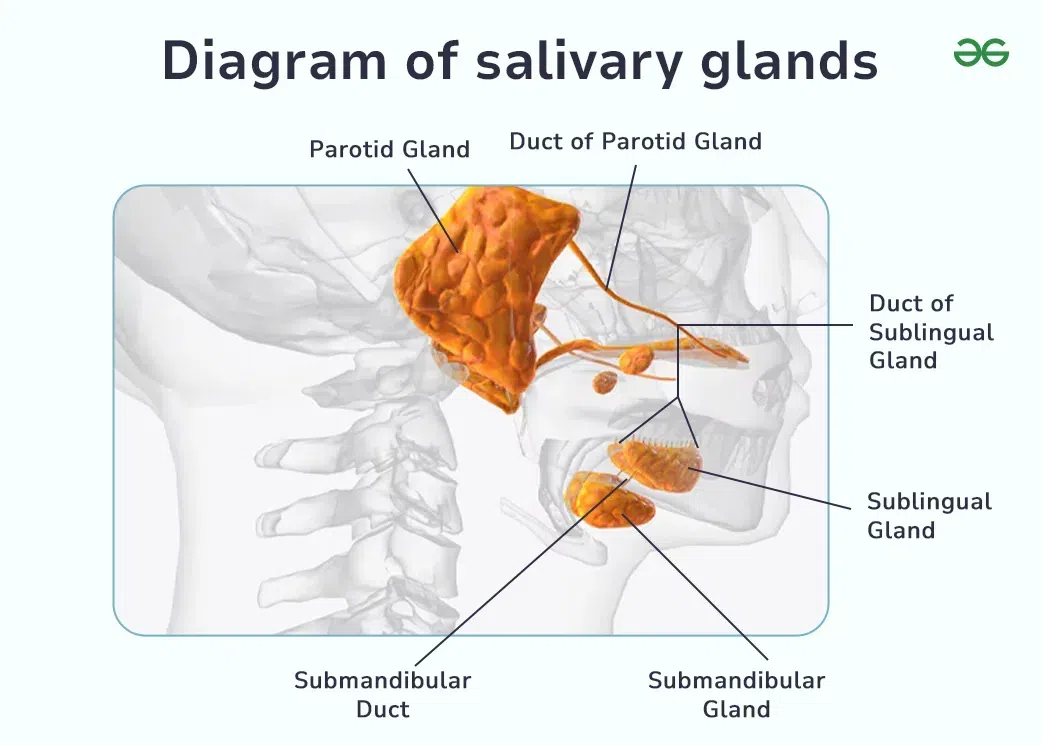
Functions of Salivary glands are given below:
- Helps in processing
- Helps to bite and gulp.
- Greasing up impact: saturates within the mouth and makes smoother discourse.
- Dissolvable impact: breaks down food and permits the tongue to taste food.
2. Pharynx
**Pharynx is a y-shaped fibromuscular tube attached at the mouth end terminal. It connects the mouth and oesophagus. Pharynx helps in passaging of crushed food from the mouth to the oesophagus. Pharynx also plays a crucial role in the respiratory system.

Functions of Pharynx are given below:
- Pharynx helps in passaging of crushed food from the mouth to the oesophagus.
- Pharynx also plays a crucial role in the respiratory system.
**Also Read: Difference Between Pharynx And Larynx
3. Oesophagus
Oesophagus is the long muscular tube, also known as the food pipe. Oesophagus connects with the pharynx. Chewed food is passed from the food pipe to the stomach. The moment of food in the food pipe is known as peristalsis.

Functions of Oesophagus are:
- Oesophagus connects with the pharynx.
- Chewed food is passed from the food pipe to the stomach.
- The moment of food in the food pipe is known as **peristalsis.
**Also Read: Difference Between Oesophagus And Trachea
**4. Stomach
The stomach is a solid organ situated on the left half of the upper mid-region (abdominal region). The stomach gets chewed food from the food pipe. As the food arrives at the end of the oesophagus, it enters the stomach through a valve called the Lower Oesophageal Sphincter (LES).

The stomach secretes various enzymes that digest food. The pyloric sphincter is a solid valve that opens to permit food to pass from the stomach to the small intestine. The stomach wall produces gastric juice (hydrochloric corrosive and digestive enzymes) that digests proteins.
- **Mucous: Mucous is produced by the mucous membranes. Mucous helps the stomach layer by protecting it from an acidic environment.
- **Digestive Enzymes: Various digestive enzymes are released in the stomach to digest food by converting complex food into simpler ones.
- **Hydrochloric Acid: HCl is released in the stomach and helps in breaking the food.
5. Small Intestine
The small intestine acquires most of the abdominal area. Villi are present on the inner surface of the small intestine which increases the absorption via increasing the surface area.
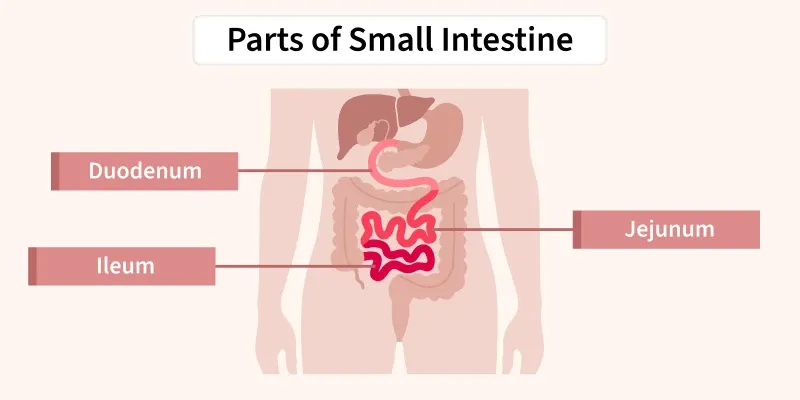
Functions of Small Intestine are given below:
- The small intestine is the thing long (10 feet) tube
- It is called little since it is around 3.5cm in width, yet giving heaps of region to absorption is around 5m long.
- A large portion of the substance processing of proteins, fats, and starches is finished in the small digestive system.
6. Large Intestine
The **large intestine is about **1.5 meters (5 feet) long and is responsible for absorbing water and salts from the remaining undigested food.
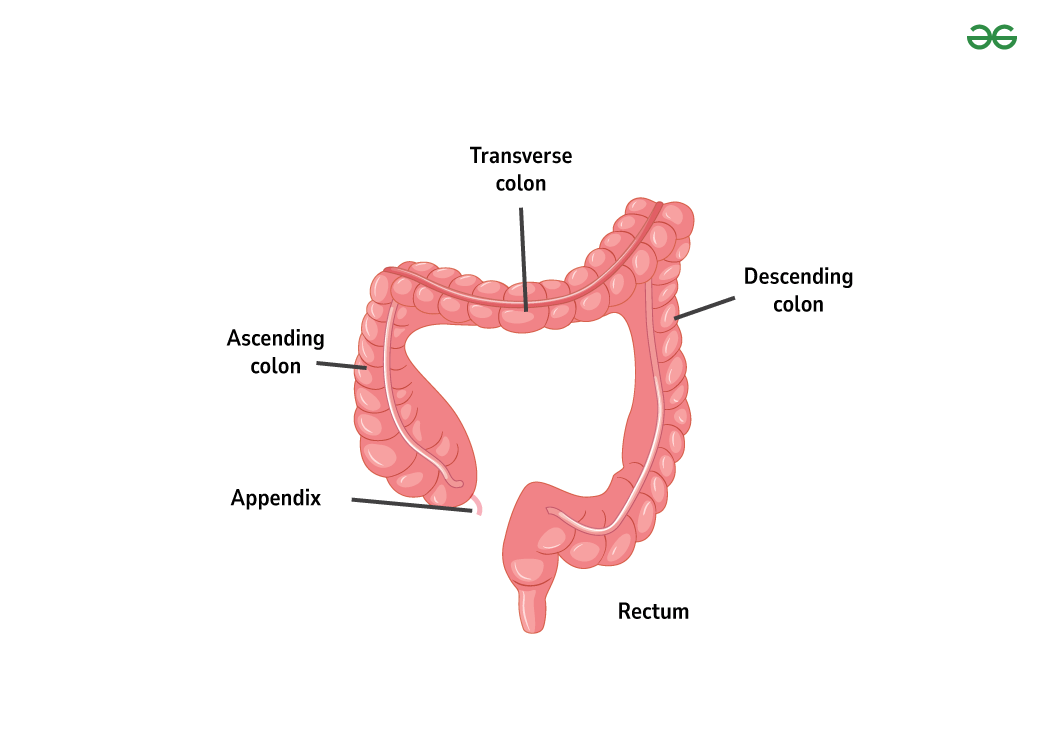
Functions of Large intestine are given below:
- Faecal matter is formed and put away in the last organ of the digestive organ (the rectum) prior to being dropped off the body through the rear end.
- The coating of the digestive organ retains water, mineral salts, and nutrients.
- Undigested fibre is blended in with bodily fluid and microscopic organisms, which halfway separate the fibre to support the cells of the digestive organ wall thus assisting with keeping the internal organ solid.
**Also Read: Difference Between Small Intestine And Large Intestine
**7. Rectum
The lower end of your internal organ, the rectum, stores stool until it pushes stool out of your butt during defecation. Characteristics of Rectum are given below:
- The rectum is the last step before the faecal matter is discharged out of the human body through the butt centric trench.
- The electrolytes, for example, sodium, potassium, and chloride are ingested and the unpalatable food fixings are deteriorated by anaerobic microorganisms, like the colon.
- The stool is thickened by the retention of water and blended in with bodily fluid.
Process of Digestion
Process of Digestion in Human beings is a complex process which involves various of step including:
- **Ingestion: This is first step in food digestion which involves uptake of food via mouth.
- **Mastication or mechanical digestion: In this process food is broken down into smaller pieces which makes it to process it faster through Digestive enzymes.
- **Carbohydrate breakdown in mouth: Enzyme known as amylase present in saliva start breaking down carbohydrate in mouth.
- **Swallowing of food: Food is now swallowed via oesophagus route is known as bolus.
- **Peristalsis: It is an involuntary muscular contraction which moves down food from oesophagus to stomach.
- **Stomach: After reaching to stomach, gastric juices and enzyme pepsin start breaking down food and protein into peptides.
- **Churning: Muscles present in stomach start contracting to mix the food and form as slurry known as **chyme.
- **Small Intestine: After chyme formation it enters into small intestine where pancreatic enzyme, bile juice and villi aids in digestion and absorption of nutrients, respectively.
- **Absorption of nutrients: Nutrients like carbohydrate, protein, amino acids, glycerol start absorbing from small intestine and reaches to liver.
- **Large intestine: Remaining food particle start forming faeces and water and electrolytes absorbed.
- **Elimination of faecal material: **Defecation is the process through which faecal material excreted from anus.
**Also Read: Salivary Gland
Regulation of the Human Digestive System
Your hormones and nerves cooperate to assist with controlling the stomach-related process. Signals stream inside your GI lot and this way and that from your GI parcel to your mind.
**Hormones
- Cells covering your stomach and small digestive system make and deliver chemicals that control how your stomach-related system functions.
- These chemicals let your body know when to make stomach-related squeezes and convey messages to your mind that you are eager or full.
- Your pancreas likewise makes chemicals that mean quite a bit to process.
**Nerves
- The human body has nerves that associate with the central nervous system cerebrum and spinal cord to the stomach-related system and control a few stomach related capabilities.
- For instance, when you see or smell food, your mind conveys a message that makes your salivary organs "make your mouth water" to set you up to eat.
Importance of the Human Digestive System
Absorption is significant for separating the food into supplements, which the body utilizes for energy, development, and cell fix. Food and drink should be changed into more modest particles of supplements before the blood retains them and conveys them to cells all through the body. The body separates supplements from food and drinks into starches, protein, fats, and nutrients.
**Also Read: Digestion and Absorption
Disorders of the Human Digestive System
Following are the various disorders related to the human digestive system those are:
| Disorders of the Human Digestive System | Description |
|---|---|
| Vomiting | It is the ejection of stomach contents from the mouth. A feeling of nausea precedes vomiting. A vomit centre is located in the medulla of the brain. |
| Constipation | the faeces are retained within the colon and the bowel movements occur irregularly. |
| Indigestion | Food is not properly digested which results in a feeling of fullness. The reasons for it include inadequate enzyme secretion, anxiety, food poisoning, overeating and spicy food. |
| Diarrhoea | It is the abnormal frequency of bowel movement and increased liquidity of the faecal discharge. Food absorption gets reduced. |
**Related Articles: