InSitu and ExSitu Conservation of Biodiversity (original) (raw)
In-Situ and Ex-Situ Conservation of Biodiversity
Last Updated : 24 Feb, 2026
Biodiversity refers to the variety of life on Earth, including plants, animals, and microorganisms. Rapid industrialisation, deforestation, pollution, and climate change have caused a serious decline in biodiversity. To protect and preserve living organisms, scientists use two major conservation strategies: In-situ conservation and Ex-situ conservation.

In-situ conservation mainly focuses on protecting the organism in its natural habitat, whereas ex-situ conservation mainly focuses on protecting the organism by relocating it into an ideal protective habitat. In-situ and ex-situ conservation both focus on the protection of an organism, however utilizing different means.
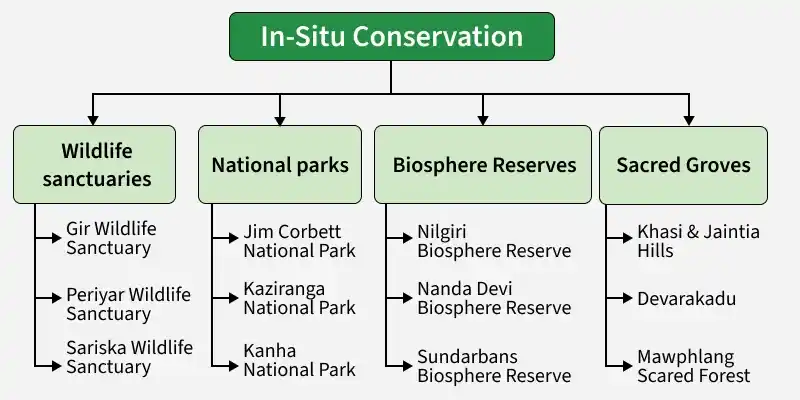
When we conserve and protect at all levels of biological organisation, that is, the whole ecosystem, the approach is known as in situ conservation. In this, the conservation of species is protected within their natural habitat. An in-situ conservation example can be to save the tiger; we save the whole forest. The protected areas where in situ conservation takes place are: wildlife sanctuary, national park, biosphere reserve, and sacred groves.
**1. Wild Life Sanctuary
- A wildlife sanctuary is a protected area where wild animals and birds are conserved and protected in their natural habitat.
- The capturing, killing, and poaching of animals are strictly prohibited. However, human activities like the collection of firewood, etc., are allowed to some extent.
- Wildlife sanctuaries can be created for particular species—for example, the Gir wildlife sanctuary to protect lions.
**2. National Park
- The national park protects the entire plant, animals, and landscape of the region.
- Cultivation of land, forestry, and grazing are not allowed at all.
- Human activities are strictly prohibited, for example, in the A Corbett National Park.
**3. Biosphere Reserve
- Biosphere Reserve is a large protected area for the conservation of wildlife, plant and animal resources, and traditional tribal life in the area.
- It contributes to the protection and preservation of the natural ecosystem and culture of the region.
- It may also contain other protected areas like wildlife sanctuaries or national parks.
- The Biosphere Reserve examples are Pachmarhi Biosphere Reserve, which contains Satpura National Park and Bori and Pachmarhi Wildlife Sanctuary.
**4. Sacred Groves
- Sacred groves are tracts of forested land that are protected by the community living around them.
- The community attaches some religious or cultural significance to the protected forest land.
- It helps protect many rare, threatened, and endemic plant and animal species found in a region—for example, the Khasi and Jantia hills in Meghalaya.
Advantages of In-situ Conservation
- The wildlife species are preserved within their natural habitat. They easily adjust and adapt to their surroundings.
- It conserves the entire ecosystem, not just one particular species.
- It is a more economical and convenient method.
- Useful in conserving large populations of a species
- The chances of recovery are high.
Disadvantages of In-situ Conservation
- Conditions that threaten the survival of the organism will still be present.
- The genetic diversity of the region may already have decreased.
- Endangered habitats may be fragmented and may affect the survival of the species.
Ex-situ Conservation of Biodiversity
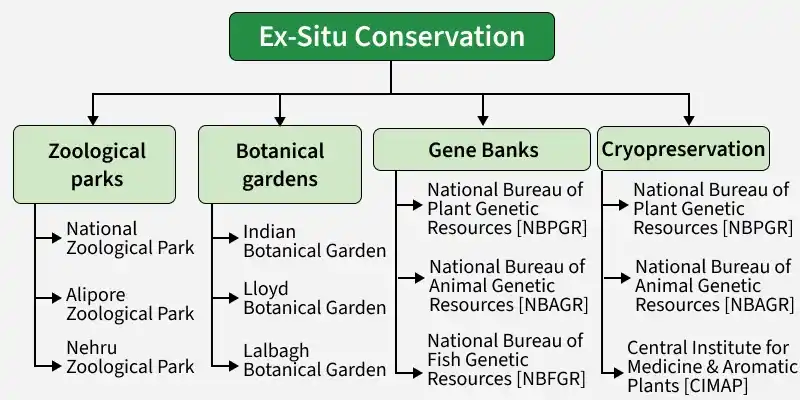
In ex-situ conservation, threatened animals and plants are taken out of their natural habitat and placed in a unique and ideal setting where they can be protected and given special care. Zoological parks, botanical gardens, gene banks, and cryopreservation serve the above purpose.
**1. Zoological Park
- A zoological park is a facility where animals are kept within enclosures for public display and are often bred for conservation purposes.
- Zoological parks increase the public interest in the understanding of wildlife and are centres for recreation and education, like the National Zoological Park, Delhi.
**2. Botanical Gardens
- A botanical garden is a garden specially meant for the collection, cultivation, preservation, and display of a wide variety of plants, which are typically labelled with their botanical names.
- They serve the purpose of scientific research, conservation, display, and education, like the National Botanical Garden, Lucknow.
**3. Gene Bank
- A gene bank is a biorepository that preserves the genetic material.
- It is a collection of seeds, plants, tissue cultures, etc., of potentially valuable species. It conserves the genetic diversity of wild and domesticated plants and animals, like the National Animal Gene Bank, Karnal.
**4. Cryopreservation
- Cryopreservation is the long-term process of keeping live cells, tissues, and other biological samples frozen at sub-zero temperatures for storage and preservation.
- The sample is commonly kept at −196°C. It preserves the biological material, and the genetic integrity of the material is stored like that present in IARI, New Delhi.
Advantages of Ex-situ Conservation
- It protects endangered species from external threats like predation and poaching.
- Selective breeding programs can be implemented.
- It is a focused approach, as the health of individual animals can be monitored.
- The genetic diversity of the population is preserved
- It is invaluable for research and public education.
- It has the potential to reintroduce organisms back into their natural habitat.
Disadvantages of Ex-situ Conservation
- The individual is living outside its natural habitat.
- Animals may not adjust to the new environment.
- Captive animal populations have limited genetic diversity.
- It is expensive to maintain.
- Animals may not survive reintroduction into the wild.