Isobilateral (Monocotyledonous) Leaf (original) (raw)
Last Updated : 10 Jun, 2026
A monocot leaf is the leaf of a monocotyledonous plant, whose seed contains a single cotyledon. It is an important photosynthetic organ responsible for food production, gaseous exchange, and transpiration. Monocot leaves typically exhibit parallel venation and are generally long, narrow, and isobilateral in structure. These features help the leaf perform photosynthesis efficiently while maintaining proper water balance.
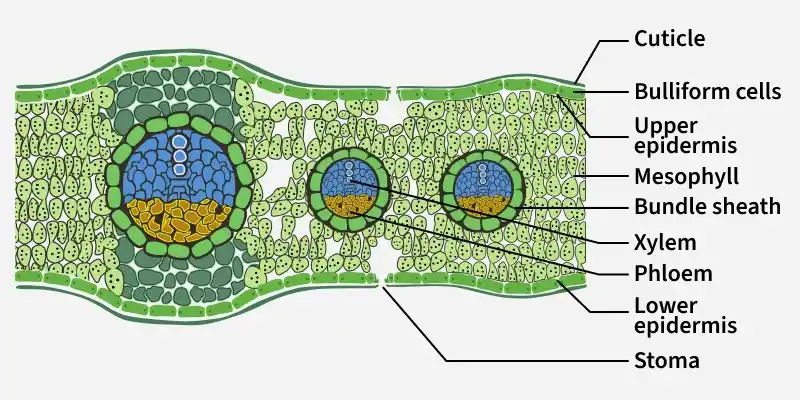
Structure of Monocot Leaf
The internal structure of a monocot leaf can be studied by observing a transverse section. Unlike the dicot leaf, the monocot leaf is generally isobilateral, meaning that the upper and lower surfaces are almost similar in structure and function. The internal tissues of the monocot leaf include the upper epidermis, mesophyll tissue, vascular bundles, bundle sheath, and lower epidermis.
Upper Epidermis
- The upper epidermis forms the outer protective covering of the upper surface of the leaf. It consists of a single layer of compactly arranged epidermal cells covered by a thick cuticle.
- The cuticle helps reduce water loss through transpiration and protects the leaf from mechanical injury and pathogen attack.
- A unique feature of many monocot leaves, especially grasses, is the presence of large, thin-walled cells known as **bulliform cells or motor cells. These cells are located in groups on the upper epidermis.
- Bulliform cells help in the rolling and unrolling of leaves during water stress. When water availability decreases, these cells lose water and shrink, causing the leaf to roll inward and reduce water loss. When sufficient water becomes available, the cells regain turgidity and the leaf unfolds.
- Stomata are present on the upper epidermis and facilitate gaseous exchange.
Mesophyll Tissue
- The mesophyll occupies the region between the upper and lower epidermis. It consists of chlorenchymatous parenchyma cells containing numerous chloroplasts.
- Unlike the dicot leaf, the mesophyll of a monocot leaf is generally undifferentiated, meaning it is not separated into palisade and spongy tissues. The mesophyll cells are relatively uniform in shape and distribution throughout the leaf.
- The chloroplast-rich mesophyll cells carry out photosynthesis and produce food for the plant. Small intercellular spaces among the cells allow the diffusion of gases necessary for photosynthesis and respiration.
Vascular Bundles
Numerous vascular bundles are scattered throughout the mesophyll tissue and are arranged in parallel rows corresponding to the pattern of venation. Each vascular bundle consists of xylem and phloem surrounded by a bundle sheath.
- **Xylem: The xylem is generally located toward the upper side of the vascular bundle and is responsible for conducting water and mineral salts from the roots to the leaves.
- **Phloem: The phloem is situated toward the lower side of the vascular bundle and transports food materials produced during photosynthesis to various parts of the plant.
- **Bundle Sheath: Each vascular bundle is surrounded by one or more layers of compactly arranged parenchymatous cells known as the bundle sheath. The bundle sheath provides mechanical support and regulates the movement of substances between the vascular tissues and mesophyll cells.
Lower Epidermis
- The lower epidermis forms the protective outer layer on the lower surface of the leaf. It consists of a single layer of compactly arranged epidermal cells covered by a cuticle.
- Stomata are present on the lower epidermis and are generally distributed almost equally on both surfaces of the leaf. This characteristic contributes to the isobilateral nature of monocot leaves.
- The lower epidermis protects the internal tissues and helps regulate gaseous exchange and transpiration.
Characteristics of Monocot Leaf
- The leaf exhibits parallel venation.
- The leaf is generally long, narrow, and elongated.
- The leaf is isobilateral, with similar upper and lower surfaces.
- The epidermis is covered by a protective cuticle.
- Bulliform cells are present in the upper epidermis.
- Stomata are present on both epidermal surfaces.
- The mesophyll is generally undifferentiated.
- Numerous vascular bundles are arranged in parallel rows.
- Each vascular bundle is surrounded by a bundle sheath.
- Vascular bundles are conjoint, collateral, and closed.
- The leaf sheath is usually well developed.
Functions of Monocot Leaf
- The primary function of the monocot leaf is the synthesis of food through photosynthesis. Chlorophyll present in the mesophyll cells captures sunlight and converts carbon dioxide and water into carbohydrates.
- Water is lost from the leaf through stomata in the form of water vapor. This process helps regulate temperature and assists in the upward movement of water through the plant.
- The stomata facilitate the exchange of oxygen and carbon dioxide between the plant and the environment.
- The vascular bundles transport water, minerals, and food substances throughout the plant body.
- The epidermis and cuticle protect the internal tissues from dehydration, pathogens, and physical damage.
- Bulliform cells help reduce excessive water loss by causing the leaf to roll during drought conditions.