Joints : Locomotion and Movement (original) (raw)
Last Updated : 25 May, 2026
Joints are the points of contact between two or more bones or between bones and cartilage. They are also known as articulations. Joints play a crucial role in the human body by allowing movement, providing flexibility, and maintaining the stability of the skeletal system. The type and structure of a joint determine the range and type of movement it can perform, varying from completely immovable to highly movable.

Joints can be classified into different categories based on their structure and the function they perform.
- Based on structure, the joint is classified into Fibrous joint, Cartilaginous joint, and Synovial joint
- Based on function, the joint is classified into synarthrosis, amphiarthrosis, and diarthrosis.
**Based on Structure
Based on the presence or absence of any supporting tissues or joint cavity, joints are classified into 3 types of joints:
**1. Fibrous Joint
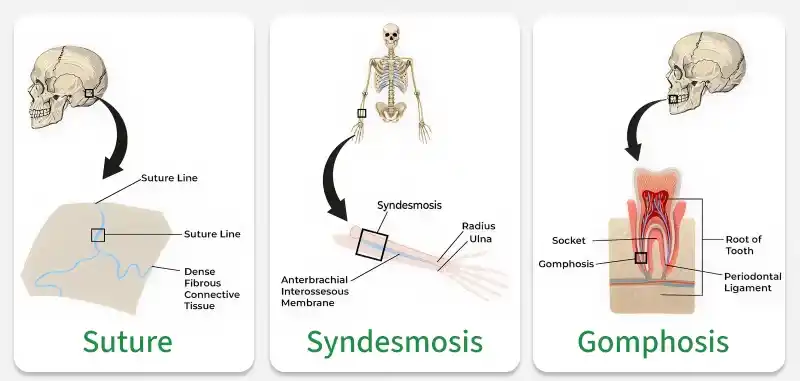
Fibrous joints are those in which bones are connected by dense fibrous connective tissue. These joints do not have a joint cavity and are usually immovable or allow very little movement. The strong collagen fibres hold the bones tightly together, providing stability.
- Sutures of the **skull: immovable joints
- **Gomphosis: attachment of teeth in sockets
- Syndesmosis: joint between tibia and fibula
These joints are mainly involved in protecting vital organs, such as the brain.
**2. Cartilaginous Joint
In cartilaginous joints, bones are connected by cartilage. These joints do not have a joint cavity and allow limited movement. They provide strength and flexibility and act as shock absorbers in certain parts of the body.
Cartilaginous joints are of two types:
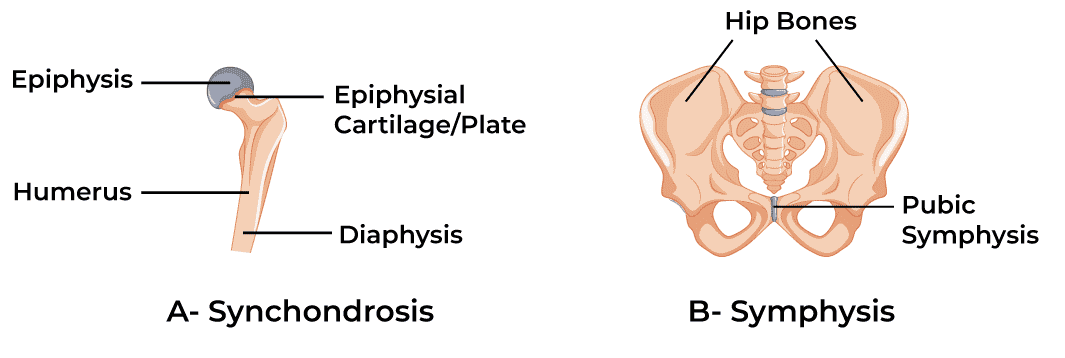
- **Synchondrosis: Bones are joined by hyaline cartilage. These joints are usually temporary and found in growing bones. Example: Epiphyseal plate in long bones
- **Symphysis: Bones are joined by fibrocartilage. These joints are permanent and allow slight movement. Examples: Pubic symphysis, intervertebral discs
**3. Synovial Joint
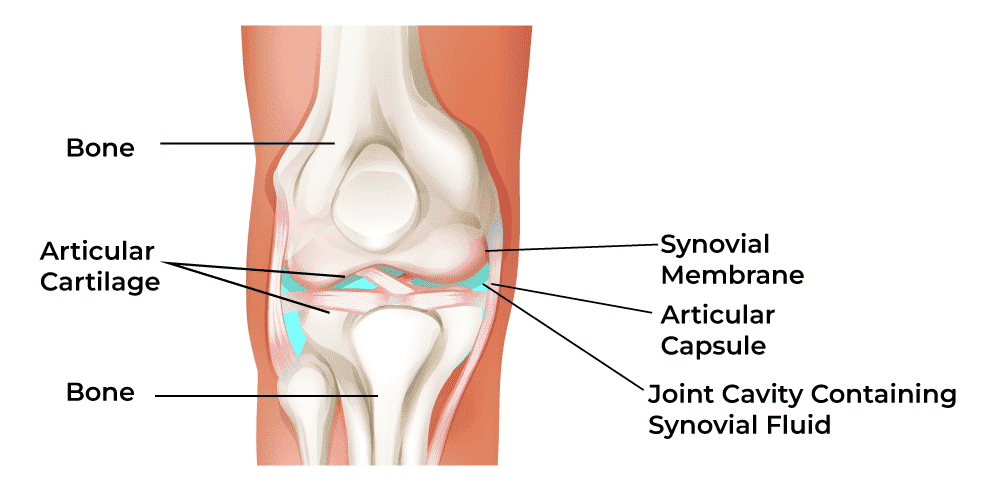
Synovial joints are the most movable type of joints in the human body. They are characterized by the presence of a joint cavity filled with synovial fluid. This fluid reduces friction between the articulating surfaces and allows smooth movement.
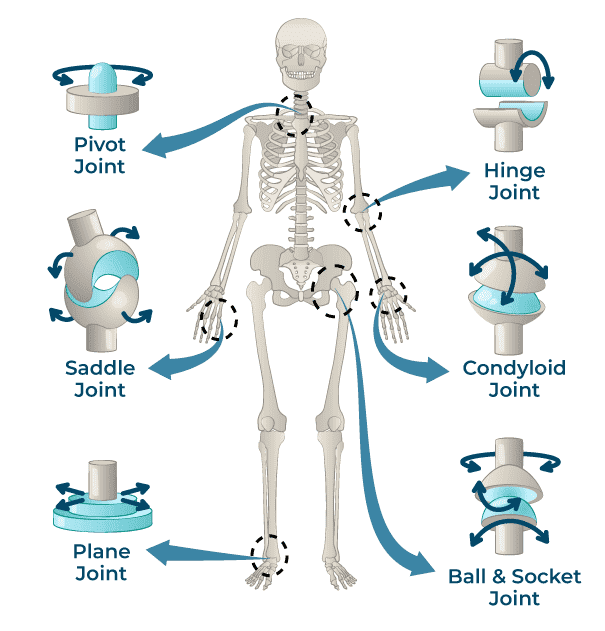
Synovial joints are of six main types based on their specific structure and range of motion:
- **Ball and socket: In this joint, the rounded head of one bone fits into the cup-like cavity of another bone. It allows movement in all directions, including rotation.Examples: Shoulder joint, hip joint
- **Pivot joint: In a pivot joint, one bone rotates around another, allowing rotational movement along a single axis.Example: Joint between atlas and axis vertebrae
- **Saddle joint: Saddle joints allow movement in two planes and provide greater flexibility than condyloid joints.Example: Joint at the base of the thumb
- **Condyloid or Ellipsoid joint: This joint allows movement in two directions (back-and-forth and side-to-side) but does not allow rotation. Examples: Wrist joint, joints of fingers
- **Gliding joint or Plane joint: In gliding joints, flat or slightly curved surfaces slide over one another, allowing limited movement in different directions. Examples: Joints between carpals (wrist) and tarsals (ankle)
- **Hinge joint: Hinge joints allow movement in one plane, similar to a door hinge. They permit flexion and extension.Examples: Elbow joint, knee joint
**Based on Function
The joints can also be classified into three types based on the degree of movement that the joints are allowed to show.
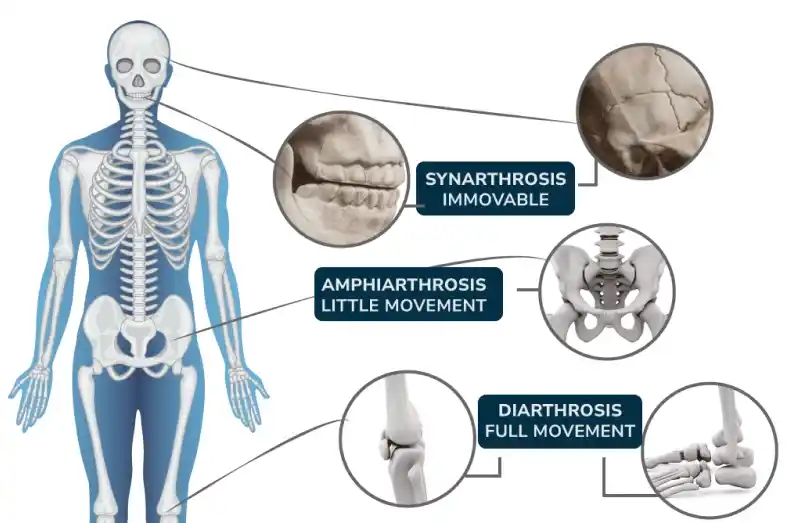
- **Synarthrosis/Immovable Joints: These joints do not allow movement and provide strong support and protection.Examples: Sutures of the skull
- Amphiarthrosis/Slightly Movable Joints: These joints allow limited movement and are usually connected by cartilage.Examples: Intervertebral joints, pubic symphysis
- **Diarthrosis/Freely Movable Joints: These joints allow free movement and include all synovial joints. Examples: Shoulder joint, hip joint, elbow joint