Krebs Cycle or Citric Cycle (original) (raw)
Last Updated : 3 Jun, 2026
The Krebs cycle is an important metabolic pathway of cellular respiration in which food molecules are completely oxidised to release energy. It occurs after glycolysis and plays a major role in the production of ATP, NADH, and FADH₂ required for cellular activities. The Krebs cycle takes place in the mitochondrial matrix of eukaryotic cells and is also known as the Citric Acid Cycle or Tricarboxylic Acid (TCA) Cycle.
It acts as a central pathway connecting the metabolism of carbohydrates, fats, and proteins in living organisms.
Location of the Krebs Cycle
The location of the Krebs cycle differs in prokaryotic and eukaryotic organisms.
- **In Eukaryotes: The Krebs cycle occurs in the mitochondrial matrix. Mitochondria are known as the powerhouses of the cell because most ATP production takes place inside them.
- **In Prokaryotes: Since prokaryotic cells do not possess mitochondria, the Krebs cycle occurs in the cytoplasm.
Before entering the Krebs cycle, pyruvate produced during glycolysis is transported into the mitochondria, where it undergoes oxidative decarboxylation to form acetyl-CoA.
Link Reaction (Formation of Acetyl-CoA)
The Krebs cycle cannot begin directly with glucose. First, glucose undergoes glycolysis in the cytoplasm to produce pyruvate. Pyruvate then enters the mitochondria and is converted into acetyl-CoA through a process called oxidative decarboxylation. During this reaction one molecule of carbon dioxide is released, NAD⁺ is reduced to NADH, and Acetyl-CoA is formed. The reaction is catalysed by the pyruvate dehydrogenase complex.
Steps of the Krebs Cycle
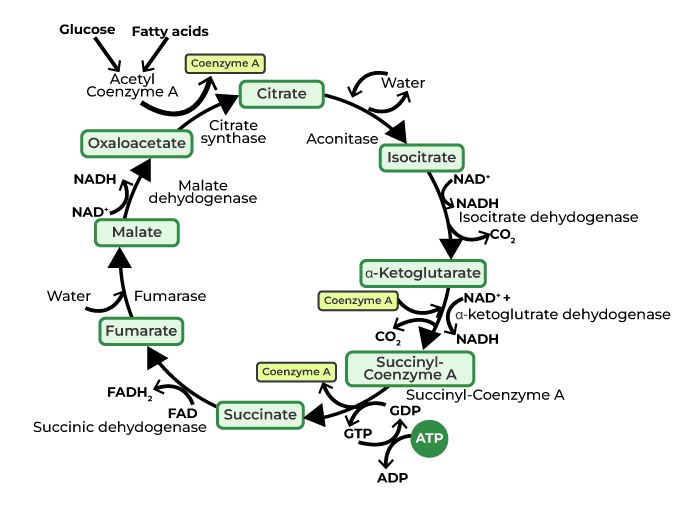
The Krebs cycle consists of a sequence of enzyme-mediated reactions.
- **Step 1 – Formation of Citrate: The cycle begins when acetyl-CoA, a two-carbon compound, combines with oxaloacetic acid, a four-carbon compound, to form citrate or citric acid, a six-carbon compound. This reaction is catalysed by the enzyme citrate synthase.
- **Step 2 – Formation of Isocitrate: Citrate is converted into its isomer, isocitrate, through the action of the enzyme aconitase. This step involves dehydration followed by hydration.
- **Step 3 – Formation of Alpha-Ketoglutarate: Isocitrate undergoes oxidative decarboxylation in the presence of the enzyme isocitrate dehydrogenase. During this step one molecule of carbon dioxide is released, NAD⁺ is reduced to NADH, and Alpha-ketoglutarate, a five-carbon compound, is formed.
- **Step 4 – Formation of Succinyl-CoA: Alpha-ketoglutarate undergoes another oxidative decarboxylation reaction catalysed by the alpha-ketoglutarate dehydrogenase complex. During this step one molecule of carbon dioxide is released, NAD⁺ is reduced to NADH, and Succinyl-CoA, a four-carbon compound, is formed.
- **Step 5 – Formation of Succinate: Succinyl-CoA is converted into succinate by the enzyme succinyl-CoA synthetase. During this reaction, one molecule of GTP or ATP is produced by substrate-level phosphorylation.
- **Step 6 – Formation of Fumarate: Succinate is oxidised into fumarate by the enzyme succinate dehydrogenase. During this step FAD is reduced to FADH₂. Succinate dehydrogenase is attached to the inner mitochondrial membrane and also participates in the electron transport chain.
- **Step 7 – Formation of Malate: Fumarate is converted into malate through the addition of water. This hydration reaction is catalysed by the enzyme fumarase.
- **Step 8 – Regeneration of Oxaloacetate: Malate is oxidised to oxaloacetate by the enzyme malate dehydrogenase. During this step NAD⁺ is reduced to NADH. The regenerated oxaloacetate is now ready to combine with another molecule of acetyl-CoA, and the cycle repeats.
Products of the Krebs Cycle
For each molecule of acetyl-CoA entering the cycle, the following products are formed 2 molecules of carbon dioxide, 3 molecules of NADH, 1 molecule of FADH₂, and 1 molecule of ATP or GTP. Since one molecule of glucose produces two molecules of acetyl-CoA, the Krebs cycle operates twice for each glucose molecule. Thus, complete oxidation of one glucose molecule through the Krebs cycle produces 4 CO₂, 6 NADH, 2 FADH₂, and 2 ATP
Equation of the Krebs Cycle
The overall simplified equation of the Krebs cycle is:
2Acetyl CoA + 6NAD+ + 2FAD + 2 ADP + 2Pi +2 H2O → 4CO2 + 6NADH + 2FADH2 + 2ATP + 2CoA
Importance of the Krebs Cycle
The Krebs cycle is extremely important because it is the major energy-producing pathway in aerobic organisms.
- It is the final common pathway for the oxidation of carbohydrates, fats, and proteins.
- It generates high-energy electron carriers required for oxidative phosphorylation.
- It provides energy necessary for growth, movement, transport, and biosynthesis.
- It supplies intermediates for several anabolic pathways.
- It helps maintain metabolic balance in the cell.
- Defects in enzymes of the Krebs cycle may lead to serious metabolic and neurological disorders.