NCERT Solutions of Class12 Biology Chapter5: Molecular Basis of Inheritance (original) (raw)
Last Updated : 23 Jul, 2025
Molecular Basis of Inheritance Class 12 NCERT Solution is all about the process of inheritance at the molecular level. These NCERT Solutions are prepared by our Top Biology Experts in order to take care of all Important Topics that might be asked in the upcoming examination 2023. So, Students can also refer to these solutions for their final Examination preparation.
This Class 12 Biology Chapter 2 Molecular Basis of Inheritance NCERT Solutions are carefully developed using easy-to-understand language while adhering to the guidelines for solving NCERT Chapter-Wise Solutions for Class-12. Working through these solutions can be highly beneficial for students in their board exams, as well as in preparing for future competitive Exams.
Molecular Basis of Inheritance Class 12 Questions and Answers
NCERT CBSE Chapter 05 **Molecular Basis of Inheritance of Class 12 explains about the genetic material i.e., DNA, inheritance pattern, and genetic basis of those patterns. The basic knowledge of DNA and RNA, how genetic information transfers from one generation to the other. Revise the basic concepts of the **Molecular Basis of Inheritance for quick revision and class notes.
**Q1: **Group the following as nitrogenous bases and nucleosides:
**Adenine, Cytidine, Thymine, Guanosine, Uracil, and Cytosine.
**Answer:
A **Nitrogenous base is a molecule that contains nitrogen and has the chemical properties of a base. So, among the molecules listed above, **Adenine, Cytosine, Uracil & Thymine are called nitrogenous bases because they contain nitrogen atoms. The lone pairs of electrons on these nitrogen atoms are critical for binding DNA together.
Whereas, the molecules, **Cytidine & Guanosine mentioned above fall in the group of **Nucleosides because they are made of a nitrogenous base and a five-carbon carbohydrate ribose.
**Q2: If a double-stranded DNA has 20% of cytosine, calculate the percent of adenine in the DNA.
**Answer:
According to **Chargaff's rules, the amount of adenine(A) is equal to the amount of thymine(T) and the amount of cytosine(C) is equal to the amount of guanine(G).
So, **A = T and G = C
Hence if a dsDNA has 20% cytosine, then the amount of guanine will be the same i.e. 20% (G + C = 40%) Thus the remaining 60% will be formed by the remaining base pairs i.e. adenine and thymine. [A + T = 60%, (30% each)]
Hence the amount of Adenine in a dsDNA is 30%.
**Q3. If the sequence of one strand of DNA is written as follows:
**5'-ATGCATGCATGCATGCATGCATGCATGC-3'
**Write down the sequence of the complementary strands in the 5'→ 3' direction.
**Answer:
Adenine always pairs with thymine and cytosine always pairs with guanine. So, if the sequence of DNA is
5'-ATGCATGCATGCATGCATGCATGCATGC-3'
The sequence of the complementary strand will be
3`- TACGTACGTACGTACGTACGTACGTACG - 5`.
So, in a 5' - 3' strand, it would be
**5'- GCATGCATGCATGCATGCATGCATGCAT-3'
**Q4. If the sequence of the coding strand in a transcription unit is written as follows:
**5'-ATGCATGCATGCATGCATGCATGCATGC-3'. Write down the sequence of mRNA.
**Answer:
If the sequence of the coding strand in a transcription unit is
5’- ATGCATGCATGCATGCATGCATGCATGC-3’
Then, the template strand in a 3’ to 5’ direction would be
3’ – TACGTACGTACGTACGTACGTACGTACG-5’
As we all know that the sequence of mRNA is the same as the coding strand of DNA. But in RNA, Uracil replaces thymine. Hence, the sequence of mRNA will be
**5’- AUGCAUGCAUGCAUGCAUGCAUGCAUGC-3’
**Q5: **Which property of DNA double helix led Watson and Crick to hypothesize a semi-conservative mode of DNA replication? Explain.
**Answer:
The complementary base pairing property of DNA double helix led **Watson & Crick to hypothesize a semi-conservative mode of DNA replication. Semi-conservative mode of replication produces two copies, each containing one original strand and one new strand. This means that every double helix in the new generation of an organism consists of one complete “old” strand and one complete “new” strand wrapped around each other.

**Q6: **Depending upon the chemical nature of the template (DNA or RNA) and the nature of nucleic acids synthesized from it (DNA or RNA), list the types of nucleic acid polymerases.
**Answer:
There are two different types of nucleic acid polymerases:
- DNA-dependent DNA polymerases
- DNA-dependent RNA polymerases
- RNA-dependenta RNA polymerase
- RNA-dependent DNA polymerase
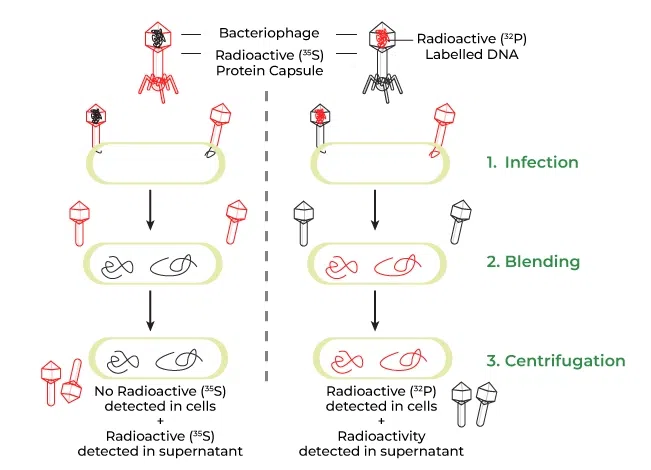
**Q7: How did Hershey and Chase differentiate between DNA and protein in their experiment while proving that DNA is the genetic material?
**Answer:
**Hershey & Chase cultured bacteriophage in two different media. One contained radioactive phosphorus (32P) and the other media contained radioactive sulfur (35S). Phosphorous is a component of the nucleotides and it forms the nucleic acid whereas sulfur is a component of amino acids methionine and cysteine, that form the protein. Now the two samples of bacteriophage were allowed to infect its host cell i.e., E. coli. After infection, the samples were analyzed for radioactivity in the host cells. For analysis, the virus and bacteria were separated via centrifugation. Since the protein coat was lighter, it was found in the supernatant while the infected bacteria got settled at the bottom of the centrifuge tube. Hence, it was proved that DNA is the genetic material as it was transferred from virus to bacteria.
**Q8: Differentiate between the followings:
**a) Repetitive DNA & satellite DNA
**b) mRNA & tRNA
**c) Template strand & Coding strand
**Answer:
a) Difference between repetitive DNA & Satellite DNA:
**Repetitive DNA **Satellite DNA Repetitive DNA are tandem repeats or interspersed repeats Satellite DNA is micro-satellite or mini-satellite Repetitive DNA forms light bands. It forms small dark bands. It doesn't show polymorphism. Shows polymorphism.
**b) Difference between mRNA & tRNA:
**mRNA **tRNA It forms the connection between genes & protein It provides correct amino acids to the ribosomes. It has a linear structure It has a cloverleaf structure. It carries genetic information from the nucleus to the ribosome It carries amino acids to ribosomes. It consists of codons. It consists of anticodons.
**c) Difference between Template strand & Coding Strand:
**Template Strand **Coding Strand Template strand refers to the DNA sequence that can duplicate itself during mRNA synthesis. The coding strand is the DNA strand whose base sequence is similar to its primary transcript (RNA). It runs from 5’ to 3’ It runs from 3’ to 5’ It contains anticodons. It contains codons.
**Q9: List two essential roles of the ribosome during translation.
**Answer:
Ribosomes have the following roles during translation:
- Responsible for protein synthesis.
- Act as a catalyst during the formation of peptide bonds.
**Q10: In the medium where E. coli was growing, lactose was added, which induced the lac operon. Then, why does the lac operon shut down sometime after the addition of lactose in the medium?
**Answer:

Lac operon is a segment of DNA that works in a coordinated manner to metabolize lactose into galactose & glucose. As mentioned above, the lac operon acts as an inducer. So, it binds to the repressor & inactivates it leading to RNA polymerase binding to the promoter region. Hence, three structural enzymes express their product & respective enzymes are produced. After some time when the level of the inducer decreases, it causes the synthesis of repressor from the regulator gene. Now repressor binds to the operator gene & prevents RNA polymerase from transcribing the operon. Hence, the transcription is stopped.
**Q11: Explain (in one or two lines) the function of the following:
**a) Promoter
**b) tRNA
**c) Exons
**Answer:
Functions of the following:
- **Promoter: A promoter is a region of DNA that helps in initiating the process of transcription. It serves as the binding site for RNA polymerase.
- **tRNA: It acts as an adapter molecule for linking amino acids to its specific codon present in mRNA.
- **Exons: Exons are the protein-coding sequences of RNA that serve to carry genetic information from DNA to proteins.
**Q12: Why is the Human Genome project called a mega project?
**Answer:
The human genome project is called a mega project because:
- The sequencing of each and every nucleotide base pair present in the human genome took around 13 years it's complete.
- The aim of this project was to develop new technology and new information in the field of genomic studies.
- It was a large-scale project and provided opportunities in the field of genetics, biotechnology, and medical sciences.
- Also, it provided clues regarding the understanding of human biology. Hence, it was considered a mega project.
**Q13: What is DNA Fingerprinting? Mention its application.
**Answer:
DNA fingerprinting is a technique that shows the genetic makeup of living things. It is a method of finding the difference between the satellite DNA regions in the genome.
**Application of DNA Fingerprinting is:
- It is used in forensic science to identify potential crime suspects.
- It is used to establish paternity and family relationships.
- It is used to identify and protect the commercial varieties of crops and livestock.
- It is used to find out the evolutionary history of an organism and trace out the linkages between groups of various organisms.
**Q14: Briefly describes the following:
**a) Transcription
**b) Polymorphism
**c) Translation
**d) Bioinformatics
**Answer:
- **Transcription: The process by which a cell makes an RNA copy of a piece of DNA. This RNA copy, called messenger RNA (mRNA), carries the genetic information needed to make proteins in a cell. It carries the information from the DNA in the nucleus of the cell to the cytoplasm, where proteins are made.
- **Polymorphism: Polymorphism means "many forms", and it occurs when we have many classes that are related to each other by inheritance. Inheritance lets us inherit attributes and methods from another class. Polymorphism uses those methods to perform different tasks.
- **Translation: Translation is the process of translating the sequence of m RNA into a sequence of amino acids. Translation takes place during protein synthesis.
- **Bioinformatics: Bioinformatics is an emerging branch of biological science that emerged from the combination of both biology and information technology. It is an interdisciplinary field of study that uses Biology, Chemistry, Mathematics, Statistics, and Computer Science that have merged to form a single discipline. Bioinformatics is mainly used to extract knowledge from biological data through the development of algorithms and software.