Parts of a Flower and Their Functions (original) (raw)
Last Updated : 17 Mar, 2026
The flower is the specialized reproductive structure of angiosperms (flowering plants). Its primary purpose is to facilitate sexual reproduction by producing gametes, enabling pollination, and ensuring fertilization. Ultimately, the flower transforms into fruits and seeds to ensure the continuation of the species. A typical flower is composed of four distinct whorls: sepals, petals, stamens, and carpels.

Flowers are classified based on the presence of their floral parts:
- **Complete Flower: Contains all four whorls (sepals, petals, stamens, and pistils).
- **Incomplete Flower: Lacks one or more of these essential structures.
Structurally, these parts are categorized into Vegetative (accessory) and Reproductive (essential) organs.
Vegetative Part of a Flower
The vegetative part of a flower includes the sepals and petals, which are primarily involved in protecting the developing bud and attracting pollinators, respectively. These components are not directly related to the reproductive function of the flower but contribute to its overall structure and function. They are defined as follows:
**1. Calyx (Sepal)
The outermost green protective whorl of the plant is known as the calyx. The unit of the calyx is a sepal. The initial layer in the flower structure is the calyx. They are said to be modified leaves. Hence, the collection of sepals is called the calyx. The sepal or calyx is green in colour, and its chief function is to protect the flower. It encloses the unopened bud. They protect the flower in the bud stage and may remain at the base even after the flower blooms.
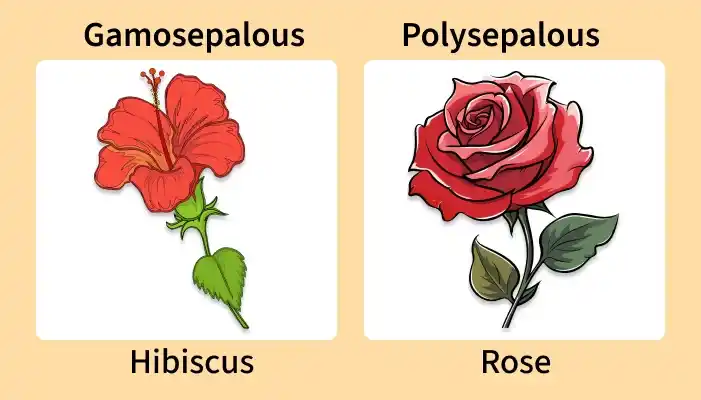
**Types of Calyx
- **Gamosepalous: sepals united.
- **Polysepalous: sepals free.
2. Corolla (Petal)
A corolla is the second accessory whorl of a flower made up of petals. The collection of petals is known as the corolla. It is just beneath the calyx. Petals are usually brightly coloured to attract insects for pollination calyx and corolla together form the perianth, the non-reproductive portion of the flower. The corolla part of the flower varies greatly in plants in shape and colour. It may be tubular-shaped, funnel-shaped or wheel-shaped.
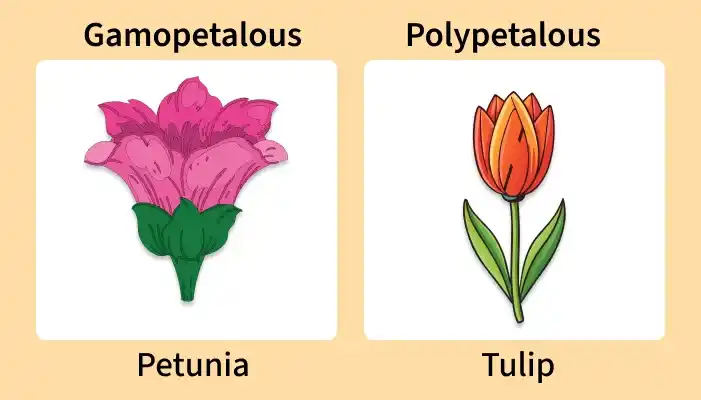
**Types of Corolla
- **Gamopetalous: petals united
- **Polypetalous: petals free
**Functions of the Corolla
- **Pollination: Since the corolla is the attractive part of a flower and the petals are brightly coloured moreover, it releases an aromatic smell which catches the insect's attention, like birds, bees, etc those help in the pollination of the flower and are known as pollinating agents.
- **Protection of essential Whorl: Corolla protects the essential whorl, i.e., androecium and gynoecium, the reproductive parts of a flower that participate in the fertilisation of the flower to produce fruit.
- **Storage Part: Petals function as the storage house of sugar-rich nectar, attracting pollinating agents.
- **Reproduction: The corolla does not directly take part in fertilization but helps to attract pollinating agents and perform pollination. Its main function is to assist in the reproductive process of a plant. Reproduction in plants occurs by the method of pollinationfollowed by fertilisation.
Reproductive Part of a Flower
The reproductive part of a flower consists of the stamens and the pistil (or carpel). Stamens are the male reproductive organs, producing pollen containing male gametes. The pistil is the female reproductive organ, containing the stigma, style, and ovary, where the female gametes (ovules) are located. These parts play a central role in pollination and fertilisation, ensuring the plant's reproduction.
**1. Androecium
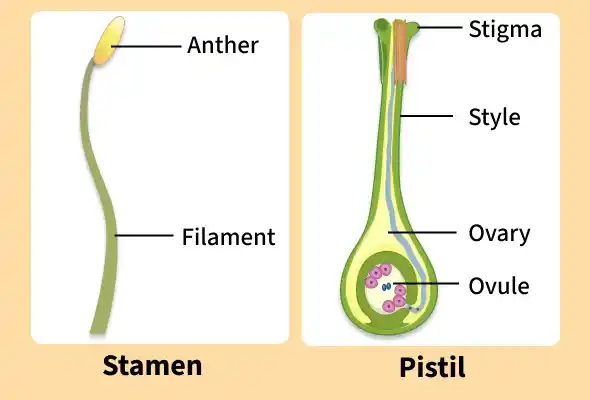
The androecium is an essential whorl of the plant, and it is considered as male reproductive organ of the plant. It consists of a stamen****,** each of which consists of an anther and a filament that produces a pollen grain. Collectively, the stamens form the androecium. Pollen grains are produced in pollen sacs.
- A staminode is a sterile stamen that does not produce pollen and cannot participate in reproduction. For example Caesalpinioideae family.
- When stamens are attached to the petals, the condition is called Epipetalous. For example Brinjal, or Epiphyllous.
- when stamens are attached to the perianth, the condition is called epiphyllous. For example Lily.
**Function of Androecium
- **Production of Pollen Grains: Its main function is to produce microspores, i.e., pollen grains containing male gametes within anther lobe. The androecium serves the purpose of fertilisation in flowering plants.
- **Pollination: Androecium consists of stamens, which have 2 parts: anther and filament. Anther helps to protect, store and produce pollen grain and the filament holds the anther up. These parts help the pollinating agents to perform pollination.
**2. Gynoecium
The gynoecium is the second essential whorl of the plant, or the innermost whorl, and is considered a female reproductive organ of the plant. It is surrounded by the androecium. The structural unit of the gynoecium is the carpel. It consists of three parts: Stigma, Style and Ovary.
**Parts of Gynoecium
- **Stigma: The stigma is the uppermost part of the gynoecium. It has a sticky or receptive surface that receives pollen grains during pollination.
- **Style: The Style is a tube like structure through which the pollen grains move towards the ovary.
- Ovary: The lower swollen part of the gynoecium is known as the ovary. The ovary consists of the ovule, and within the ovule, an embryo sacis present where double fertilisation takes place.
**Types of Gynoecium (Based on Carpels)
- **Apocarpous: When two or more carpels are free and not fused. For examples, Rose, Lotus.
- **Syncarpous: When two or more carpels are fused together.For examples, Mustard, Tomato.
**Function of Gynoecium
- **Fertilisation: Fertilisation takes place in the gynoecium. The gynoecium develops into seeds and fruits after fertilisation.
- **Protection: Gynoecium plays an important role in producing and protecting ovules.
Parts of Flower and Function
| **Flower Parts | **Function |
|---|---|
| Receptacles | Provides support for the floral organs and serves as the attachment point for the other floral parts. |
| Sepals | Protect the developing flower bud during the budding stage |
| Petals | Attract pollinators like bees and butterflies to aid in pollination |
| Stamens | Male reproductive part of a flower |
| Carpel | The female reproductive part of a flower |
Functions of Flower
- The primary function of a flower is to facilitate the reproduction of the plant by producing seeds through pollination and fertilization.
- Flowers use their colours, fragrances, and nectar to attract pollinators such as bees, butterflies, birds, and insects, which aid in the transfer of pollen between flowers.
- Sepals, the outermost part of a flower, protect the developing bud from damage, harsh weather, and herbivores.
- Flowers facilitate the process of fertilisation by bringing together pollen from the stamens to the stigma of the pistil, allowing for the fusion of male and female gametes.
- After successful fertilisation, flowers develop seeds within the ovary, which can later be dispersed for the growth of new plants.
- Flowers contribute to biodiversity by supporting a wide range of pollinators and providing essential resources for various species within ecosystems.
- Some flowers, such as those of fruit-bearing plants, develop into fruits that protect and nourish the seeds, making them more appealing to animals for dispersal.