Phylum Annelida (original) (raw)
Last Updated : 5 Feb, 2026
Phylum Annelida includes a group of bilaterally symmetrical, triploblastic, and coelomate animals commonly known as segmented worms. The body of annelids is divided into a series of ring-like segments called metameres, which show a high level of organisation. These animals are found in marine, freshwater, and terrestrial habitats.
Classification of **Phylum Annelida
Based on the number and presence or absence of setae, the phylum Annelida is divided into three classes.
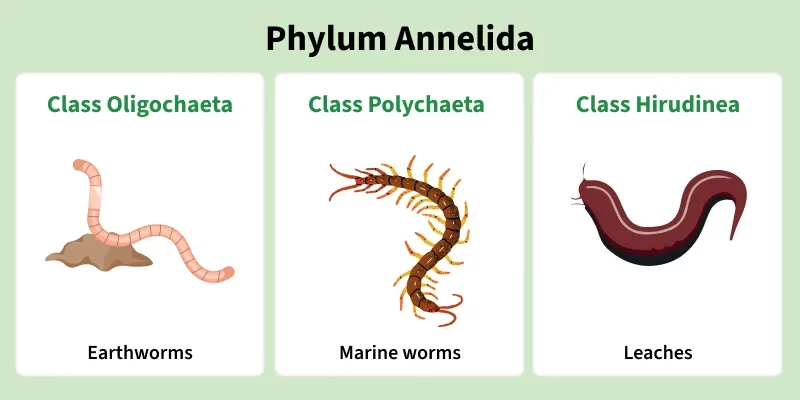
**1. Polychaeta
- They are mostly marine and have highly developed parapodiawith numerous setae.
- The development is indirect, undergoing metamorphosis with a free-swimming trochophore larva.
- Examples: Nereis (Clam worm or sandworm or Ragworm), Aphrodite (Sea mouse), Chaetopterus (Paddle worm), Sabella (peacock worm), Arenicola (lugworm), Amphitrite, Terebella, Serpula(Fanworm).
**2. Oligochaeta
- They are semi-terrestrial or freshwater annelids.
- They have a few setae.
- Clitellumis present.
- There is no metamorphosis.
- Example: Pheretima, Lumbricus, Tubifex.
**3. Hirudinea
- They are ectoparasitic annelids.
- The clitellum is formed only during the breeding season.
- Surrounding the alimentary canal is found botryoidal tissue.
- Example: Hirudinaria, Pontobdella, Hirudo.
Characteristics of Phylum Annelida
The phylum Annelida exhibits the following key characteristics:
- Annelids occur in freshwater, seawater, or moist soil. Some are free-living, some are burrowing, and a few are parasitic.
- Organ-level body organisation.
- The first animal to acquire a true coelom.
- Both longitudinal and circular muscles are present.
- Straight and complete alimentary canal.
- Excretion with the help of nephridia.
- The first animal to have a closed circulatory system.
- Blood is red due to haemoglobin dissolved in plasma.
- The mode of respiration is cutaneous respiration through moist skin.
- Locomotion organs are segmentally arranged paired lateral appendages, parapodia, chitinous setae, or chaetae.
- Sex may be unisexual (nereis) or may be bisexual (Earthworm).
- Fertilisation is external or internal.
- Development is direct or indirect, and there is a free-swimming larval stage(trochophore).
- The nervous system consists of a dorsal “brain” and a ventral nerve cord, having ganglia and lateral nerves in each body segment.
**Examples of Phylum Annelida
Some of the Examples of the phylum Annelida are given below:
**1. Nereis
- It is commonly called a clam worm, or sandworm, or ragworm.
- Nereis is unisexual, and its reproductive phase is called Heteronereis****.**
- During development, a trochophorelarva is present.
- Each segment bears laterally one pair of fleshy projections, the parapodia****,** used in swimming.
- They are cylindrical in shape, found not only in sandy areas, and they are adapted to burrowing.
**2. Hirudinaria (Bloodsucking leech)
- It is a facultative ectoparasiteof cattle.
- It is sanguivorous****.**
- Its saliva contains an anticoagulant called hirudin.
- The body cavity is filled with a mesodermal botryoidal tissueformed of branching tubular cells
**3. Pheretima (Earthworm)
- It is found in wet soil containing rich organic matter.
- It is omnivorous, fossorial, nocturnal, hermaphrodite, and protandrous.
- Furthermore, it possesses a great power of regeneration.
- Earthworm is brown or clay-colored due to the pigment porphyrin.
- The body shows metamorphic segmentation.
- The digestive system consists of the alimentary canal and digestive glands.
- The blood vascular system of earthworms is a closed type.