Phylum Aschelminthes (original) (raw)
Last Updated : 5 Feb, 2026
Aschelminthes, also known as Nematoda, is a group of bilaterally symmetrical, triploblastic, and pseudocoelomate animals. They are commonly called roundworms because of their cylindrical, elongated body shape. These organisms may be free-living or parasitic and are found in soil, water, plants, animals, and humans.

Ascaris lumbricoides is an endoparasite of the small intestine of human beings. Ascaris shows sexual dimorphism. Males are smaller than females. The posterior end of the male is curved. Female Ascaris has a separate anus and genital aperture. Spicules are absent in female Ascaris. Adult Ascaris lives for about 9 to 12 months in the host.
Characteristics of Phylum Aschelminthes
Some of the characteristics of the phylum Aschelminthes are given below:
- Many roundworms live as parasites in plants and animals.
- A large number of nematodes are free-living and occur in freshwater, seawater and soil.
- They are called roundworms because they appear circular in cross-section. They are unsegmented.
- The body cavity is pseudocoelor pseudocoelom****.**
- Digestive Tract is completewith an anterior mouth and posterior anus with the muscularpharynx****.**
- Skeletal****,** respiratoryand circulatorysystemsare absent. Pseudocoelomic fluid present in the pseudocoelom maintains body shape.
- Ammonia is the main excretory matter. Ascaris excretes both ammonia and urea.
- The nervous system consists of a circumpharyngeal ring that gives rise to nerves, forwards as well as backwards.
- Papillae and amphids are present on the lip and phasmids on the posterior end of the body.
- The roundworms are usually dioecious(unisexual). Generally, they show sexual dimorphism.
- Fertilisation is internal. There is no asexual reproduction.
**Classification of Phylum Aschelminthes
Aschelminthes is classified into 2 classes, i.e., Aphasmidia and Phasmidia.
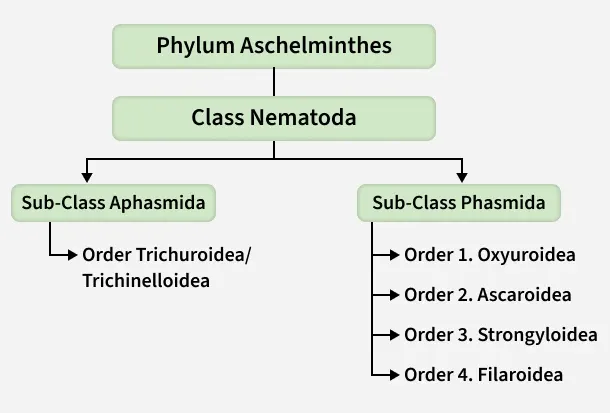
**1. Aphasmidia
- Phasmids are absent.
- Excretory organs are reduced or absent.
- **Examples: Trichinella, Trichuris, etc.
**2. Phasmidia
- Phasmids are present.
- Excretory organs are well developed.
- **Examples: Ascaris, Enterobius, Ancylostoma, Wuchereria, etc.
**Examples of Achelminthes
**Ascaris: Ascaris lumbricoides is an endoparasite of the small intestine of human beings. It is more common in children. Ascaris shows sexual dimorphism. Males are smaller than females. Adult Ascaris lives for about 9 to 12 months in the host.
**Ancylostoma (The hookworm): It is found as an endoparasite in the small intestine of human beings, and Ancylostoma duodenale (Hookworm) causes acute anaemia.
**Wuchereria (The Filaria worm): Adult Wuchereria bancrofti lives as an endoparasite in the lymphatic vessels and lymph nodes of human beings(primary host). The mosquito(certain species of Cupex and Aedes mosquitoes) is the intermediate host. Thus, its lifecycle is digenetic.
**Dracunculus (The Gunlea worm): It occurs in the subcutaneous tissue of man. When the host comes in contact with cold water, the female worm found below the skin releases larvae in the water.
**Diseases caused by Aschelminthes
Aschelminthes are known to cause various diseases in plants, animals and also humans. Some of the diseases are:
**1. Ascariasis
- The causal agent of this disease is Ascaris lumbricoides in humans.
- It is very common in children.
- Symptoms of Ascariasis are abdominal pain, diarrhoea, and vomiting.
- This disease is a kind of roundworm infection.
**2. Ancylostomiasis
- It is caused due to hookworm infection in the small intestine.
- It causes anaemia.
- Worms live in the small intestine in large numbers.
- It gets stuck to its intestinal wall and causes anaemia by sucking blood.
**3. Filariasis
- It is caused by roundworms.
- Lymphatic filariasis is caused by Wuchereria bancrofti, Brugia timori and Brugia malayi.
- It causes thickening of the skin and tissue present beneath the skin.
**4. Enterobiasis
- Enterobiasis is caused by the pinworm Enterobiasis vermicularis.
- Itching in the anal area and sleeping discomfort are caused by this disease.