Post Fertilization Events in Flowering Plants (original) (raw)
Last Updated : 18 May, 2026
Post-fertilisation events in flowering plants refer to the series of developmental changes that occur after fertilisation inside the ovule. Fertilisation in angiosperms is unique because of double fertilisation, which results in the formation of a diploid zygote and a triploid primary endosperm nucleus.
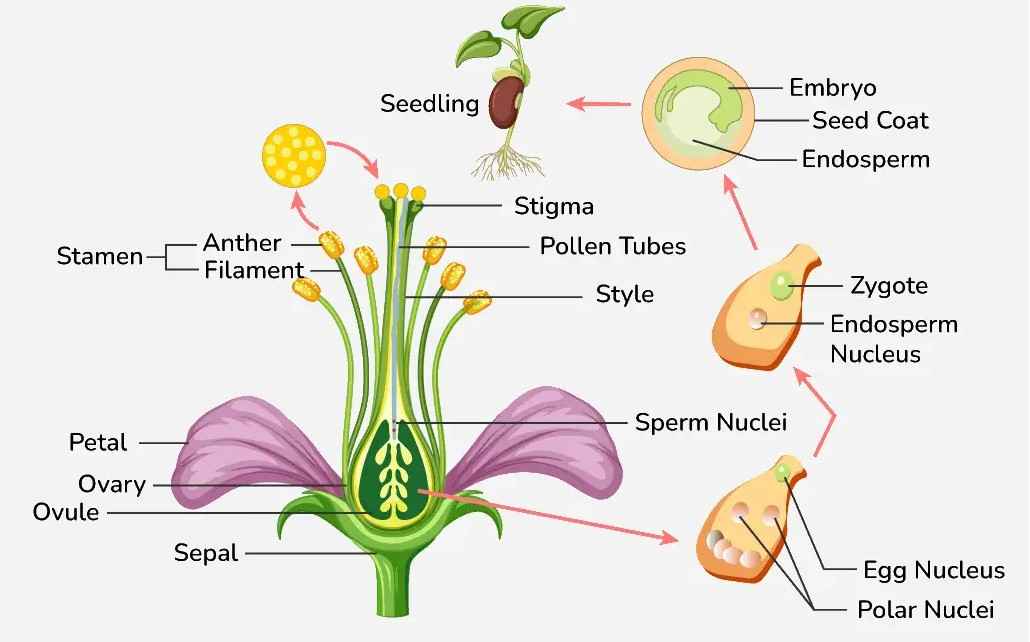
Following double fertilisation, the events of endosperm development, embryo development, maturation of ovules into seeds, and transformation of the ovary into fruit are collectively known as post-fertilisation events.
Development of Endosperm
The second fertilisation event leads to the formation of the primary endosperm nucleus (3n) by the fusion of a male gamete with two polar nuclei. The endosperm develops before the embryo and serves as a source of nutrition. The primary endosperm nucleus (PEN) divides repeatedly to form the triploid endosperm tissue.
- **Free-nuclear endosperm: This is the most common type of endosperm development. The PEN undergoes successive nuclear divisions to give rise to free nuclei. Cell walls are not formed immediately after nuclear division. This stage of endosperm development is called free-nuclear endosperm.
- **Cellular endosperm: Cellular endosperm is a type of endosperm development found in flowering plants in which cell wall formation occurs after every nuclear division of the primary endosperm nucleus. As a result, the endosperm is cellular right from the beginning, and no free-nuclear stage is present.
- **Helobial endosperm:In helobial endosperm, the first division of the primary endosperm nucleus is followed by wall formation, dividing the embryo sac into two chambers. It is less common and is typically seen in some monocotyledonous plants.
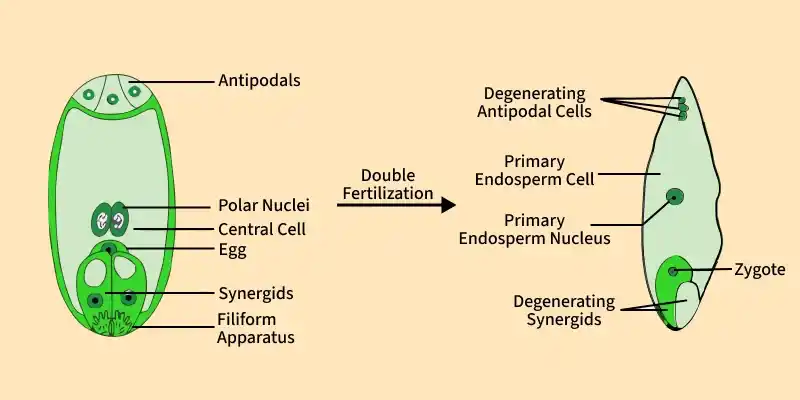
Endosperm can vary in composition and structure across different plant species. In some plants, such as monocots like corn and wheat, the endosperm remains as a significant component of the mature seed, serving as a starchy food reserve. In contrast, in dicots like beans and peas, the endosperm is often absorbed by the developing embryo during seed maturation, with the cotyledons taking over its nutritive role.
Development of Embryo
The embryo develops at the micropylar end of the embryo sac, where the zygote is situated. Most zygotes divide only after a certain amount of endosperm is formed. This adaptation provides assured nutrition to the developing embryo. Although mature seeds differ greatly, the early stages of embryogeny are similar in both monocotyledons and dicotyledons.
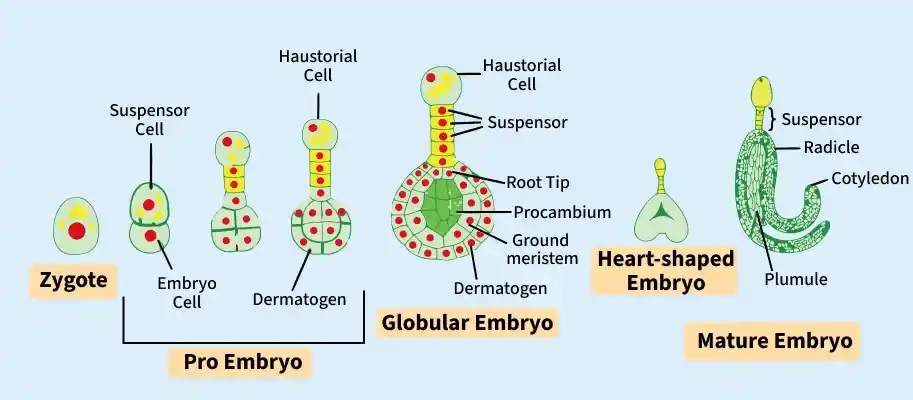
The zygote gives rise to the proembryo, which subsequently develops into the globular, heart-shaped, and mature embryo.
- **Pro-embryo: The first division of the zygote is transverse, forming: Terminal cell (forms the embryo proper) and Basal cell (develops into the suspensor).
- **Globular Embryo: Embryo becomes spherical due to rapid cell divisions. Differentiation of the three primary tissue systems begins: Protoderm, Ground meristem, and Procambium.
- **Heart-shaped Embryo: Two cotyledonary primordia appear, giving a heart-shaped appearance and bilateral symmetry becomes established during this stage.
- **Mature Embryo: Embryo becomes fully differentiated and remains inactive until germination. The seed dehydrates and enters dormancy.
Development of the Seed
Seed development in flowering plants begins after fertilisation and involves a series of well-coordinated changes in the ovule that lead to the formation of a mature seed. After fertilisation, the ovule develops into a seed, and the integuments of the ovule form the seed coat, which consists of two layers: the outer testa and the inner tegmen.
A mature seed consists of the seed coat, the embryo, and the endosperm. In some seeds, such as black pepper and beet, remnants of the nucellus are also persistent. This residual, persistent nucellus is the perisperm.
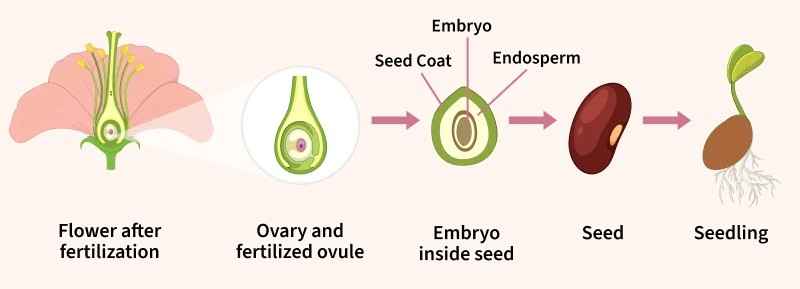
Based on the presence or absence of endosperm, seeds are classified into two types that are given below.
- Endospermic seeds(Albuminous Seeds): These are seeds in which the endosperm does not get consumed completely, and also provide nourishment to growing embryos along with the cotyledon. Examples include Maize, Wheat, Rice, Coconut, etc.
- Non-endospermic seeds(Ex-Albuminous Seeds): these are those seeds in which the cotyledon develops properly and the endosperm gets consumed completely. The growing embryo is nourished by the cotyledon. Examples include pea, gram, bean, and groundnut.
Development of Fruits
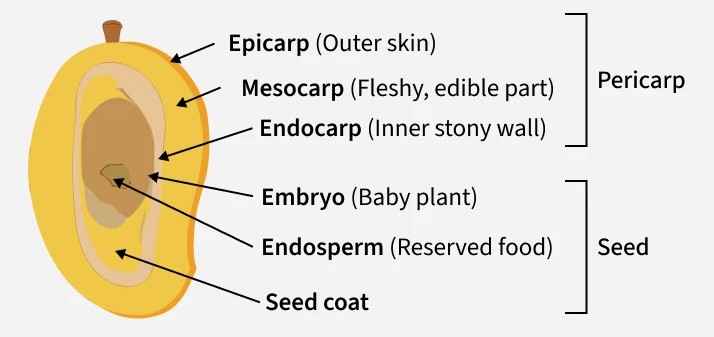
After fertilisation, the ovary develops into a fruit. This process is known as fruit development and plays an important role in the protection and dispersal of seeds. The outermost part of the fruit or covering over the seed is known as the pericarp. Mostly, the edible part of the fruit is the pericarp. The pericarp is composed of 3 layers known as:
- **Epicarp: The outermost skin of the fruit is known as the epicarp, also known as the exocarp.
- **Mesocarp: The fleshy part of the fruit. It is present between the epicarp and endocarp.
- **Endocarp: The innermost layer of the pericarp that surrounds the seed is known as the endocarp.
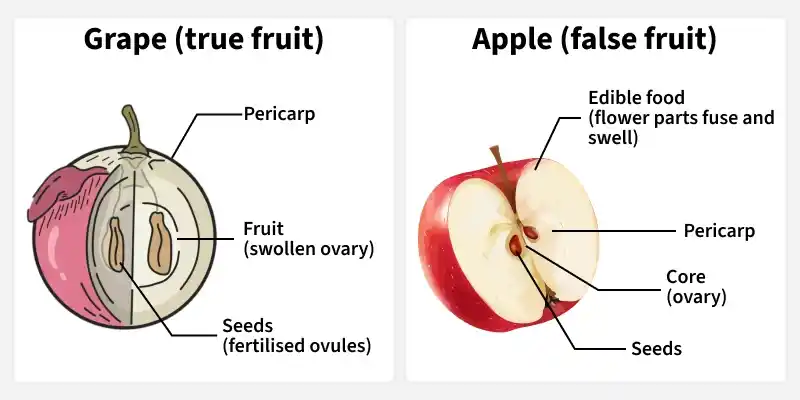
Based on whether fruit develops from the ovary or not, fruits are classified into two types that are given below:
- **True Fruit- True fruits are those that develop solely from the ovary. Mango, tomato, and coconut are examples of true fruits.
- **Pseudocarp or False Fruit- The fruit is not formed by the ovary in some fruits. Some flower parts, such as the thalamus, inflorescence, and calyx, are modified to become a part of the fruit. These are referred to as false fruits. Apple, strawberry, and other fruits are examples.
Parthenocarpy
Some plants produce fruits that either do not have seeds or have non-viable seeds. Such fruits are called parthenocarpic fruits or seedless fruits. These fruits are produced without fertilisation of the ovule. Some common examples of Parthenocarpy can be seen in different types of bananas, grapes, seedless watermelons, eggplants, etc.