Protein Structure Primary, Secondary, Tertiary, Quaternary (original) (raw)
Last Updated : 12 Jul, 2022
Biomolecules, additionally called natural particles, are any of various substances that are created by cells and living creatures. Biomolecules have many sizes and designs and play out an immense range of capabilities. The four significant sorts of biomolecules are fat, lipids, nucleic acids, and proteins. Among biomolecules, nucleic acids, in particular DNA and RNA, have the extraordinary capability of putting away a creature's hereditary code — the succession of nucleotides that decides the amino corrosive grouping of proteins, which are of basic significance to life on Earth.
There are 20 distinct amino acids that can happen inside a protein; the request where they happen assumes a basic part in deciding protein design and capability. Proteins themselves are major underlying components of cells.
Functions of biomolecule
Biomolecules are fundamental for life as it helps organic entities to develop, maintain, and recreate. They are associated with building organic entities from single cells to complex living creatures like people, by communicating with one another. The variety in their shape and design gives variety in their capabilities**.**
Types of biomolecule
Carbohydrates, lipids, nucleic acids, and proteins are types of biomolecules.
Carbohydrate
Starches are an imperative piece of a solid eating routine. They give the energy expected to take care of business. Experimentally, it's a polyhydroxy aldehyde or polyhydroxy ketone. Carbohydrates are the most bountiful biomolecules on the planet.
Types of Carbohydrates and Their Functions
- Monosaccharides: These are made out of a solitary unit of polyhydroxy aldehyde or ketone. Monosaccharides are dull, glasslike solids that are totally solvent in water.[1] They are associated with creating energy for the body. Models incorporate glucose, fructose, ribose, and arabinose.
- Disaccharides: These are made out of two units of sugars joined by O-glycosidic bonds. A rundown of disaccharides with their monomer units and capabilities is given beneath.
- Polysaccharides: These comprise in excess of two sugar monomer units. They are otherwise called glycans. They are of two sorts, Homopolysaccharides and Heteropolysaccharides.
Proteins

Proteins are unbranched polymers of amino corrosive deposits. There are around 22 amino acids that are associated with the blend of proteins as per their area and function. Proteins are sorted into four gatherings relying upon their primary association. Protein structure is defined as a polymer of amino acids joined by peptide bonds.
Classification of Proteins
Proteins can be classified into two types- fibrous and globular protein
- Fibrous Proteins: When the polypeptide chains run equal and are kept intact by hydrogen and disulfide bonds, then, at that point, the fiber-like construction is formed. Such proteins are for the most part insoluble in water. These are water-insoluble proteins. Example - keratin (present in hair, fleece, and silk) and myosin (present in muscles),
- Globular proteins: This design results when the chains of polypeptides loop around to give a round shape. These are typically dissolvable in water. Example - Insulin and albumins are normal instances of globular proteins.
Protein Structure
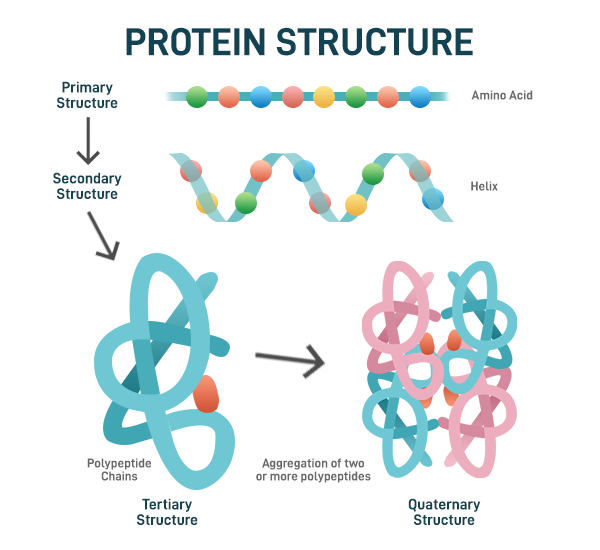
Primary structure
The primary structure is the different formation and order in which the amino acids (the building blocks) mix and link to give us a protein molecule. Protein gets all its properties from its primary structure. Each protein determines by the sequencing of the amino acids. The development and order of these amino acids in proteins are very specific. If we alter even one amino acid in the chain it brings about a non-working protein or what we call a gene mutation.
Secondary structure
It is a collapsed structure inside a polypeptide that is because of the development of hydrogen connections between amide hydrogen and the carbonyl oxygen of the peptide backbone. It incorporates structures like alpha-helix and beta-sheet.
- α-helix: The backbone follows a helical structure. The hydrogen bonds with the oxygen between the different layers of the helix give it this helical structure.
- β-pleated sheet: the polypeptide chains are stacked next to each other and their outer hydrogen molecules form intramolecular bonds to give it a sheet-like structure
Tertiary structure
It is three-layered compliance that is shaped because of the collaboration between R-gatherings or side chains of the amino acid.
Quaternary Structure of Protein
Proteins are made out of at least two polypeptide chains refer to as sub-units. The spatial arrangements of these subunits regarding each other is known as quaternary structure.
Numerous proteins, the vast majority of which are chemicals contain organic or elemental components required for their action and stability. Hence the investigation of protein advancement gives primary understanding as well as interfaces proteins of very various parts of the metabolism.
Rules of Protein Structure
The sort determines the functions of a protein.
A protein's not entirely settled by its primary structure.
The amino acid succession inside a not entirely settled by the encoding grouping of nucleotides in the gene (DNA).
Functions of proteins
- Proteins are fundamental parts of organic entities.
- It is in pretty much every cycle inside cells.
- It is associated with the cycles of DNA replication, cell flagging, catalyzing metabolic responses, development of cell and tissue designs, and transportation of atoms.
- They act as a messenger so help in the cell signaling
- Provide structure and support.
Nucleic acid
Nucleic acids are macromolecules present in cells and infections, and they are engaged with the capacity and move of hereditary data. The nucleic corrosive was first found by Friedrich Miescher in quite a while of leukocytes. Later, further examinations showed that it's a combination of essential proteins and phosphorus-containing natural corrosive.
Lipids
Lipids are natural mixtures that are insoluble or inadequately solvent in the water yet solvent in natural solvents (like breaks down like) like ether, Benzene, and chloroform. These are composed of fatty acids, an attachment platform for fatty acids, a phosphate, and an alcohol attached to phosphate. They are part of the cell membrane of organisms.
Conceptual Questions
Question 1: What makes up protein structure?
Answer:
A protein's essential structure refers to the amino acid succession in the polypeptide chain.
Question 2: What are the 4 types of protein structure?
Answer:
The total structure of a protein can be depicted at four unique degrees of intricacy: primary, secondary, tertiary, and quaternary structure.
Question 3: What is the protein formula?
Answer:
Protein perpetually has the overall equation RCH(NH2)COOH, where C is carbon, H is hydrogen, N is nitrogen, O is oxygen, and R is a gathering, differing in synthesis and structure, called a side chain.
Question 4: What are protein structure functions?
Answer:
Proteins overlap up into explicit shapes as per the succession of amino acids in the polymer, and the protein capability is straightforwardly connected with the subsequent 3D structure
Question 5: What is globular protein give examples?
Answer:
This structure results when the chains of polypeptides coil around to give a spherical shape. These are usually soluble in water. Example – Insulin and albumins are common examples of globular proteins.