Protochordates (original) (raw)
Last Updated : 16 Feb, 2026
Protochordates are a group of simple, primitive chordate animals that show some basic chordate characteristics but lack a well-developed backbone. They act as a connecting link between invertebrates and vertebrates, helping us understand the evolution of higher animals. This phylum's organisms have a notochord at some point in their life cycle.
**Classification of Phylum Protochordates
Protochordates possess a notochord, a supporting structure that provides strength to the body, either throughout life or during certain stages of development. They are classified into three subphyla based on the nature and persistence of the notochord.
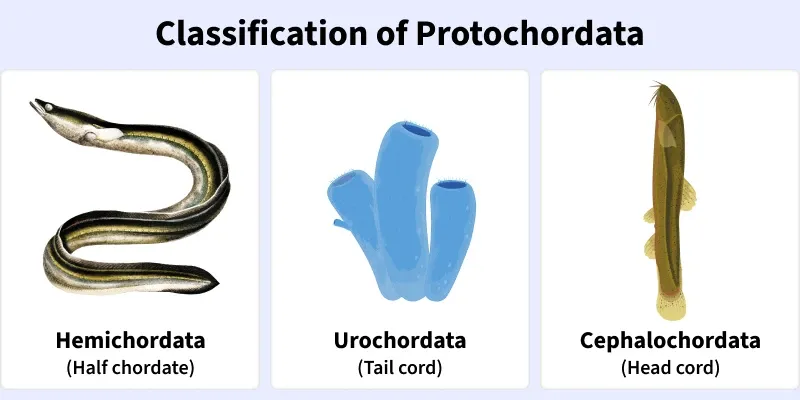
The subphyla of Protochordates are given below:
**1. Hemichordata
- Hemichordata are all marine organisms. Some live in solitary confinement, while others may be colonial.
- Their bodies are unsegmented, cylindrical, and stout, giving them a worm-like appearance. They are bilaterally symmetrical and triploblastic. The body wall is composed of a single layer of epidermis and smooth longitudinal fibres.
- Hemichordata may have tentacles or arms after the collar, but locomotory appendages are absent.
- Their circulatory systems are comprised of a dorsal heart and longitudinal dorsal and ventral vessels.
- Hemichordata's blood is colourless and devoid of corpuscles.
- The body of hemichordata has a broad surface that allows for easy breathing. Otherwise, breathing is accomplished through a pair or multiple pairs of gill slits.
- The excretory system includes the glomerulus, or proboscis gland.
- Hemichordata's nervous system is made up of an epidermal plexus of nerve cells as well as nerve fibres.
- Hemichordate sexes can be united or separated, and gonads can exist in multiple pairs or just one.
- Example: Cephalodiscus, Balanoglossus, and Rhabdopeura.
**2. Cephalochordata
- Cephalochordata are also filter feeders and marine organisms.
- Cephalochordata's tails remain throughout their lives.
- Their body wall is made up of myotomes, which gives them a fish-like appearance.
- Cephalochordata do not develop a brain and instead rely on the nerve cord throughout their lives.
- Their notochord remains intact throughout their lives, reaching up to the head or cephalic region.
- Excretion occurs in Cephalochordata via paired protonephridia with solenocytes (a type of flagellated cell).
- They have a lot of gill stilts, which they keep even when they're adults. These lead to the atrium.
- Cephalochordata have been observed burrowing and swimming freely.
- Example: Amphioxus.
**3. Urochordata
- This subphylum's organisms are also known as tunicates because their bodies are surrounded by a leathery sheath known as tunicin.
- They are mostly marine organisms that are sessile and filter-feeders.
- The notochord appears in the tail of these organisms during the larval stage but is absent in the adult.
- Retrogressive metamorphosis refers to a phenomenon in which larvae are much more developed than adults.
- The larva has a neural tube, whereas adults have a dorsal ganglion.
- The respiratory system of these organisms is made up of gills.
- These organisms' circulatory systems are open, which means that the tissues are washed directly by blood.
- Budding is the mode of reproduction in these organisms.
- Example: Herdmania and Selpa.
**Characteristics of Phylum Protochordates
The main characteristics of Phylum Protochordates are listed below:
- Protochordates are aquatic animals and are mostly marine.
- They are triploblastic, having three germ layers: ectoderm, mesoderm, and endoderm.
- They are coelomate organisms, possessing a true body cavity surrounded by mesoderm.
- They show an organ-system level of organization.
- At some stage of their life cycle, their body possesses a long, rod-like supporting structure called a notochord.
**Protochordates VS Vertebrates
The following table compares the main features of protochordates and vertebrates:
| Protochordates | Vertebrates |
|---|---|
| Primitive animals with a simpler body organization | More advanced animals with complex organization |
| Backbone absent | Backbone present |
| Notochord present at some or all life stages and does not form vertebrae | Notochord present in embryo and develops into vertebral column |
| Less specialization of tissues and organs | Highly specialized tissues and organ systems |
| **Examples: tunicates and lancelets | **Examples: fishes, amphibians, reptiles, birds, and mammals |