Rhodophyceae (original) (raw)
Last Updated : 7 May, 2026
Red algae belong to the class Rhodophyceae and are mostly marine algae found in warm coastal waters. They are called red algae because of the presence of the red pigment phycoerythrin, which gives them their characteristic colour. Rhodophyceae are considered one of the most advanced groups of algae. Examples of Rhodophyceae include Gracilaria, Gelidium, Porphyra, and Polysiphonia.
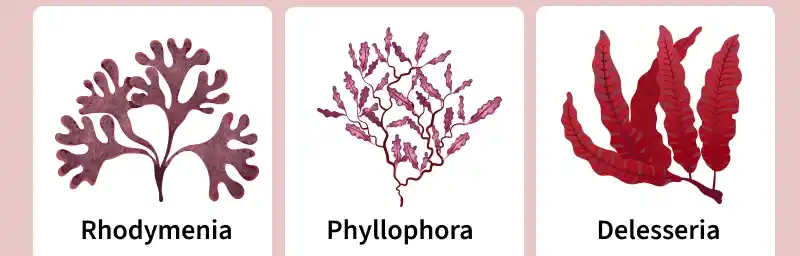
**Morphology of Red Algae
Red algae can range in morphology from being unicellular to having complex parenchymatous and non-parenchymatous thallus. Red algae possess a cell wall with an inner cellulose layer and an outer mucilaginous layer containing polysaccharides such as agarose and agaropectin. These substances can be extracted to produce agar, which is widely used in food and microbiological industries. The majority of the inside walls are made of cellulose. Additionally, their plastid genomes are the most gene-rich ones yet found.
**Cell Structure
- Red algae do not have centrioles and do not have flagella during their whole life cycle.
- The presence of normal spindle fibres, microtubules, unstacked photosynthetic membranes, phycobilin pigment granules, pit connections between cells, filamentous genera, and the lack of chloroplast endoplasmic reticulum defines red algal cell structure.
**Chloroplast
- The phycobilins (phycocyanobilin, phycoerythrobilin, phycourobilin, and phycobiliviolin), which are contained within phycobilisomes, give red algae their distinctive colour.
- In the chloroplast, thylakoids are evenly dispersed and ungrouped. Other pigments include lutein, zeaxanthin, a and b-carotene, and chlorophyll.
- The double membrane of the chloroplast envelope encloses the chloroplast.
- The absence of grana and the attachment of phycobilisomes to the stromal surface of the thylakoid membrane are two further traits that set red algal chloroplasts apart from other types.
**Pit Connections
- Red algae can be identified by their pit connections and pit plugs, which develop during the cytokinesis process following mitosis. In red algae, cytokinesis is not present. In the majority of situations, the centre of the newly formed division is left with a small pore.
- The pit connection is created in the areas where the daughter cells are still in contact. Shortly after the pit connection is formed, a pit plug forms and is deposited in the wall gap that connects the cells, blocking cytoplasmic continuity.
- Cells that have a common parent cell form primary pit connections because apical development is the norm; the majority of red algal cells have two principal pit connections, one to each subsequent cell.
**Storage Products
- Among the most significant photosynthetic products are Floridoside (the main product), Disofloridoside, digeneaside, mannitol, sorbitol, dulcitol, and others.
- As a long-term storage product, floridean starch, which is analogous to amylopectin in land plants, is freely (scattered) deposited in the cytoplasm.
- The concentration of photosynthetic products is influenced by environmental variables such as pH, medium salinity, light intensity, dietary constraints, and others. As the salinity of the medium increases, the amount of floridoside produced grows, preventing water from leaving the algal cells.
**Characteristics of Rhodophyceae
- **Habitat: More than 98% of red algae are marine (found in seas and oceans), and the individuals might develop as saprophytes, parasites, or epiphytes.
- **Plant Body (Thallus): The plant body can be multicellular or unicellular (Porphyridium). The multicellular shape might be feathery (Polysiphonia), parenchymatous (Porphyra, Crinellia), pseudoparenchymatous (Helminthocladia), filamentous (Goniotrichum), or ribbon-like (Chondrus).
- **Absence of Motile Stages: Flagellated or motile stages are completely absent in their life cycle, and even the male gametes are non-motile.
- **Cell wall: The cell wall is made up of an inner cellulose layer and an exterior pectic layer. Agar-agar and carrageenans make up the majority of the dry weight of the cell wall and are the main components of the mucilaginous substance of the outer layer.
- **Nuclei: The number of nuclei in a cell varies greatly across Rhodophyceae members. Cells of the subclass Bangioideae are uninucleate, but the majority of members of the subfamily Florideae are multinucleate, with Griffithsia having 3,000–4,000 nuclei.
- **Chromatophores: The cells may only have one discoid and parietal chromatophore with pyrenoids (Bangioideae) or several of them (Florideae).
- **Photosynthetic pigments include: Chlorophyll a (chlorophyll b is absent), Xanthophylls like teraxanthin, lutein, violaxanthin, zeaxanthin, and Phycobilins such as r-phycoerythrin and r-phycocyanin. Phycoerythrin gives the algae their red colour by masking chlorophyll a.
- **Reserve Food: Stored food materials are: Floridean starch, Floridoside, and Mannoglycerate.
- **Vegetative Reproduction: Occurs mainly in unicellular forms.
- **Asexual Reproduction: By different types of non-motile spores, such as Monospores, Neutral spores, Carpospores, Bispores, and Tetraspores.
- **Sexual Reproduction: Always oogamous in advanced forms. Male sex organ: Spermatangium, producing one non-motile spermatium and Female sex organ: Carpogonium (or procarp), flask-shaped with a long trichogyne.
- **Life Cycle: Most red algae show Biphasic or Triphasic life cycles.
Economic Importance of Rhodophyceae
Red algae are crucial for the environment. They are an essential link in the food chain and contribute between 40 and 60% of the world's oxygen supply, which is used in both terrestrial and other aquatic settings. Several red algae's ecological and commercial values are listed below.
- Fish and other aquatic creatures may eat algae naturally.
- The most significant commercial food in Japan and the North Atlantic area is red algae.
- Red algae are used to make agar, also known as agar-agar, a jelly-like material that is used in puddings, dairy toppings, and other fast food products.
- Due to their high vitamin and mineral content, as well as their abundance of calcium, magnesium, and antioxidants, red algae have been utilised as a food source for thousands of years.
- They are sources of dietary fibre because they can cut bad cholesterol, improve circulation, and control blood sugar levels.
- They support the health of your bones and skin, as well as your immune system.