Diversity in The Living World (original) (raw)
Last Updated : 18 Feb, 2026
The living world includes all organisms present on Earth, ranging from microscopic bacteria to large plants and animals. Despite their great diversity in form, size, habitat, and life span, all living organisms share certain common characteristics that distinguish them from non-living things. The study of the living world helps us understand life, its origin, and the interactions among organisms and their environment.
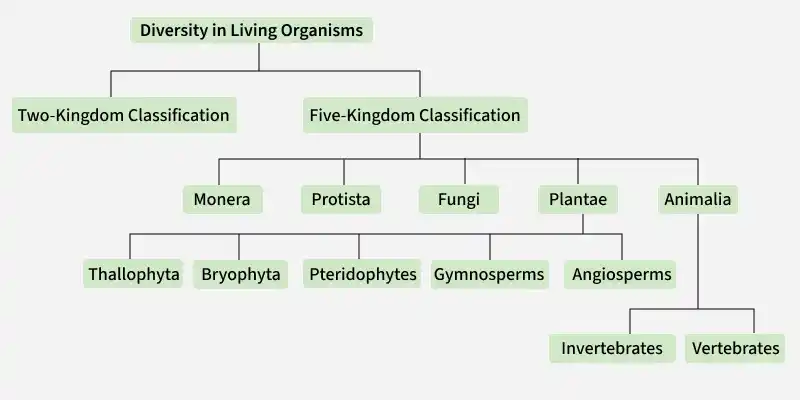
**Biodiversity
A large variety of organisms, or terms used to refer to the number of varieties of plants and animals on earth, is termed biodiversity. There are three types of biodiversity: genetic, species, and ecological diversity. There are over 15 Lakh species in the world, of which 10 Lakh are animals(8 Lakh of insects and 2 Lakh of others) and 5 Lakh of plants.
**Characteristics of the Living World
All living organisms grow and increase in mass and number of individuals. Growth, reproduction, the ability to sense the environment, and the capacity to mount a suitable response are unique features of living organisms. Given below are some characteristic features of the Living world:
- **Growth: Living organisms grow by an increase in cell number and cell size, and Growth occurs from inside the body.
- **Metabolism: The total of all chemical reactions occurring in a living organism, and it includes Anabolism (constructive processes) and Catabolism (destructive processes). Metabolism is a defining feature of life.
- **Reproduction: The ability of organisms to produce offspring and ensure continuity of the species. It can be sexual or asexual
- **Consciousness: The ability to sense and respond to environmental stimuli, including response to light, temperature, chemicals, touch, etc.
- **Organisation: Living organisms show cellular organisation.
- **Adaptation: The ability to adjust to the environment for survival. Adaptations may be structural, physiological, or behavioural.
**Nomenclature
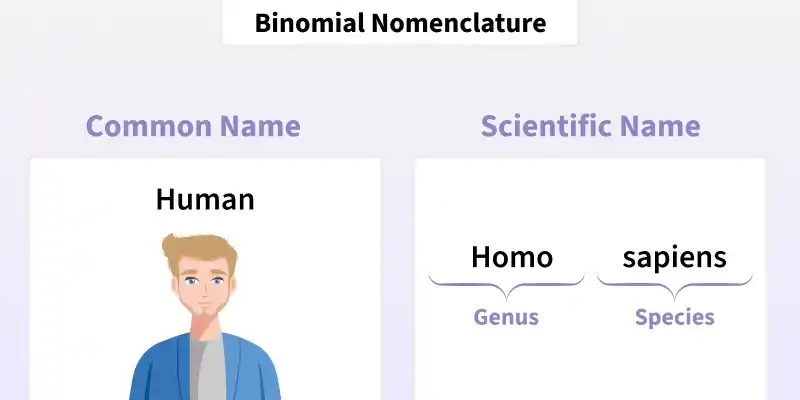
The scientific naming of organisms is known as nomenclature. Nomenclature is defined as the language of sculpture. The scientific name of the mango is Mangifera indica.
**Rules of Nomenclature
- Latinised names are used.
- The first word represents the genus, and the second word is the species name.
- Printed in italics, if handwritten, then underline separately.
- The first word starts with a capital letter, while the species name is written in small letters.
**ICBNInternational Code of Botanical Nomenclature (This is for giving scientific names to plants).
**ICZN International Code of Zoological Nomenclature(Thisis for giving scientific namesto animals).
**Classification
Grouping organisms into categories on the basis of similarities and differences is known as classification. Classification is the process by which anything is grouped into systematic categories based on some easily observable characteristics. For example, we easily recognise groups such as plants or animals, dogs or cats, insects, or reptiles.
**Need for Classification
Classification is done to organise the vast number of plants and animals into categories that can be named, remembered, studied, and understood. Classification avoids confusion among the different varieties of organisms. Moreover, it makes the study of organisms easier.
**Taxonomy
The study of principles and procedures of classification is termed taxonomy. Based on characteristics, all living organisms can be classified into different taxa. This process of classification is taxonomy.
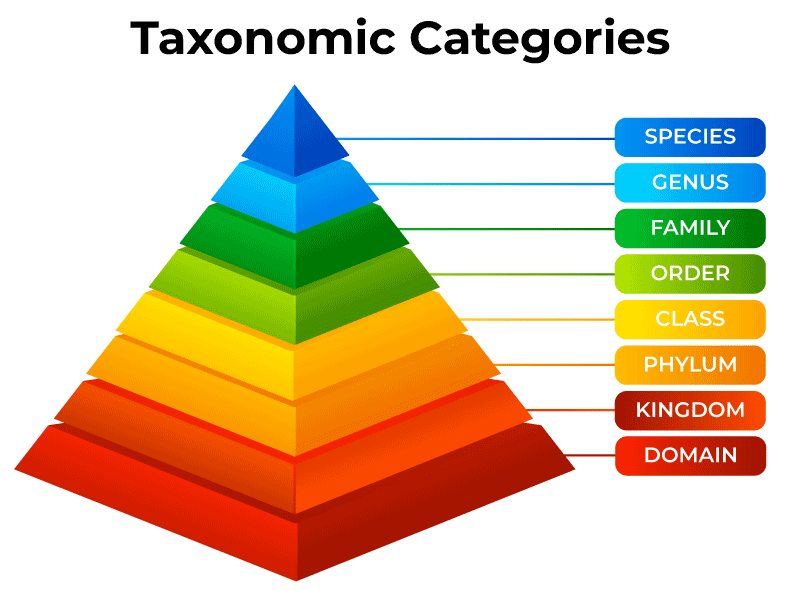
Taxonomic Categories
A. P. Candolle is credited with coining the term "taxonomy," which refers to the seven main taxonomic categories. It is the listing of categories from the top-most kingdom to the bottom-most species, either in ascending or declining orders.
- **Species: The smallest and most fundamental distinction in classification is the species. It describes a population that is comparable in terms of form, shape, and reproductive characteristics. Similar reproductive characteristics can lead to the formation of fertile siblings.
- **Genus: This is the grouping of several closely related species that share linked features and are thought to have shared ancestors. For example, the genus Panthera is where the leopard and cat belong.
- **Family: Families are associations of connected genera. The vegetative and reproductive characteristics are used to categorise the families. The Felidae family includes animals like tigers and lions as examples.
- **Order: It is the combination of one or more common families, which is regarded as a higher category. Felidae family members participate in the Carnivora order.
- **Class: A class designates a division in a phylum made up of one or more orders. All mammals, including gorillas, monkeys, humans, and gibbons, are included in the Mammalia class.
- **Phylum: It contains a group of related classes. Mammalia, along with reptiles, fish, amphibians, and birds, make up the phylum Chordata.
- **Kingdom: The highest taxonomic classification, known as a kingdom, is given to every animal that belongs to various phyla. The kingdoms Animalia and Plantae encompass all living things, including both plants and animals. A taxon is a classification that identifies an organismal group based on external characteristics.