Stem Characteristics and Functions (original) (raw)
Last Updated : 7 May, 2026
The plant's stem is a crucial component as well. The portion of the plant axis that is ascending is what produces the branches, leaves, flowers, and fruits, as well as aids in mineral and water conduction. It is the plant's aerial part, formed from the plumule of an embryo or the germination of seeds. Initially, green, young stems gradually grow brown and woody. The stem can take on a variety of shapes depending on its purpose.
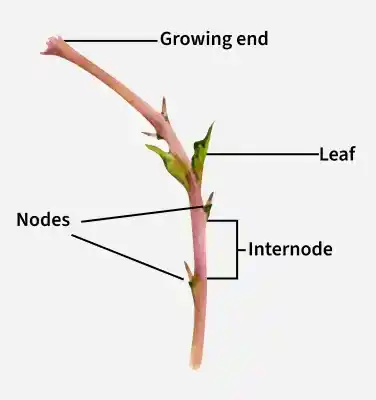
The stem is the ascending part of the axis bearing branches, leaves, flowers, and fruits. They have the nodes and internodes. The region where the leaves are born is called a node, and the internodes are present between the nodes. The stem bears buds which may be terminal or axillary. The stem is generally green; later, it becomes wood, and it turns dark brown.
Characteristics of Stem
- The stem develops from the embryo's plumule and epicotyl.
- The erect stem extends away from the ground in the direction of the light.
- There is a terminal bud at the stem's tip.
- Angiosperm shoots are separated into internodes and nodes.
- Young stems are green and photosynthetic.
- Multicellular hair can be seen.
- The stems and branches of mature plants yield fruits and flowers.
Modifications of Stem
Stems serve a variety of purposes in many plants, including perennation, vegetative reproduction, food storage, synthesis, etc. In addition to axial stability, plants' stems change under specific circumstances. In order to maintain the plant's health and growth despite the shifting environmental factors, the modified stems perform functions such as protection, vegetative propagation, food synthesis, and others.

Based on the type of modifications, stem modifications can be classified into Aerial modifications, Subaerial modifications, and Underground modifications.
**Aerial Stem Modifications
The aerial stem is a stem that grows vertically or erect above the earth. The two types of aerial stems are reduced stems and erect stems. Aerial stem modifications serve a variety of unique purposes, including climbing, food storage, plant protection, and vegetative propagation. The aerial stem can be modified in 6 different ways.
- **Stem Tendrils: Tendrils, which are green structures that resemble leafless threads and are utilised for climbing, are modified versions of the plant's stem or branches. Tendrils can be categorised into the following four categories. Example: Passiflora(Axillary tendrils), Cucurbita(Extra axillary tendrils), Antigonon(Floral bud tendrils), and Grapevine(Apical bud tendrils).
- **Thorns: These are sharp, solid, or woody objects that occasionally have leaves and flowers. Additionally, they may branch. Thorns, which are altered axillary buds, are seen on plants including Duranta and Citrus. Thorns are utilised for climbing or defence.
- **Phylloclade: These flattened or cylindrical branches are fleshy in nature. The leaves change into spines or scales, and they control transpiration as well. Phylloclade store water and participate in photosynthesis. Euphorbia, coccoloba, etc.
- **Cladophylls: These flattened or cylindrical branches, also known as cladodes, aid in photosynthesis. Ruscus has a single internode forming a flattened cladode, while Asparagus has multiple needle-like cladodes.
- **Bulbil: These are modified vegetative or floral buds that have food reserves for the plant's body. They are designed to be multiplied vegetatively. Bulbils split off to form new plants. Example: In lilies, the floral buds develop into bulbils, unlike in Dioscorea, where bulbils are compressed axillary buds.
**Subaerial Stem Modification
In a stem of this kind, a portion of the stem remains underground while the other portion develops aerial roots. On the stem, a dormant bud becomes active and forms lateral branches for vegetative reproduction.
- **Runner : A form of creeping stem with lengthy internodes is called a runner. They carry scale leaves, adventitious roots, and scale leaves as they move horizontally across the soil surface. The axillary bud is where this kind of steam emanates. Numerous runners can be produced by a mother plant in all directions. They eventually separate and develop into new plants. Examples include lawn grass and wood sorrel.
- **Sucker: Sucker stems emerge from the main stem's underground basal region. They initially expand horizontally below the soil before obliquely expanding upward. Before detaching from the mother plant, the stem grows an adventitious root system and a leafy shoot. Chrysanthemum and mentha, for instance (Pudina).
- **Stolon: A weak lateral stem emerges from the base of the main stem. It eventually bends down to touch the ground after growing aerially for some time. A new shoot and adventitious roots are produced by this plant's terminal bud. Jasmine and Colocasia, for instance.
- **Offset: The one internode on this short runner is by itself. It begins as a leaf axil, grows into a short horizontal branch, forms a rosette of leaves above, and then begins to form adventitious roots below. In aquatic plants, this kind of stem alteration is typically seen. Pistia, Eichhornia, and other examples.
**Underground Stem Modification
Underground stems are, as their name suggests, stems that emerge from the ground. Most of these stems aid in reproduction, permanency, and the storage of food, water, or minerals. These include, but are not limited to, corms, rhizomes, bulbs, and tubers.
- **Rhizome: It is a fleshy, non-green subterranean stem with internodes and nodes. Dry scale leaves with axillary buds can be found at the nodes. Moreover, terminal buds are seen. The accidental roots start on the bottom sides. A root-stock rhizome is a name given to the rhizome stem that grows obliquely; straggling rhizomes are the names given to the stems that grow horizontally. Ginger and turmeric are correct examples of rhizomes. Lotus and Canna are examples of straggling rhizomes.
- **Bulb Modification: This kind of modified stem resembles a discoid stem that has been densely compressed. There are several fleshy-scaled leaves and a terminal bud on the upper surface. There are several adventitious roots at the bulb's base. Onions and garlic are examples of tunicate bulbs. Lily is an example of a scaly bulb.
- **Corm: This is a compact rhizome that develops vertically. It is roughly spherical in shape and has a base that flattens out. Its internodes and nodes are clearly round. Scale leaves and axillary buds can be visible on the nodes, and adventitious roots can be observed at the base or all over the body. Crocus, for instance, and colocasia.
- **Tuber: It is a corry-covered, swelling tip of a subterranean lateral stem. The eyes are a number of depressions in the skin. Every eye, which is a node, has one or more buds that are protected by a leaf scar. Its connection to a stolon is shown by a large scar at one end, also referred to as the potato heel end. In general, tubers lack adventitious roots. as in potatoes.
Functions of Stem
- It holds fruits, flowers, and leaves in place.
- The stem enables the leaves to position themselves so they can receive direct sunlight and effectively carry out photosynthesis. Gas exchange is also made possible by the arrangement and positioning of leaves.
- The vascular bundles of stems include the xylem and phloem, which transport water and minerals throughout the plant.
- Flowers and fruits are carried on stems in a way that promotes pollination, fertilisation, and seed dispersal.
- To hold food and water, some stems are modified. Think about succulents.