Transport of Carbon Dioxide in the Blood (original) (raw)
Last Updated : 11 Jun, 2026
Carbon dioxide is a waste product generated during cellular respiration and must be continuously removed from the body to maintain normal physiological functions. The circulatory system transports carbon dioxide from body tissues to the lungs, where it is expelled during exhalation. Unlike oxygen, carbon dioxide is carried in the blood mainly as bicarbonate ions, with smaller amounts transported as carbaminohaemoglobin and dissolved in plasma.
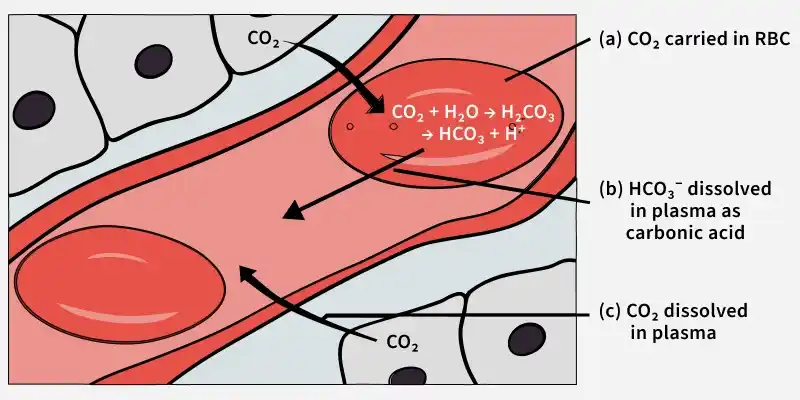
Modes of Transport of Carbon Dioxide
Carbon dioxide is transported in the blood by three main methods:
1. Transport of Carbon Dioxide Dissolved in Plasma
- A small portion of carbon dioxide, approximately 7%, is transported directly in dissolved form in the blood plasma.
- Carbon dioxide is about twenty times more soluble in water than oxygen, which allows a certain amount of it to dissolve in plasma.
- This dissolved carbon dioxide contributes to the partial pressure of carbon dioxide (PCO₂) in the blood and plays an important role in the diffusion of carbon dioxide between tissues, blood, and alveoli.
- Although this method accounts for only a small fraction of total carbon dioxide transport, it is physiologically significant because it helps establish the concentration gradients necessary for gas exchange.
2. Transport of Carbon Dioxide as Bicarbonate Ions
- The majority of carbon dioxide, approximately 70%, is transported in the form of bicarbonate ions (HCO₃⁻). This is the most important mechanism of carbon dioxide transport.
- When carbon dioxide enters the red blood cells, it combines with water in the presence of the enzyme carbonic anhydrase to form carbonic acid.
CO2+ H2O ⇌ H2CO3
- Carbonic acid is unstable and quickly dissociates into hydrogen ions and bicarbonate ions.
H2CO3 ⇌ H+ + HCO3−
- Most of the bicarbonate ions diffuse out of the red blood cells into the plasma. To maintain electrical neutrality, chloride ions move from the plasma into the red blood cells. This exchange of bicarbonate ions and chloride ions is known as the chloride shift or Hamburger phenomenon.
- In the plasma, bicarbonate ions combine with sodium ions to form sodium bicarbonate.
Na+ + HCO3− → NaHCO3
- The bicarbonate transport system is highly efficient and also plays a major role in maintaining the acid-base balance of the blood.
3. Transport of Carbon Dioxide as Carbaminohaemoglobin
- Approximately 20–23% of carbon dioxide is transported by binding directly to haemoglobin, forming carbaminohaemoglobin. Carbon dioxide combines reversibly with the amino groups present in the globin portion of haemoglobin.
Hb + CO2 ⇌ HbCO2
- This reaction occurs more readily in tissues where the partial pressure of carbon dioxide is high and the partial pressure of oxygen is low. The formation of carbaminohaemoglobin is reversible, allowing carbon dioxide to be easily released when the blood reaches the lungs.
- The ability of haemoglobin to carry carbon dioxide increases when it releases oxygen in the tissues, a phenomenon known as the Haldane effect.
Release of Carbon Dioxide in the Lungs
- When blood reaches the lungs, the partial pressure of carbon dioxide in the alveoli is lower than that in the blood. As a result, carbon dioxide moves from the blood into the alveolar air.
- Carbaminohaemoglobin dissociates and releases carbon dioxide.
HbCO2 ⇌ Hb + CO2
- Similarly, bicarbonate ions re-enter the red blood cells and combine with hydrogen ions to form carbonic acid.
H+ + HCO3− ⇌ H2CO3
- Carbonic acid is then converted back into carbon dioxide and water by the enzyme carbonic anhydrase.
H2CO3 ⇌ CO2 + H2O
- The carbon dioxide thus formed diffuses into the alveoli and is expelled from the body during exhalation.
Importance of Carbon Dioxide Transport
- The transport of carbon dioxide is essential for maintaining normal physiological functions.
- It helps remove metabolic waste products from tissues, maintains the acid-base balance of blood, regulates blood pH, and ensures the proper functioning of enzymes and cellular processes.
- Efficient carbon dioxide transport is therefore necessary for maintaining homeostasis and supporting life.