Viroids Structure, Characteristics, Features, and Diseases (original) (raw)
Last Updated : 9 Jun, 2026
Viroids are the smallest known infectious agents and are important pathogens of plants. They consist only of a short, circular, single-stranded RNA molecule and lack both a protein coat and protein-coding genes, distinguishing them from viruses. Despite their extremely simple structure, viroids can infect plants and cause several economically important diseases. The discovery of viroids provided valuable insights into the role of RNA in disease causation and significantly advanced the understanding of molecular biology and plant pathology.
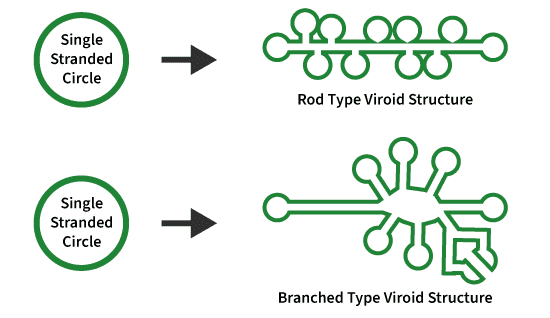
Structure of Viroids
Viroids consist of a single-stranded circular RNA molecule that folds into characteristic secondary structures such as rod-shaped or branched forms through internal base pairing. These compact structures help maintain the stability and infectivity of viroids despite their extremely simple organization. The structure of a viroid is extremely simple. It consists of:
- A small circular RNA molecule.
- Single-stranded RNA.
- Absence of protein coat.
- Absence of lipid envelope.
- Absence of any protein-coding genes.
The RNA molecule folds upon itself due to complementary base pairing, forming a compact rod-like structure. This folding increases the stability of the RNA and helps it survive within host cells.
Characteristics of Viroids
- Viroids are the smallest known infectious agents. Their RNA molecules contain only a few hundred nucleotides, making them much smaller than viruses.
- A viroid consists solely of a circular, single-stranded RNA molecule. It contains no DNA and no protein components.
- Unlike viruses, viroids do not possess a protective protein covering called a capsid. This is one of the most important features that differentiate viroids from viruses.
- Viroids are known to infect higher plants and cause various plant diseases. No viroid has been found to infect animals or humans.
- Viroids cannot survive independently. They depend completely on the living cells of the host plant for replication and multiplication.
- Viroids do not contain genes that can direct the synthesis of proteins. They utilize the enzymes and machinery present in the host cells.
Replication of Viroids
Viroids replicate inside the cells of infected plants. Since they do not contain any enzymes or proteins of their own, they utilize the host plant's enzymes for replication. The replication process involves the following steps:
- The viroid enters the host cell through wounds or infected plant material.
- The host cell enzymes recognize the viroid RNA.
- New RNA copies are synthesized using the host machinery.
- These RNA molecules are processed and circularized.
- Newly formed viroids spread to other cells and tissues of the plant.
Diseases Caused by Viroids
Viroids are responsible for several economically important plant diseases.
| Diseases | Description | Symptoms |
|---|---|---|
| 1. Potato Spindle Tuber Disease | This disease is caused by the Potato Spindle Tuber Viroid (PSTVd). | Elongated spindle-shaped tubers Reduced yield Stunted growth Poor quality potatoes |
| 2. Citrus Exocortis Disease | This disease affects citrus plants. | Bark cracking Scaling of bark Reduced growth Decline in fruit production |
| 3. Coconut Cadang-Cadang Disease | This disease affects coconut palms and may lead to severe losses in coconut production. | Yellowing of leaves Reduced fruit formation Gradual death of the palm |
| 4. Chrysanthemum Stunt Disease | This disease affects ornamental chrysanthemum plants. | Stunted growth Reduced flowering Poor plant development |
Transmission of Viroids
Viroids can spread from one plant to another through several methods.
- **Mechanical Transmission: Contaminated agricultural tools such as knives, pruning shears, and grafting equipment can transfer viroids between plants.
- **Vegetative Propagation: Infected cuttings, tubers, bulbs, and grafts can carry viroids to healthy plants.
- **Seed Transmission: Some viroids can be transmitted through infected seeds.
- **Pollen Transmission: Viroids may also spread through pollen during fertilization.
- **Human Activities: Agricultural operations such as pruning, grafting, and transplantation can facilitate the spread of viroids.
Economic Importance of Viroids
Viroids are agriculturally important because they infect many crop plants and reduce their productivity. Infected plants often show poor growth, reduced flowering, decreased fruit and seed production, and lower yields. As a result, farmers may suffer significant economic losses. Viroid infections can also affect the quality of agricultural products and hinder international trade in plant materials.