Top 7 Backend Development Frameworks [2025 Updated] (original) (raw)
In the era of web development, the backend serves as the engine that powers the functionality and logic behind every successful web application. Choosing the right backend frameworks is crucial for building robust, scalable, and efficient web solutions that meet the demands of modern users
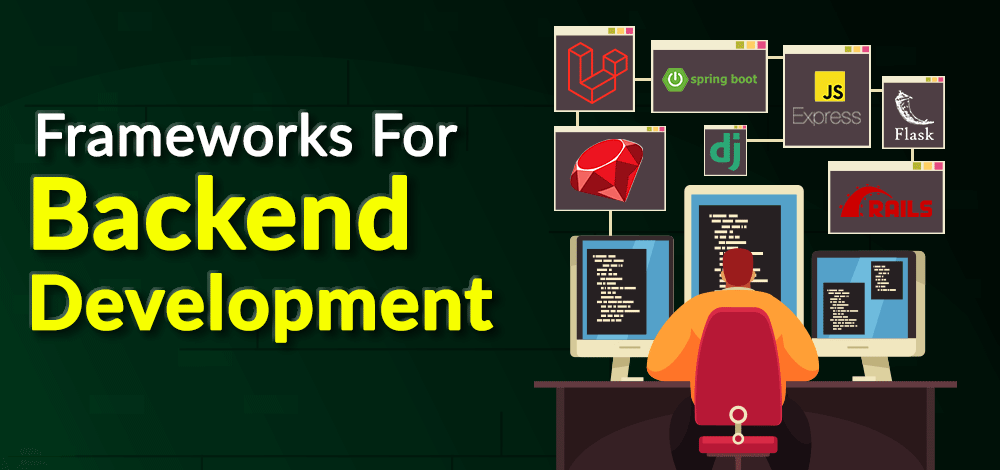
In this comprehensive guide, we'll explore the top seven backend frameworks that are revolutionizing the landscape of web development. From established favorites to emerging contenders, each framework offers unique features, advantages, and use cases, catering to the diverse needs and preferences of developers.
Top 7 Backend Frameworks For Development
1. Django
Django (written in Python), being one of the most popular backend frameworks was released in 2005. It is an open-source and high-level framework that is scalable and customizable and contains everything that a developer may require. Django is based on the DRY code principle, which mainly focuses on reusing the code thereby making it fast and efficient, and also, it follows the MVC pattern. This framework can also be used in JSON, XML, and HTML formats. It is mainly considered for building web applications rapidly and makes use of popular python features also, providing an admin interface to perform **CRUD****(Create, Read, Update, Delete)** operations. Popular applications using Django are Google, YouTube, Instagram, Spotify, Pinterest, DropBox, Mozilla, and National Geographic.
**Features of Django:
- Secure Authentication
- Batteries included
- Support of middleware
- SEO Optimized
- Huge community support
- Easy integration with third-party applications
2. Laravel
Laravel is an open-source PHP framework, released in 2011, which follows MVC (Model-View-Architecture) architecture. It consists of extensive libraries and API support, also with an intuitive interface. It is mainly responsible for building blogs, e-commerce websites, and news. It provides database tools like ORM (Object Relational Mapper)**, With the help of Laravel, developers create amazing custom web apps using the expressive and elegant syntax of PHP. Also, it allows rapid application mail sending through local or cloud-based services. Laravel can be called a mixture of Django and Ruby on Rails as it is scalable and secure just like Ruby on Rails and follows MVC architecture to build websites just like Django. It is a complete server-side framework, responsible for data manipulation. _Some of the companies using Laravel as their backend frameworks are 9GAG, Pfizer, Crowdcube, and Razorpay.
**Features of Laravel:
- Own CLI (Command Line Interface)
- Integrates with MySQL, SQL Server, SQLite, and Postgres.
- Migration of database
- Simple API
- Template Engine
3. Express
Express, released in 2010, is a Nodejs web application framework written in JavaScript which supports REST API applications. It is fast, unopinionated, minimalist, and the backend part of the MEAN and MERN stack used for building interactive mobile and web applications. JS developers use Express because of its high flexibility of applications. Express, a framework for NodeJS allows developers to create single-page, multi-page, and even hybrid pages. It integrates with NoSQL, MongoDB, and Nodejs to handle **GET, PUT, POST, and DELETE requests. Companies like Accenture, PayPal, Twitter, Myntra, Uber, and IBM use Express as their backend frameworks.
**Features of Express:
- Routing
- Middleware
- Debugging
- Plugin support
- Extensive templates
- HTTP utility methods
4. Spring Boot
Spring Boot, released in 2014 is an open-source and lightweight Java-based framework. It is used for creating stand-alone applications. It contains a spring core container which is a module providing containers. It is one of the most popular backend frameworks, following MVC architecture, and performs CRUD operations. There are extensions for creating web applications and it renders configurable security methods. Developers perform lazy initialization which helps them to create beans based on the language. It has many useful functionalities like transaction management, monitoring, caching, and security. The reason behind choosing Spring Boot are microservices, easy setup, and fast development. Companies using Spring Boot are Google, Microsoft, Udemy, Amazon, and Trivago.
**Features of SpringBoot:
- Simple API
- Dependency management
- Avoids Complex configuration of XML
- Microservices
5. Ruby on Rails
Ruby on Rails, released in 2004, is an open-source and server-side Backend frameworks written in Ruby. It offers a default structure for web services and follows MVC architecture. It creates a bug-free database and uses HTML, CSS, and JavaScript for creating applications. It works on two basic concepts involving DRY (Don't Repeat Yourself) and CoC (Convention over Configuration). The first one is used to avoid repetition of code, and the second one is to provide maximum approaches to solve a problem. Companies using Ruby on Rails are GitHub, Shopify, Netflix, Airbnb, and Crunchbase.
**Features of Ruby on Rails:
- Good community support
- Reliable and high-quality
- Simple testing
- Scaffolding
- Localization
6. Flask
Flask, released in 2010, is an open-source, lightweight Backend frameworks written in Python and used for creating robust web apps. It is simple to learn and work on, a "beginner-friendly" framework that doesn't contain any kind of dependencies, making it easy to implement. It offers RESTful request dispatching, unit testing, and secure cookies. It is also classified as a microframework as it does not contain any kind of libraries and tools. It supports object-relational mapping, uploading, and validating. Being used for building both small-scale and large-scale applications, LinkedIn and Pinterest are the famous companies using Flask as their backend framework.
**Features of Flask:
- Unicode backend
- Development server
- Rapid development
- Minimalistic
- Good documentation
7. ASP.NET
ASP.NET (Active Server Pages), released in 2002, is a free, open-source, and free backend frameworks written in C#. It is a modular framework, that runs across the .NET framework across Windows. It is the best framework used for building real-time web apps and has rich API services and microservices. .NET, an advanced version of ASP.NET, is a platform for developers which is made up of tools, libraries, and programming languages. It can run on Windows, Linux, and macOS. Companies using ASP.NET as their backend framework are Slack, SpaceX, Alibaba Travels, and MasterCard.
**Features of ASP.NET are:
- Has multiple versions
- Minimal coding
- Asynchronous
- Support for containers
- Various support options for lifecycle
Top 7 Backend Development Frameworks
| Features | Release year | Programming language | Architecture | Core Features | Companies Using |
|---|---|---|---|---|---|
| Django | 2005 | Python | MVC (MTV) | Batteries Included, Admin Interface, Secure Authentication | Google, Instagram, Spotify, Pinterest |
| Laravel | 2011 | PHP | MVC | ORM, Command Line Interface, Template Engine | 9GAG, Pfizer, Crowdcube |
| Express | 2010 | JavaScript | MVC | Routing, Middleware, HTTP Utility Methods | PayPal, Uber, Twitter |
| Spring Boot | 2014 | Java | MVC | Microservices, Simple API, Dependency Management | Google, Amazon, Microsoft |
| Ruby On Rails | 2004 | Ruby | MVC | DRY (Don't Repeat Yourself), CoC (Convention over Configuration) | GitHub, Netflix, Airbnb |
| Flask | 2010 | Python | Microframework | Rapid Development, Minimalistic, Unicode Backend | LinkedIn, Pinterest |
| ASP.Net | 2002 | C# | Modular | Asynchronous, Support for Containers, Cross-Platform | Slack, SpaceX, Alibaba |
Conclusion
In conclusion, choosing the right backend frameworks is crucial for building efficient and scalable web applications. The seven frameworks discussed in this guide offer diverse strengths and capabilities to meet the needs of developers and businesses. By staying informed and leveraging these frameworks, developers can streamline their workflows and deliver exceptional user experiences in today's competitive digital landscape.