Prompt Engineering Best Practices for AI Models (original) (raw)
Last Updated : 30 Apr, 2026
Prompt engineering is the practice of designing and refining inputs to guide large language models (LLMs) toward accurate, relevant and high-quality outputs. For developers, researchers and AI professionals, it is an important skill for getting reliable and useful results from AI systems.
- Improves accuracy and relevance of outputs
- Ensures useful and reliable AI responses
- Becomes more important as AI capabilities grow
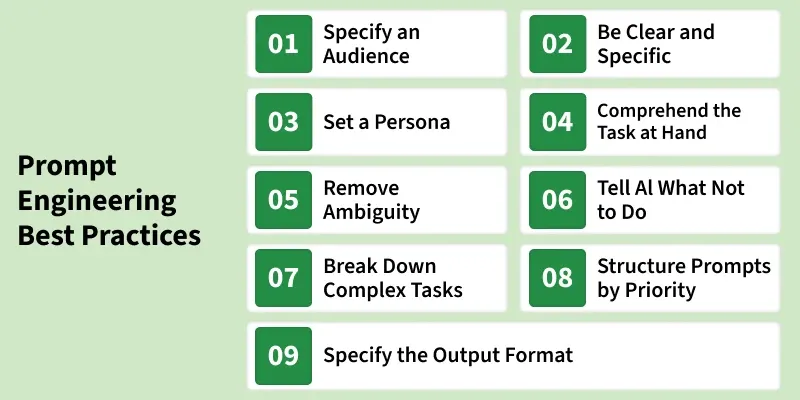
Prompt Engineering Best Practices for AI Models
Best Practices for Prompt Engineering
1. **Be Clear and Specific
- **Action: Clearly define our request with precision.
- **Benefit: Reduces ambiguity, ensuring the AI generates focused, accurate responses.
- **Example: "List three key benefits of renewable energy for businesses."
2. **Specify Response Format
- **Action: Indicate the desired structure for the answer like list, bullet points, essay, etc.
- **Benefit: Ensures the AI delivers the response in the preferred format, improving clarity and usability.
- **Example: "Summarize the latest trends in AI technology in 100 words, using bullet points."
3. **Provide Context
- **Action: Include relevant background or situational context to guide the AI’s response.
- **Benefit: The AI prepares its answer based on the provided context, resulting in a more accurate and relevant response.
- **Example: "As a financial analyst, explain the investment options for beginners with examples."
4. **Structure Step-by-Step Instructions
- **Action: Break down complex tasks into clear, sequential steps.
- **Benefit: Helps the AI produce logical organized instructions that are easy to follow.
- **Example: "Explain how to boil pasta, step by step, including cooking time."
5. **Set Output Constraints
- **Action: Define word limits, tone or complexity for the response.
- **Benefit: Ensures the response aligns with your needs, whether for brevity, style or depth.
- **Example: "Explain AI in 150 words in a friendly tone for beginners."
6. **Experiment and Iterate
- **Action: Adjust our prompt based on previous responses to optimize for better results.
- **Benefit: Refining our prompt over time improves the AI's accuracy and relevance.
- **Example: "What are the best practices for time management?" or "What are the top 5 time management strategies for busy professionals?"
7. **Use Clear Action Verbs
- **Action: Start prompts with specific action verbs such as "describe", "analyze" or "compare".
- **Benefit: Action verbs help guide the AI’s approach to provide the desired depth or type of response.
- **Example: "Describe the process of photosynthesis in plants."
8. **Ask for Multiple Perspectives or Solutions
- **Action: Request answers from different viewpoints or propose multiple solutions.
- **Benefit: Encourages a more comprehensive and diverse response.
- **Example: "Provide solutions for improving urban transportation from the perspectives of an environmentalist, a city planner and a commuter."
9. **Refine With Clarifying Questions
- **Action: Follow up on the initial response with additional questions for more detailed information.
- **Benefit: Helps us fine-tune the AI's output to focus on specific aspects of the topic.
- **Example: "What are the benefits of a plant-based diet?" instead of this, try this "Can you explain the environmental benefits in more detail?"
10. **Test Different Wordings for Better Results
- **Action: Experiment with rewording our prompt to see which phrasing gets the best output.
- **Benefit: Different wordings can encourage the AI to generate more targeted or creative responses.
- **Example: "How can I improve my writing?" rather try "What are some effective strategies to improve clarity and coherence in writing?"
11. Use Conditional Prompts for Focused Answers
- **Action: Use “if-then” conditional statements to guide the AI’s response.
- **Benefit: Conditional prompts make the response more focused and context-specific.
- **Example: "If I wanted to improve my diet, how would I incorporate more protein?"
12. **Request for Examples or Case Studies
- **Action: Ask for real-world examples or case studies to illustrate the concept or solution.
- **Benefit: Examples make abstract ideas more tangible and relatable.
- **Example: "Explain the benefits of automation in healthcare and provide a real-world case study of its implementation."
13. **Be Transparent About Your Expectations
- **Action: Clearly state what you expect in terms of detail, length and tone.
- **Benefit: Transparency ensures the AI delivers a response that matches your needs, reducing the need for further clarifications.
- **Example: "Provide a detailed 500-word analysis of climate change’s economic impact, with academic references."
14. **Use Time Frames or Historical Context
- **Action: Provide a time frame or historical context for the topic being discussed.
- **Benefit: Helps the AI focus on a specific period, producing a more relevant and historically accurate answer.
- **Example: "Explain the economic impact of World War II in the 1940s."
15. **Maintain a Balance Between Open-Ended and Closed-Ended Questions
- **Action: Use closed-ended questions for concise answers and open-ended ones for broader insights.
- **Benefit: The right type of question allows you to gather the level of detail you need.
**Example:
- **Closed-ended: "What are the environmental benefits of electric cars?"
- **Open-ended: "How have electric cars evolved in terms of environmental impact over the past 20 years?"
16. **Clarify the Target Audience
- **Action: Specify who the response is intended for like a child, an expert, general public, etc.
- **Benefit: Helps the AI adjust its language, tone and complexity to suit the audience’s needs.
- **Example: "Explain blockchain to a 16-year-old high school student."
17. **Use Creative or Scenario-Based Prompts for Idea Generation
- **Action: Use imaginative prompts that set up hypothetical scenarios to spark creativity.
- **Benefit: Scenario-based prompts encourage fresh, innovative ideas and solutions.
- **Example: "Imagine you’re launching a new eco-friendly product. What marketing strategies would you use to attract environmentally-conscious consumers?"
18. **Incorporate Metrics and Data for Analytical Tasks
- **Action: Include specific data points or metrics to help guide the AI's analysis.
- **Benefit: Data-driven prompts lead to more precise, fact-based responses.
- **Example: "Analyze the potential effects of a 15% increase in sales tax on the economy using GDP growth, unemployment rate and inflation data."
19. **Utilize Tone and Voice for Personalization
- **Action: Specify the tone and style you want the AI to use in its response like formal, informal, humorous.
- **Benefit: Tailoring the tone ensures that the response matches your communication style or audience’s preferences.
- **Example: "Write a friendly and encouraging message for a student preparing for exams."
20. **Request Sources or Citations
- **Action: Ask the AI to include sources or citations when discussing factual content.
- **Benefit: Requesting sources enhances the credibility of the response and allows for verification.
- **Example: "Explain the effects of deforestation on biodiversity, citing at least two scientific studies."
Avoiding Bias and Ambiguity
- **Use Neutral Language: Avoid biased or assumptive wording to ensure objective responses. For example, instead of asking why a generation is "lazy" phrase it as "What challenges does the younger generation face?"
- **Follow Ethical Guidelines: Promote fairness, inclusivity and transparency. Ensure that prompts encourage balanced perspectives and avoid harmful stereotypes.
- **Test for Bias: Regularly review AI responses to detect and address any unintended bias especially when dealing with sensitive topics.
- **OpenAI Playground: Test and refine prompts in real-time to fine-tune AI responses based on immediate feedback.
- **PromptBase: Explore and use optimized, pre-designed prompts to save time and effort while ensuring quality output.
- **PromptChainer: Chain multiple prompts together to build workflows for more structured and detailed responses.
- **Helicone: Track and analyze the performance of your prompts to optimize them based on data-driven insights.
- **Agenta: Collaborate with a team to test, iterate and improve prompts, enhancing quality through collective input.