Business Ethics (original) (raw)
Last Updated : 27 Oct, 2025
Business Ethics refers to the set of moral principles, values, and standards that guide the behavior of individuals and organizations in the business world. It defines what is right and wrong in business practices and ensures that decisions are made fairly, honestly, and responsibly.
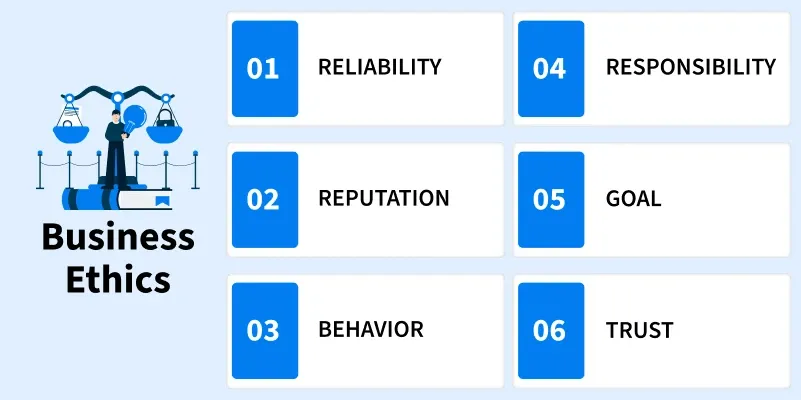
The term “ethics” originates from the Greek word ethos, meaning character or custom, and is closely associated with moral philosophy. Ethics deals with the principles of right conduct and helps individuals and organizations act with integrity and fairness in all their activities.
In the context of business, ethics influences every function from production and marketing to employee management and financial reporting. It ensures that all business operations remain transparent, lawful, and socially responsible. Ethical behavior protects the interests of all stakeholders such as employees, customers, investors, and society, while also strengthening the organization’s credibility and reputation.
Importance of Business Ethics
In today’s competitive and rapidly changing business world, success is not only measured by profits but also by how those profits are achieved. The way a business conducts its operations, treats its employees, serves its customers, and fulfills its responsibilities toward society is equally important. This highlights the significance of business ethics as the moral foundation on which every responsible enterprise is built.
Some of the key reasons why business ethics are important are discussed below.
**Improves Public Image
Ethical business practices help in building a good reputation in society. When a company is known for honesty, fairness, and transparency, people develop trust and confidence in its products and services. This enhances the goodwill and long-term stability of the business.
**Builds Customer Trust and Loyalty
Ethical behavior attracts and retains customers. When businesses provide quality products at fair prices and remain truthful in their dealings, customers prefer them over others and stay loyal for a longer time.
**Ensures Long-term Survival and Growth
Businesses that operate ethically are more likely to survive and grow in the long run. Ethical practices prevent unfair competition, reduce conflicts with stakeholders, and contribute to a stable business environment.
**Promotes Employee Satisfaction
When a business treats its employees with respect and fairness, it creates a positive work culture. Ethical management practices motivate employees, improve productivity, and reduce turnover.
**Reduces Legal Problems
Following ethical principles ensures compliance with laws and regulations. This minimizes the risk of penalties, corruption charges, and legal disputes, helping the business operate smoothly.
Ethical businesses recognize their responsibility towards society. They engage in social initiatives such as environmental protection, education, and community development, thereby contributing to the overall well-being of society.
**Encourages Sustainable Development
Ethical decision-making ensures that business activities are carried out without harming the environment or exploiting resources. This helps in achieving long-term economic and social sustainability.
Types of Business Ethics
Business ethics can be viewed from different perspectives, which help businesses apply moral principles in decision-making and daily operations.
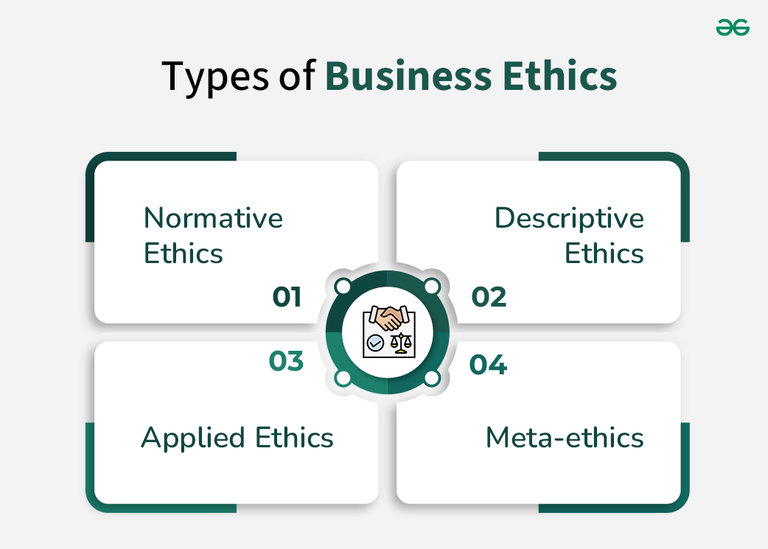
The four main types of Busniess Ethics are:
**Normative Ethics
Normative ethics focuses on identifying the moral standards that should guide behavior. In other words, it answers the question: “What should a business do?” This type of ethics sets the rules and principles for determining right and wrong actions in business.
**For example, a company following fair pricing, honesty in advertising, and transparency in financial reporting is practicing normative ethics.
**Descriptive Ethics
Descriptive ethics studies how people or organizations actually behave in real-life situations rather than prescribing what they should do. It involves observing and analyzing the ethical practices and moral decisions of businesses.
**For instance, a survey analyzing whether companies follow fair labor practices or comply with environmental laws would fall under descriptive ethics.
**Applied Ethics
Applied ethics focuses on practical application of ethical principles in real business scenarios. It helps managers and employees make decisions when facing moral dilemmas.
**For example, deciding how to handle a conflict of interest, whether to implement eco-friendly production methods, or how to treat customers fairly involves applied ethics.
**Meta-Ethics
Meta-ethics explores the philosophical basis of moral principles. It examines questions like why certain actions are considered right or wrong, what morality itself means, and how ethical values are formed.
**For businesses, meta-ethics helps understand the foundation of ethical standards and why they are important for long-term trust and sustainability.
**Elements of Business Ethics
The elements of business ethics are discussed below:
**Top Management Commitment
The top management of an organization plays a pivotal role in promoting business ethics. Leaders, including the CEO and senior managers, must demonstrate a strong commitment to ethical behavior. Their actions set an example for the rest of the employees, encouraging everyone to follow ethical practices. By leading with integrity, top management ensures that ethical conduct becomes an integral part of the organizational culture.
**Publication of a Code of Conduct
An effective ethics program begins with a written code of conduct. This document outlines the organization’s principles and standards, covering areas such as product quality and safety, honesty, adherence to laws, financial reporting, marketing practices, employment policies, and workplace health and safety. A clearly defined code serves as a reference for employees and guides the organization’s decisions and actions.
**Establishment of Compliance Mechanisms
Merely having a code of conduct is not enough. Organizations must establish mechanisms to ensure adherence to ethical standards. This can include evaluating the values and ethics of potential employees during recruitment, setting up communication channels for reporting unethical behavior, and implementing systems for monitoring compliance across all departments.
**Involving Employees at All Levels
Employees are key to implementing ethical practices at every level of the business. Organizations should actively involve employees in the ethics program to make ethical behavior practical and meaningful. For instance, companies can form small committees to discuss and review the ethics policies, assess employee understanding, and encourage participation in maintaining ethical standards.
**Measuring Results
Measuring the effectiveness of an ethics program can be challenging, but it is essential for continuous improvement. Organizations can audit ethical practices, review employee behavior, and evaluate the overall adherence to ethical policies. After assessment, management and employees can discuss the results to identify areas for improvement and take necessary corrective actions.