Management Roles by Henry Mintzberg (original) (raw)
Last Updated : 16 May, 2026
Management is often described as the process of planning, organizing, leading, and controlling organizational resources to achieve goals effectively and efficiently. However, the practical work of managers is much more dynamic and complex than traditional theories suggest. One of the most influential contributions to understanding managerial work was made by Henry Mintzberg, who identified the different roles managers perform in organizations.
Through extensive observation and research, Mintzberg concluded that managers do not simply sit and plan systematically; instead, they engage in a variety of activities, switching rapidly from one task to another. He categorized managerial activities into ten roles grouped under three major categories: interpersonal roles, informational roles, and decisional roles.
Mintzberg’s Managerial Roles
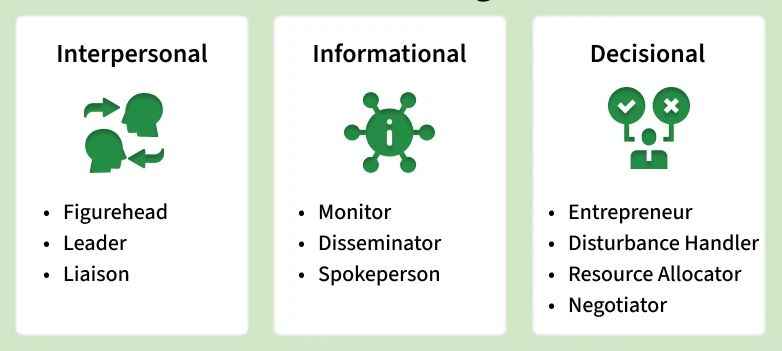
Mintzberg proposed that every manager performs ten different roles, regardless of the type or size of the organization. These roles are grouped into three categories:
- Interpersonal Roles
- Informational Roles
- Decisional Roles
Each role reflects a particular set of managerial behaviours and responsibilities.
1. Interpersonal Roles
Interpersonal roles involve interaction with people inside and outside the organisation like employees, colleagues, customers, and external stakeholders . These roles arise from the manager’s formal authority and position.
****(a) Figurehead**
The figurehead role involves performing ceremonial and symbolic duties. Managers act as representatives of the organisation in official events and formal activities.
**Responsibilities:
- Attending meetings and functions
- Signing official documents
- Representing the organisation publicly
**Example:
A company manager inaugurates a new office branch and signs partnership agreements on behalf of the organisation.
****(b) Leader**
The leader role is the most pivotal because it reflects how effectively a manager influences people. Managers are responsible for their employees’ performance, whether leading a small team, a department, or the entire organisation.
**Responsibilities:
- Hiring and training employees
- Motivating and guiding staff
- Evaluating performance and maintaining discipline
**Example:
A manager sets clear targets for the team and communicates expectations. He monitors progress, motivates employees, and provides feedback and resources to help them achieve organisational goals.
****(c) Liaison**
In the liaison role, managers maintain relationships with individuals and groups outside their immediate work unit. These contacts help in information exchange and coordination.
**Responsibilities:
- Building external networks
- Communicating with suppliers, customers, and officials
- Gathering useful information
**Example:
A marketing manager regularly interacts with advertising agencies and distributors to collect market information and coordinate promotional activities.
2. Informational Roles
Informational roles focus on managing information. Managers act as a central point for collecting and distributing information within the organisation.
****(a) Monitor**
As a monitor, the manager continuously seeks information from internal and external sources to understand organisational performance and environmental changes.
**Responsibilities:
- Reviewing reports and data
- Observing operations
- Tracking market trends
**Example:
A production manager reviews daily output reports and monitors competitor activities to identify efficiency gaps or market threats.
****(b) Disseminator**
In this role, the manager passes relevant information to subordinates to ensure smooth functioning and coordination.
**Responsibilities:
- Sharing policies and instructions
- Communicating changes and updates
- Providing feedback
**Example:
A department head informs employees about a new company policy and explains how it will affect their work responsibilities.
****(c) Spokesperson**
The spokesperson role involves communicating information about the organisation to external parties.
**Responsibilities:
- Representing the organisation to outsiders
- Communicating performance and policies
- Building organisational image
**Example:
A CEO addresses the media and investors to explain the company’s financial performance and future plans.
3. Decisional Roles
Decisional roles involve making choices and taking actions that affect the organisation’s direction and performance.
****(a) Entrepreneur**
In the entrepreneur role, managers initiate change and innovation to improve organisational performance.
**Responsibilities:
- Introducing new ideas and projects
- Improving processes
- Adapting to change
**Example:
A manager introduces a new digital system to improve customer service and reduce operational delays.
****(b) Disturbance Handler**
This role involves dealing with unexpected problems and conflicts that disrupt normal operations.
**Responsibilities:
- Resolving conflicts
- Managing crises
- Taking corrective action
**Example:
A manager resolves a dispute between two employees to restore teamwork and productivity.
****(c) Resource Allocator**
As a resource allocator, the manager decides how limited resources are distributed among different activities.
**Responsibilities:
- Allocating budgets
- Assigning manpower
- Scheduling time and equipment
**Example:
A project manager allocates funds and staff among different project tasks based on priority and deadlines.
****(d) Negotiator**
In this role, the manager represents the organisation in negotiations with internal and external parties.
**Responsibilities:
- Bargaining with suppliers or unions
- Resolving disagreements
- Reaching agreements
**Example:
A manager negotiates with a supplier to obtain raw materials at a lower cost without compromising quality.