MSME and Business Entrepreneurship (original) (raw)
Last Updated : 27 Oct, 2025
In today’s fast-changing economy, two forces drive India’s growth: MSMEs and entrepreneurship.
From local handicraft makers to cutting-edge tech startups, these businesses form the backbone of AtmanirbharBharat, or a self-reliant India. Micro, Small, and Medium Enterprises (MSMEs) are not just small-scale units; they are engines of innovation, employment, and inclusive growth. Similarly, entrepreneurship is about more than starting a business. It is about seeing opportunities where others see obstacles.
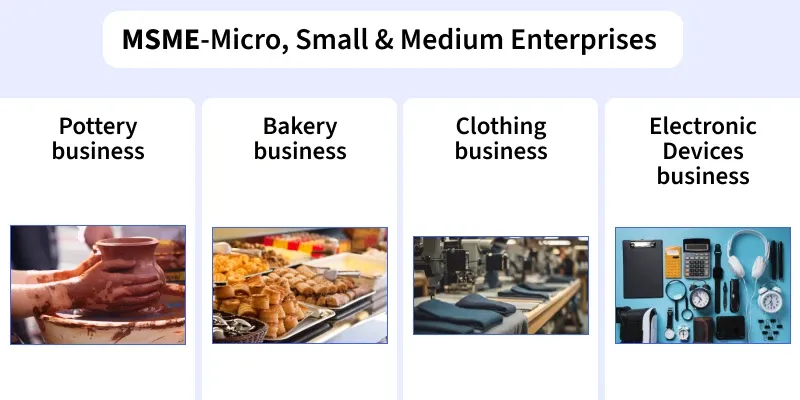
Together, MSMEs and entrepreneurs power India’s journey from being a developing economy to a global growth leader.
- These are businesses engaged in producing or providing goods and services, typically on a smaller scale compared to large industries.
- They are categorized on the basis of investment in plant and machinery or equipment and annual turnover.
Classification (as per the Indian Government – MSME Act, 2006, revised in 2020):
| Category | Investment (in Plant & Machinery/Equipment) | Annual Turnover |
|---|---|---|
| **Micro Enterprise | ≤ ₹1 crore | ≤ ₹5 crore |
| **Small Enterprise | ≤ ₹10 crore | ≤ ₹50 crore |
| **Medium Enterprise | ≤ ₹50 crore | ≤ ₹250 crore |
This uniform classification encourages businesses to grow without losing MSME benefits, helping them scale sustainably.
Role of MSMEs in Economic Development
**Employment Generation
- MSMEs are the second-largest source of employment after agriculture.
- They provide opportunities for skilled and unskilled workers, especially in rural and semi-urban areas.
- By creating local jobs, they reduce poverty and check large-scale migration to cities.
**Balanced Regional Development
- These enterprises can be set up with low investment, making them suitable for backward and rural areas.
- They use local resources and talents, spreading industrial growth evenly across the country and reducing regional economic disparities.
**Optimum Use of Local Resources
- MSMEs utilize locally available raw materials, labor, and traditional skills.
- This ensures that local resources, which might otherwise remain unused, are effectively employed to produce goods and generate income.
**Mobilization of Capital and Entrepreneurship
- By encouraging individuals to start their own ventures, MSMEs help mobilize local savings and develop entrepreneurial skills.
- This leads to better capital formation and strengthens the base of self-reliant economic activity.
**Contribution to Exports
- A significant portion of India’s exports comes from MSMEs.
- They produce a wide variety of products like textiles, handicrafts, and engineering goods, which help earn valuable foreign exchange and promote India’s global trade presence.
**Support for Large Industries
- MSMEs act as supporting units for large industries by supplying raw materials, components, tools, and services.
- This partnership improves the efficiency of large-scale production and helps maintain industrial balance.
**Promotion of Innovation
- Small businesses often emerge from new ideas and creative solutions.
- MSMEs provide a platform for experimentation and innovation, helping develop unique products and services tailored to local and global needs.
**Equitable Distribution of Income
- Since MSMEs are widely spread across different regions and owned by numerous small entrepreneurs, they help in reducing wealth concentration.
- The income generated from these units reaches a broader section of society, ensuring inclusive growth.
**Contribution to GDP
- MSMEs contribute nearly one-third of India’s GDP and play a significant role in industrial output and service growth.
- Their wide presence across sectors makes them the backbone of the Indian economy.
**Women Empowerment
- Many MSMEs are owned and managed by women, particularly in sectors like food processing, handicrafts, and apparel.
- These enterprises empower women economically and contribute to greater gender equality in society.
Did you know?
MSMEs play a vital role in India’s economy — they contribute around 30.1% to the country’s GDP, account for approximately 35.4% of total manufacturing output, and generate nearly 62% of employment across India.
Problems associated with MSMEs
Despite their vital role in the Indian economy, Micro, Small, and Medium Enterprises face several challenges that limit their growth and competitiveness. These problems often arise due to their small size, limited resources, and dependence on external factors.
- **Finance and Credit Issues: One of the major problems faced by MSMEs is the lack of adequate and timely finance. Banks and financial institutions are often hesitant to provide loans due to insufficient collateral and perceived risk. As a result, many small businesses depend on informal sources of credit, which charge high interest rates.
- **Raw Material Shortage: MSMEs often struggle to obtain quality raw materials at reasonable prices. Irregular supply and rising costs increase production expenses, reducing their profit margins and affecting competitiveness.
- **Obsolete Technology: Most small enterprises use outdated production methods and machinery, which lowers productivity and quality. Limited access to modern technology and a lack of technical knowledge make it difficult for them to compete with larger firms.
- **Marketing Problems: Due to limited financial resources, MSMEs cannot afford large-scale advertising or distribution networks. They also face stiff competition from established brands, leading to low market visibility and sales.
- **Shortage of Skilled Labor: Small businesses often face a shortage of trained and efficient workers. Inadequate training facilities and high labor turnover further affect their operational efficiency and product quality.
- **Poor Infrastructure: In many regions, MSMEs suffer from poor infrastructure facilities such as irregular power supply, inadequate transport, and limited communication networks. These factors increase production costs and cause frequent delays.
- **Managerial Inefficiency: Most small entrepreneurs lack formal managerial training. Poor planning, weak financial management, and limited business knowledge often lead to inefficiency and low profitability.
- **Global Competition: With the entry of multinational companies and cheaper imports, MSMEs face intense competition in both domestic and international markets. Their limited resources make it difficult to maintain product quality and price competitiveness.
- **Delayed Payment: Delayed payments from large buyers and government departments affect the working capital of MSMEs. This creates liquidity issues and disrupts day-to-day operations.
Meaning of Entrepreneurship
**Entrepreneurship refers to the process of identifying opportunities, organizing resources, and taking risks to start and manage a business venture. Entrepreneurship plays a vital role in transforming an economy.
- It involves creativity, innovation, leadership, and determination.
- It helps in resource mobilization, technological advancement, and job creation while fostering a spirit of innovation and independence among individuals.
An **entrepreneur is a person who initiates a business, brings together men, materials, and money, and takes responsibility for profit and loss. Entrepreneurs are often regarded as agents of change who drive economic progress by turning new ideas into practical products or services.
Characteristics of Entrepreneurship
**Systematic Activity: Entrepreneurship is a step-by-step process. Entrepreneurs should have some skill, temperament, knowledge, and most importantly, a purpose to get into entrepreneurship. It is not something that can happen by chance.
**Lawful and Purposeful Activity: Entrepreneurship businesses should not be carried forward with illegal practices. The business should be lawful and abide by all the Government's rules & regulations. One can not try to legitimize unlawful actions as entrepreneurship on any grounds.
**Innovation: Innovation is the heart of entrepreneurship. Entrepreneurship involves the creation of value by offering something new and innovative that can solve larger problems in society.
**Organization of Production: Entrepreneurship involves creating a combined utilization of diverse factors of production, land, labor, capital, and technology. Entrepreneurs are responsible for mobilizing these resources into a productive unit or firm in response to a perceived business opportunity.
**Risk-taking: In comparison to other businesses, entrepreneurs are believed to take high risks. With no assured payoffs, quitting jobs, challenging market conditions, friction at the time of entry, etc., make an entrepreneur's position very risky.
Relationship Between Entrepreneurship and MSME Growth
Entrepreneurship and MSMEs are interlinked. Entrepreneurs establish MSMEs to convert their ideas into business ventures, while MSMEs provide the structure and environment for entrepreneurs to grow.
When entrepreneurs start small businesses, they create job opportunities, promote local development, and encourage innovation. In turn, MSMEs serve as a platform for these entrepreneurs to experiment, expand, and contribute to national growth. This synergy helps build a self-sustaining cycle of innovation and employment in the economy.
Government Support for MSMEs and Entrepreneurs
Recognizing their importance, the Government of India has launched several initiatives to promote MSMEs and entrepreneurship. These schemes aim to provide financial assistance, improve technology adoption, and simplify business operations.
- **Make in India: Encourages domestic manufacturing and supports small industries in becoming part of global supply chains.
- **Digital MSME Scheme: Helps small businesses adopt digital technologies, including e-commerce and cloud computing, to enhance productivity.
- **Prime Minister’s Employment Generation Programme (PMEGP): Provides financial assistance to individuals for starting new ventures in rural and urban areas.
- **Credit Guarantee Fund Scheme (CGTMSE): Enables MSMEs to get collateral-free loans from banks, encouraging first-time entrepreneurs.
- **Pradhan Mantri MUDRA Yojana (PMMY): Offers easy loans to small businesses through three categories—Shishu, Kishore, and Tarun—depending on the stage of business growth.
- **MSME Development Act, 2006: Provides legal protection and support to micro, small, and medium enterprises, ensuring access to finance, credit facilities, and market opportunities.
Startup India Scheme
The Startup India Scheme was launched by the Government of India on 16th January 2016 with the objective of building a strong ecosystem that nurtures innovation and entrepreneurship in the country. The scheme aims to promote sustainable economic growth and create large-scale employment opportunities by encouraging new ideas and ventures.
Through this initiative, the government seeks to develop an entrepreneurial culture and shape positive attitudes toward entrepreneurship, especially among the youth. It focuses on spreading awareness about entrepreneurship as a viable career option and motivating educated individuals, scientists, and technologists to start their own ventures. The scheme also emphasizes inclusive growth by encouraging participation from women, socially and economically backward groups, and entrepreneurs from underrepresented regions.
By supporting innovation, simplifying regulatory processes, and providing easier access to funding and mentorship, the Startup India Scheme plays a crucial role in transforming India into a nation of job creators rather than job seekers, driving long-term economic progress and social development.
Intellectual Property Rights (IPRs)
Intellectual Property Rights (IPR) are legal protections granted to creators, innovators, and entrepreneurs for their original ideas, inventions, designs, and creative works. These rights ensure that the intellectual efforts of individuals or businesses are recognized, safeguarded, and can be commercially exploited without the risk of unauthorized copying or misuse. For entrepreneurs, IPR is essential because it provides a secure environment to innovate, build a brand, and establish a competitive edge in the market.
IPR is particularly important for entrepreneurs because it allows them to maintain exclusivity over their innovations, attract investors, and prevent imitation. By securing legal protection, businesses can enhance their credibility, build brand value, encourage continuous research, and ensure that the benefits of creativity and innovation remain with the creator. This fosters a culture of innovation, which is critical for the growth of MSMEs and startups in a competitive economy.
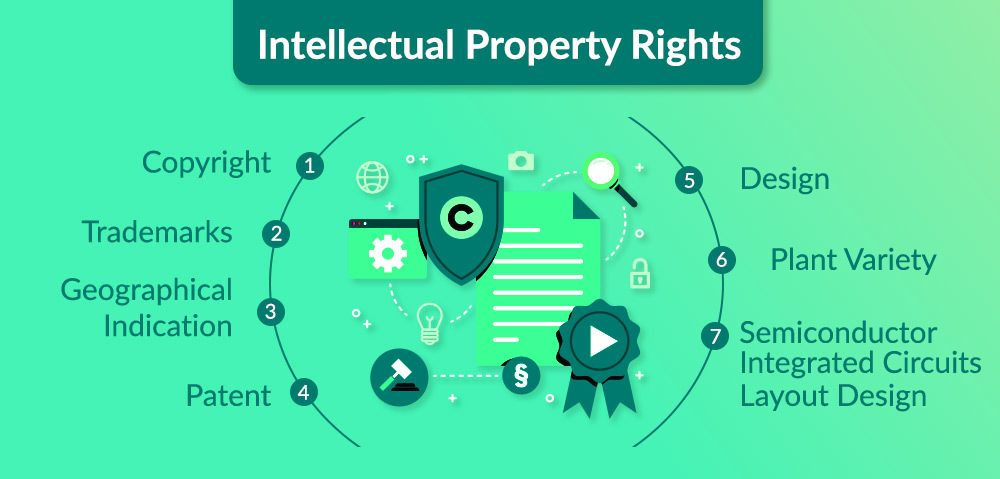
Types of Intellectual Property Rights (IPRs):
India recognizes several types of intellectual property rights, each serving a specific purpose and offering distinct benefits to innovators:
**Copyright
This protects original literary, artistic, musical, and dramatic works, ensuring that the creator can control reproduction, distribution, and public performance of their work. Copyrights encourage creators to produce content with confidence, knowing that their work cannot be used without permission. Examples include novels, paintings, software programs, and films. Copyright also allows creators to earn royalties when their work is used commercially.
**Trademark
A trademark safeguards symbols, logos, brand names, or slogans that distinguish a company’s goods or services from competitors. Trademarks help build customer trust and brand loyalty by making products instantly recognizable. For instance, the swoosh logo of a sports brand or the golden arches of a fast-food chain are protected by trademarks. Entrepreneurs can use trademarks to establish a unique identity and prevent others from exploiting their brand reputation.
**Geographical Indication (GI)
GI protection identifies products that originate from a specific geographic region and possess unique qualities or a reputation because of that origin. This not only protects the local producers but also helps in promoting regional products in domestic and international markets. Examples include Darjeeling tea, Kanchipuram silk, and Alphonso mangoes. GI encourages entrepreneurs to maintain quality and heritage while tapping into niche markets.
**Patent
Patents grant inventors exclusive rights over new inventions or improvements to existing products and processes for a defined period, typically 20 years. Patents incentivize innovation by allowing inventors to commercially benefit from their ideas while preventing others from using, manufacturing, or selling the invention without permission. Examples include a new type of medical device, a pharmaceutical drug, or a technological gadget. For entrepreneurs, patents can be a critical asset for attracting investment and entering competitive markets.
**Industrial Design
Industrial design protection covers the ornamental or aesthetic aspects of a product, including shape, pattern, and appearance. It does not protect functional features but ensures that the unique design of a product cannot be copied by competitors. For example, the distinctive design of a smartphone, furniture, or packaging can be protected. Industrial design rights help businesses maintain product uniqueness and market differentiation.
**Plant Variety Protection
This type of IPR safeguards the rights of breeders who develop new plant varieties. By protecting these innovations, plant breeders can control the propagation and sale of their new varieties, ensuring commercial benefits. Examples include hybrid crops like wheat, rice, or horticultural plants. For entrepreneurs in agriculture and biotechnology, plant variety protection encourages research, innovation, and sustainable development.
**Semiconductor Integrated Circuit Layout Design
This protects the layout designs of semiconductor chips and integrated circuits. Since semiconductor technology is critical in electronics, protecting the unique layout prevents unauthorized reproduction and copying. This type of IPR is especially important for technology startups and electronics manufacturers, ensuring that their investments in research and design are legally secured.