Overview of Project Management Metrics (original) (raw)
Last Updated : 30 Mar, 2026
Project Management Metrics are quantifiable measures used to evaluate how effectively a project is progressing toward its objectives. They provide data-driven insights into performance across key areas such as schedule, cost, quality, efficiency, risk, and stakeholder satisfaction.
They help teams to:
- Track progress accurately against timelines, budgets, and scope
- Measure performance objectively using reliable, data-driven indicators
- Improve decision-making with clear performance visibility
- Ensure strategic alignment between project outcomes and organizational goals
Why Project Performance Metrics Matter
- **Early Detection of Issues: Metrics act as an early-warning system for schedule delays, cost overruns, quality gaps, and emerging risks.
- **Performance Improvement: They highlight inefficiencies in processes, resource use, and workflows, allowing teams to optimize before problems escalate.
- **Strategic Alignment: Metrics confirm that the project remains aligned with organizational goals and is delivering expected business value.
- **Risk Management: By quantifying probability, impact, and mitigation effectiveness, metrics make risks visible and manageable.
- **Benchmarking and Learning: Standardized metrics allow comparison across projects, teams, and industry standards, driving organizational maturity.
Types of Project Management Metrics
Project metrics are typically grouped into the following categories:
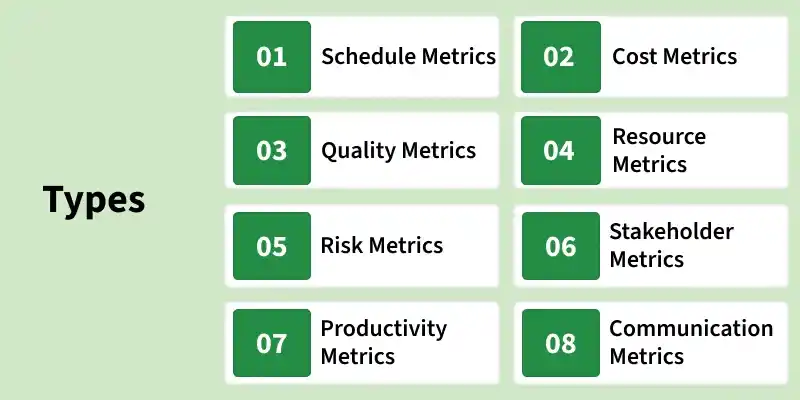
Types of Project Management Metrics
| Category | Key Metrics | What It Measures |
|---|---|---|
| **Schedule | SPI, SV, Milestone Achievement Rate | Progress against planned timeline |
| **Cost | CPI, CV, Budget Variance | Financial efficiency and health |
| **Quality | Defect Density, First Pass Yield, CSAT | Deliverable standards and stakeholder view |
| **Resource | Utilization Rate, Availability, Allocation Accuracy | People and asset efficiency |
| **Risk | Risk Exposure (Probability × Impact), Response Effectiveness | Threat level and mitigation success |
| **Stakeholder | Satisfaction Index, Engagement Level | Perception and collaboration |
| **Productivity | WBS Completion Rate, Cycle Time, Task Efficiency | Output speed and effectiveness |
| **Communication | Response Time, Meeting Participation Rate | Information flow and clarity |
How to Choose the Right Metrics for Your Project
- **Understand Project Objectives: Metrics must directly support what the project aims to achieve.
- **Consider Scope and Complexity: Large or complex projects require more detailed performance tracking.
- **Follow Industry Standards: Use established frameworks and best practices as reference points.
- **Consult the Project Team: Team members provide practical insight into meaningful measurements.
- **Prioritize What Matters Most: Focus on metrics that influence outcomes and decision-making.
- **Ensure Measurability: Select metrics that are quantifiable, reliable, and data-driven.
- **Maintain a Balanced Set: Include schedule, cost, quality, risk, resource, and stakeholder perspectives.
Collecting and Analyzing Project Metrics
Step 1: Identify Relevant Metrics
- Select measures aligned with goals, stakeholder needs, and KPIs.
Step 2: Collect and Document Data
- Use project tools, reports, and stakeholder feedback. Store data systematically for accuracy and consistency.
Step 3: Monitor Regularly
- Track performance weekly or monthly to detect deviations early.
Step 4: Analyze and Interpret
- Compare actual performance against plans. Identify root causes and performance gaps.
Step 5: Identify Trends and Patterns
- Recognize recurring issues such as budget drift or declining satisfaction.
Step 6: Decision-Making and Action Planning
- Adjust schedules, budgets, and processes based on data insights.
Step 7: Continuous Improvement
- Review metrics regularly and apply lessons learned to future projects.
Using Metrics to Drive Project Success
- **Strategic Alignment: Ensure all activities support project goals
- **Transparent Communication: Build trust through data-backed reporting
- **Proactive Risk Mitigation: Act before risks escalate
- **Performance Recognition: Celebrate milestones and achievements
What Makes a Project Successful
- **Clear Objectives and Scope: Well-defined goals and deliverables set the foundation for success.
- **Effective Planning and Execution: Structured plans, realistic timelines, and disciplined execution are essential.
- **Strong Stakeholder Engagement: Inclusive communication and shared decision-making improve outcomes.
- **Skilled Project Team: Competent, collaborative, and adaptable team members drive delivery.
- **Timely Delivery: Meeting deadlines preserves stakeholder confidence and project value.
- **Post-Project Evaluation: Review outcomes, document lessons learned, and refine best practices.