Pricing | Objectives, Importance, Factors and Pricing Strategies (original) (raw)
Last Updated : 29 Oct, 2025
Pricing in product management is the process of determining the right value a customer pays in exchange for a product or service. It plays a crucial role in balancing business profitability with customer satisfaction and market competitiveness.
- Determines how much value customers are willing to exchange for a product or service.
- Involves analyzing factors like production cost, market demand, competitor pricing, and perceived value.
- Acts as one of the core 4Ps of marketing Product, Price, Place, and Promotion and the only one that directly generates revenue.
- Helps align business goals, market positioning, and customer expectations to achieve sustainable growth.
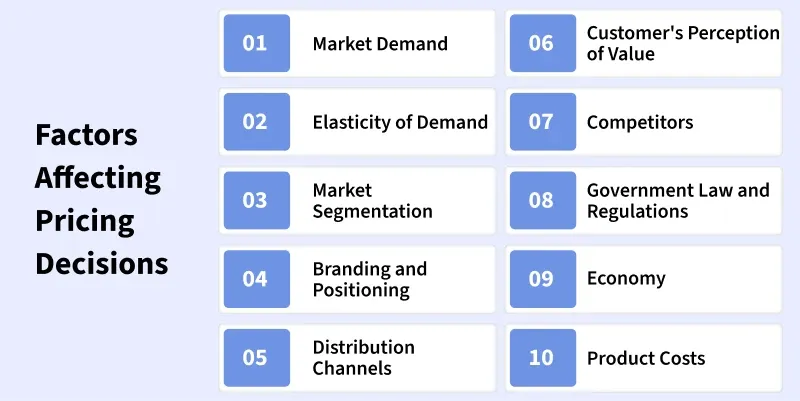
Factors Affecting Pricing.
Objectives of Pricing
The objectives of pricing encompass a range of strategic goals that businesses aim to achieve through their pricing decisions. These objectives guide how products or services are priced and contribute to overall business success. Key objectives of pricing include:
**1. Revenue Generation
- The primary goal of pricing is to maximize total revenue by balancing price and sales volume.
- Setting prices strategically helps in capturing a larger market share while maintaining profitability.
- The right price attracts customers without compromising revenue growth.
**2. Market Leadership
- Businesses often aim to dominate the market by offering competitive prices.
- To achieve a larger customer base and outperform rivals, a company must set an affordable yet profitable price.
- Market leadership pricing helps build brand recognition and long-term customer loyalty.
**3. Survival
- In highly competitive or unstable markets, the main objective may simply be to survive.
- Proper pricing ensures that the company earns sufficient revenue to cover costs and sustain operations.
- Especially during economic downturns, businesses may lower prices to maintain cash flow and retain customers.
**4. Profit Maximization
- A major objective of pricing is to achieve maximum profit by optimizing the relationship between cost, price, and demand.
- Businesses use pricing strategies that ensure the selling price exceeds production and marketing costs.
- Consistent profitability supports expansion, innovation, and overall business growth.
**5. Customer Attraction and Retention
- An effective and customer friendly pricing strategy helps in both acquiring new customers and retaining existing ones.
- Affordable prices increase satisfaction and strengthen customer loyalty.
- A wider and loyal customer base translates into sustainable long-term revenue.
Importance of Pricing
Pricing is of paramount importance in the realm of business and commerce due to its multifaceted impact on various aspects of an organization's operations, financial health, and overall success. The significance of pricing can be outlined as follows:
**1. Creates the First Impression
- Price is often the first factor customers notice before making a purchase decision.
- Even if a product offers great benefits, customers will still compare prices with alternatives.
- Overpricing can drive customers away, while competitive pricing can attract interest and build trust.
**2. Ensures Right-Level Pricing
- Setting the right price is crucial for business sustainability.
- Incorrect pricing can lead to loss of sales or even business closure due to poor revenue generation.
- Proper market research and analysis of competitors, demand, and costs are essential before finalizing prices.
**3. Promotes Sales Growth
- Pricing acts as an effective sales promotion tool.
- Temporary price reductions, discounts, or promotional offers can boost short-term sales.
- Businesses often use pricing strategies to clear inventory or attract new customers.
**4. Provides Flexibility
- Among the four marketing mix elements (Product, Price, Place, Promotion), price is the most flexible.
- It can be adjusted quickly in response to market changes, competition, or customer perception.
- Factors such as inflation, demand, and production costs directly influence pricing decisions.
**5. Drives Profit Generation
- Pricing decisions have a direct impact on profitability.
- The right pricing ensures that revenue exceeds costs, helping sustain production and growth.
- Profitability enables reinvestment in innovation, marketing, and customer service.
**6. Builds a Competitive Edge
- Smart pricing helps a business stand out from competitors.
- Competitive pricing attracts price-sensitive customers and strengthens brand positioning.
- Businesses can use value-based pricing to emphasize quality or uniqueness.
**7. Manages Market Demand
- Effective pricing can help regulate demand for products or services.
- Offering discounts during low seasons can stimulate demand, while higher prices can manage excess demand during peak times.
- This balance ensures steady sales and customer satisfaction.
Factors Affecting Pricing Decisions
The pricing of products is influenced by a multitude of factors that businesses must carefully consider to determine an appropriate and effective pricing strategy. These factors can vary across industries, markets, and individual businesses. Some of the key factors affecting product pricing include:
**1. Customer's Perception of Value:
- Customers decide what a product is worth based on the value they perceive its quality, usefulness, and brand reputation.
- If the price exceeds this perceived value, customers may turn away. Hence, a customer oriented pricing approach ensures that pricing aligns with what buyers are willing to pay.
**2. Competitors:
Competitor pricing strongly impacts pricing decisions.
Businesses can choose to:
- Match competitor prices to stay relevant,
- Price higher to signal premium quality, or
- Lower prices to attract price-sensitive buyers.
Understanding competitor moves helps maintain market balance and positioning.
**3. Government Law and Regulations:
- Laws and policies prevent unfair pricing practices like price fixing or predatory pricing.
- Compliance with legal standards not only protects customers but also builds long-term trust and credibility for the brand.
**4. Economy:
- Market factors like inflation, interest rates, and consumer spending power influence pricing.
- During downturns, businesses often lower prices to sustain sales, while in growth periods, they may raise them to offset rising costs or capture higher margins.
**5. Product Costs:
- The total cost covering raw materials, labor, distribution, and marketing forms the baseline for pricing.
- A business must ensure prices cover costs and yield a reasonable profit without alienating customers.
**6. Market Demand:
- When demand is high, businesses can maintain or increase prices.
- In contrast, when demand falls, flexible pricing or discounts can help stimulate purchases and retain market share.
**7. Elasticity of Demand:
- Elasticity measures how sensitive buyers are to price changes.
- Inelastic demand: Prices can rise without major impact on sales.
- Elastic demand: Even small price increases can reduce sales significantly.
- Analyzing elasticity helps strike the right balance between price and volume.
**8. Market Segmentation:
- Different customer groups have different willingness to pay.
- Segmented pricing such as student discounts or premium tiers helps target each group effectively and maximize overall revenue.
**9. Branding and Positioning:
- Different customer groups have different willingness to pay.
- Segmented pricing such as student discounts or premium tiers helps target each group effectively and maximize overall revenue.
**10. Distribution Channels:
- Pricing also depends on how the product reaches the customer.
- Selling directly (D2C) allows more flexible pricing, while using intermediaries like retailers adds mark-ups that raise the final price.
Pricing Strategies
Different pricing strategies that a company can adopt to decide the price of its product/service include:
**1. New Product Pricing Strategies
When launching a new product, determining the right price is often the biggest challenge. Businesses usually adopt one of two key approaches:
- **Market-Skimming Pricing
Used when a company introduces an innovative product with little or no competition. The product is launched at a high initial price to maximize profits from early adopters and is gradually reduced as competition grows or demand stabilizes. - **Market-Penetration Pricing
The opposite of skimming, this strategy involves setting a low introductory price to quickly attract customers, capture market share, and build brand loyalty. Prices may be increased later once the product gains traction.
**2. Product Mix Pricing Strategies
When a product is a part of the product mix, the business would like to charge higher prices for the product in order to increase the overall profits of the product mix. There are various strategies coming under Product Mix Pricing Strategy, stated as:
| Strategy | Description |
|---|---|
| **Product Line Pricing | Setting prices across an entire product line |
| **Optional-product Pricing | Pricing accessary or optional products sold with the main product |
| **Captive-product Pricing | Pricing products that are complementary to the main product |
| **By-Product Pricing | Pricing low-value by-products to get rid of them |
| **Product Bundle Pricing | Pricing bundles of products sold together |
3. Price-Adjustment Strategies
Companies keep on changing their pricing strategy to account for various customer differences and changing situations. There are various strategies coming under Price-Adjustment Strategies, such as:
| Strategy | Description |
|---|---|
| **Discount and Allowance Pricing | Reducing prices to give rewards to customers for exceptional responses like paying early or promoting the product |
| **Segmented Pricing | Adjusting prices to allow for differences in customers, products, or location |
| **Psychological Pricing | Adjusting prices for psychological effect |
| **Promotional Pricing | Temporarily reducing prices to increase short-run sales |
| **Geographic Pricing | Adjusting prices to account for customers' geographic location |
| **Dynamic Pricing | Adjusting prices continually to meet the needs of individual customers and situations |
| **International Pricing | Adjusting prices for international markets |