Responsibilities of a Product Manager (original) (raw)
Last Updated : 2 Jun, 2026
A Product Manager is a strategic leader responsible for the end-to-end success of a product from idea to launch to growth. PMs bridge teams, set direction, and turn insights into outcomes.
- Bridge the gap between teams, turning ideas into reality
- Set the product vision and roadmap, keeping teams aligned
- Track user feedback and market trends to drive innovation
But the real value lies in how these responsibilities are executed.
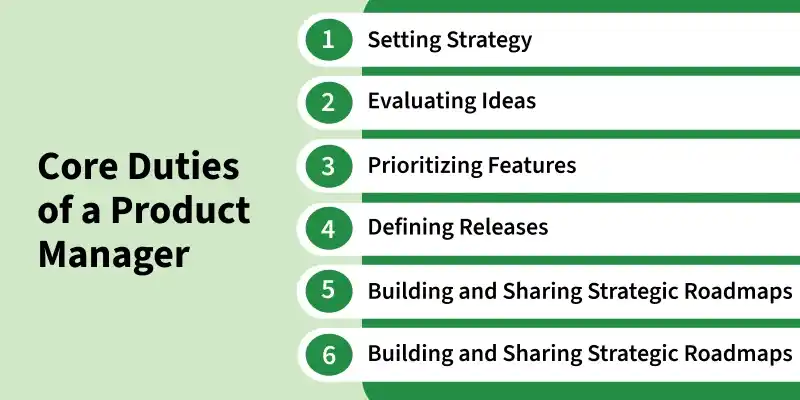
Core Duties of a Product Manager
1. Setting Strategy
Product strategy defines where the product is going and why.
**Key Activities:
- Market and user research
- Competitive analysis
- Defining vision and value proposition
- Setting OKRs or KPIs
- Aligning with company strategy
2. Evaluating Ideas
PMs assess ideas based on value, feasibility, and strategic fit.
**Key Activities:
- Collecting ideas from users, support, sales, and internal teams
- Running feasibility checks with engineering and design
- Deciding to advance, iterate, or reject ideas
**RICE Framework:
- **Reach: How many users?
- **Impact: How much value?
- **Confidence: How sure are we?
- **Effort: Cost to build?
3. Prioritizing Features
Prioritization is about saying no to good ideas to focus on the right ones.
**Key Activities:
- Using frameworks (RICE, MoSCoW, Value vs Effort)
- Balancing short-term wins with long-term vision
- Managing stakeholder expectations
- Maintaining a clear, outcome-focused backlog
4. Defining Releases
Releases translate strategy into shippable value.
**Key Activities:
- Grouping features into meaningful releases
- Coordinating with engineering, QA, marketing, and support
- Managing timelines and dependencies
- Ensuring launch readiness (docs, training, GTM)
5. Building and Sharing Strategic Roadmaps
A roadmap communicates why, what, and when not just deadlines.
**Key Activities:
- Creating tailored roadmap views (execs vs teams vs customers)
- Keeping roadmaps flexible and evidence-driven
- Communicating changes transparently
6. Analyzing and Reporting on Progress
This involves tracking the progress of development and product performance, and reporting results to stakeholders to ensure accountability and data-driven decisions.
**Key Activities:
- Tracking metrics (adoption, NPS, conversion)
- Monitoring delivery against roadmap
- Running retrospectives and post-launch reviews
Use Case: Launching a Remote Work Stays Feature
A Product Manager identifies the growing demand for long-term stays and leads the product from idea to launch and optimization.
How Responsibilities Come Together:
- **Setting Strategy: Defines vision, target users, and success metrics based on market trends.
- **Evaluating Ideas: Shortlists features like long-stay discounts and work-friendly filters using frameworks (RICE).
- **Prioritizing Features: Focuses on high-impact features first while aligning stakeholders.
- **Defining Releases: Plans phased launches and coordinates across teams for execution.
- **Roadmapping: Communicates clear direction and adapts based on feedback.
- **Analyzing Performance: Tracks adoption, user satisfaction, and iterates post-launch.
**Outcome: A successful feature launch that improves user engagement and drives business growth through data-driven decisions.
Product Manager vs Project Manager
Here are the following differences between Product Manager and Project Manager:
| **Aspect | **Product Manager | **Project Manager |
|---|---|---|
| **Vision & Strategy | Manages product vision and strategy | Manages project teams, tasks, and resources |
| **Focus Area | Focuses on product strategy and lifecycle management | Focuses on project execution and delivery |
| **Work Duration | Works continuously across the entire product lifecycle | Works within a temporary timeframe with a clear end goal |
| **Planning Responsibility | Defines the product vision and strategy | Plans and organizes project activities |
| **Success Measurement | Measures success through product outcomes | Measures success using project milestones, timelines, and resource allocation |
Product Manager vs Product Owner
Here's a comparison between the roles of a Product Manager and a Product Owner:
| **Aspect | **Product Manager | **Product Owner |
|---|---|---|
| **Vision & Strategy | Sets the overall product vision and strategy | Manages the product backlog and feature priorities |
| **Lifecycle Ownership | Responsible for the entire product lifecycle | Focuses on managing the product backlog and iterations |
| **Roadmap & Planning | Shapes the product roadmap and strategic direction | Prioritizes features and user stories for development |
| **Primary Focus | Focuses on market needs and overall product success | Concentrates on meeting iteration goals and requirements |
| **Communication | Communicates product vision to stakeholders | Communicates detailed feature requirements to development teams |
Product Manager vs Product Developer
Here's a comparison between the roles of a Product Manager and a Product Developer in a tabular format:
| **Aspect | **Product Manager | **Product Developer |
|---|---|---|
| **Vision & Strategy | Sets the overall product vision and strategy | Implements technical aspects based on specifications |
| **Primary Responsibility | Responsible for strategic direction and market success | Focuses on technical implementation of product features |
| **Lifecycle Involvement | Manages the entire product lifecycle | Executes technical tasks based on requirements |
| **Planning & Execution | Shapes product strategy and roadmap | Works on coding, architecture, and technical problem-solving |
| **Core Focus | Focuses on strategic planning, market analysis, and leadership | Focuses on building and delivering the technical solution |