Break Statement in C (original) (raw)
Last Updated : 17 Oct, 2025
The break statement in C is a loop control statement that breaks out of the loop when encountered. It can be used inside loops or switch statements to bring the control out of the block. The break statement can only break out of a single loop at a time.
C `
#include <stdio.h>
int main() { for (int i = 1; i <= 10; i++) {
      // Exit the loop when i equals 5
    if (i == 5) {
        break;
    }
    printf("%d ", i);
}
return 0;
}
`
**Explanation: In this program, the break statement exits the loop when i == 5. As a result, the loop stops prematurely, and only the numbers 1 to 4 are printed.
How does break work?

Working of break stateemnt in C
The working of the break statement in C is described below:
- STEP 1: The loop execution starts after the test condition is evaluated.
- STEP 2: If the break condition is present the condition will be evaluated.
- STEP 3A: If the condition is true, the program control reaches the break statement and skips the further execution of the loop by jumping to the statements directly below the loop.
- STEP 3B: If the condition is false, the normal flow of the program control continues.
Flowchart of break Statement
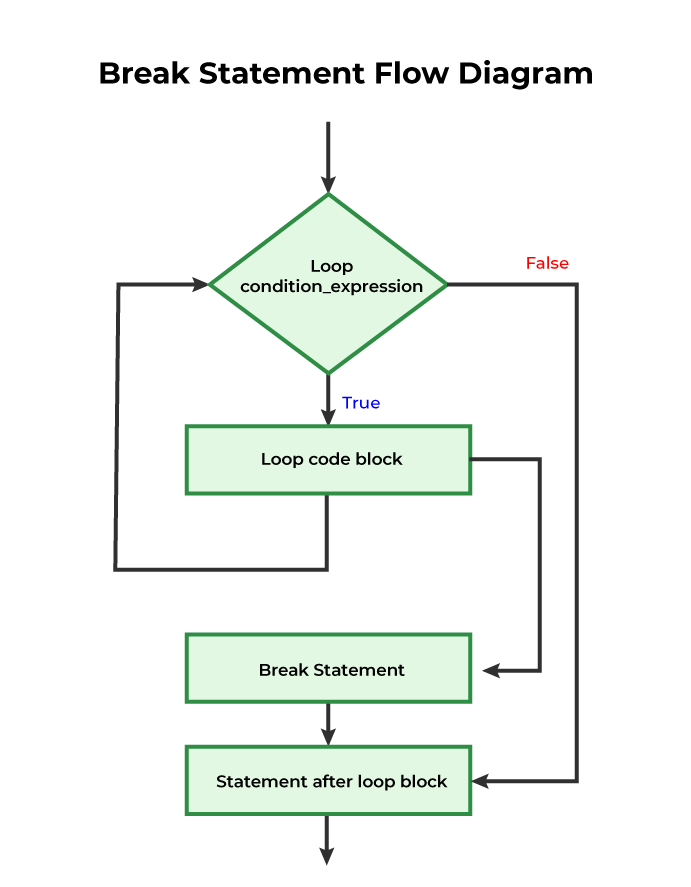
Flowchart for Break Statement in C
break with Nested Loops
C `
#include <stdio.h>
int main() {
// Nested for loops with break statement at inner loop
for (int i = 1; i <= 6; ++i)
{
    for (int j = 1; j <= i; ++j)
    {
        if (i <= 4)
        {
            printf("%d ", j);
        }
        else
        {

            // If i > 4 then this innermost loop will break
            break;
        }
    }
    printf("\n");
}
return 0;
}
`
Output
1 1 2 1 2 3 1 2 3 4
**Explanation: In the above program the inner loop breaks when the value of i becomes equal to 4, which stops the printing of the value , although the outer loop continues to run but as the inner loop encounters a break statement for every iteration of i after the value of i becomes equal to 4, no values are printed after the fourth line.
Break in C switch case
- In general, the Switch case statement evaluates an expression, and depending on the value of the expression, it executes the statement associated with the value.
- Not only that, all the cases after the matching case after the matching case will also be executed.
- To prevent that, we can use the break statement in the switch case as shown: C `
#include <stdio.h> #include <stdlib.h>
int main() { char c; float x, y;
while (1)
{
    printf("Enter an operator (+, -), if want to exit "
           "press x: ");
    scanf(" %c", &c);
    // to exit
    if (c == 'x')
        exit(0);

    printf("Enter Two Values:\n ");
    scanf("%f %f", &x, &y);

    switch (c)
    {

    // For Addition
    case '+':
        printf("%.1f + %.1f = %.1f\n", x, y, x + y);
        break;

    // For Subtraction
    case '-':
        printf("%.1f - %.1f = %.1f\n", x, y, x - y);
        break;
    default:
        printf("Error! please write a valid operator\n");
    }
}
}
`
**Output:
Enter an operator (+, -), if want to exit press x: +
Enter Two Values:
10
20
10.0 + 20.0 = 30.0
**Explanation: This C program uses a while loop to repeatedly prompt the user for an operator and two numbers, performing addition or subtraction based on the operator entered. The break statement is used in the switch case to exit after executing the relevant operation, and the program exits when the user enters 'x'. If an invalid operator is provided, an error message is displayed.
break vs continue
The difference between the break and continue in C is listed in the below table:
| break | continue |
|---|---|
| The break statement terminates the loop and brings the program control out of the loop. | The continue statement terminates only the current iteration and continues with the next iterations. |
| The syntax is: break; | The syntax is: continue; |
| The break can also be used in switch case. | Continue can only be used in loops. |