Inputoutput system calls (original) (raw)
System calls are the interface through which a program requests services from the operating system kernel, especially for operations that require privileged access. In C, many input and output operations ultimately rely on system calls, where the program interacts with the kernel to access devices such as the keyboard, monitor and other I/O resources.
Before we move on to the I/O System Calls, we need to know about the file descriptor.
File Descriptor
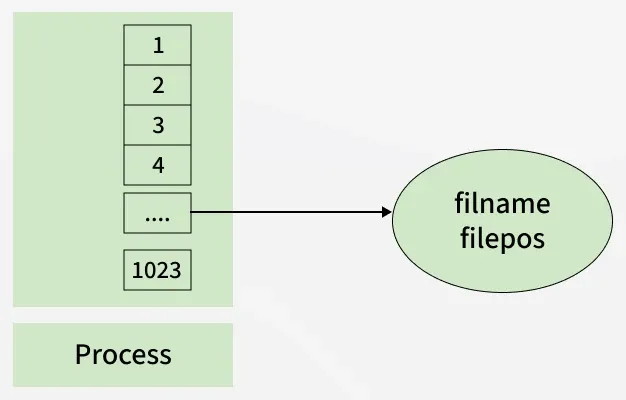
A file descriptor is an integer that uniquely identifies an opened file of the process. It is stored in the file descriptor table in which elements are pointers to file table entries. One unique file descriptor table is provided in the operating system for each process.
File table entries are a structure in-memory surrogate for an open file, which is created when processing a request to open the file and these entries maintain file position.
Standard File Descriptors
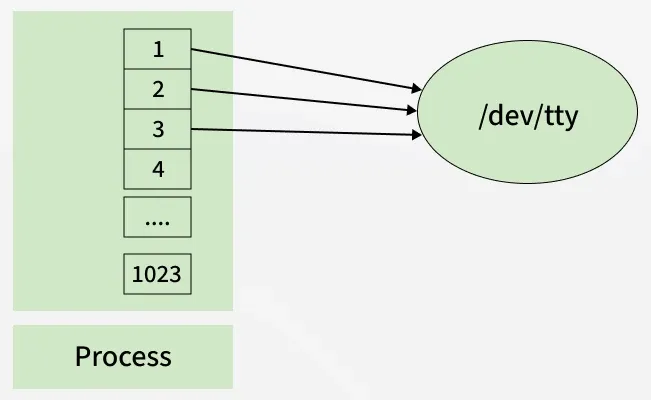
When any process starts, then that process file descriptors table’s fd(file descriptor) 0, 1, 2 open automatically, (By default) each of these 3 fd references file table entry for a file named ****/dev/tty**
- **stdin (file descriptor 0): Standard input stream, whenever we write any character from the keyboard, it reads from stdin through fd 0 and saves to a file named /dev/tty.
- **stdout (file descriptor 1): Standard output stream, any output to the video screen, it’s from the file named /dev/tty and written to stdout in screen through fd 1.
- **stderr (file descriptor 2): We see any error to the video screen, it is also from that file write to stderr in screen through fd 2.
Input-Output System Calls in C
The I/O system calls offer direct access to the operating systems' input and output functionalities and provide complete control over file operations, memory management and device communications. There are 5 input and output system calls in C:
1. Creat
The creat system call is used to create a new empty file in C and is provided as the **creat() function. It allows specifying the file name and permissions of the file. It is declared in the ****<fcntl.h>** header file.
Syntax
creat(filename, mode);
**Parameters
- **filename: Name of the file which you want to create
- **mode: Indicates permissions of the new file.
**Return Value
- Returns the first unused file descriptor (generally 3, since 0, 1, and 2 are reserved)
- Return -1 when an error occurs. C `
#include <fcntl.h> #include <unistd.h> #include <stdio.h>
int main() {
// Create a new file or open it
//if it exists (write-only access)
// File permissions: rw-r--r--
int fd = creat("newfile.txt", 0644);

if (fd == -1) {
    perror("Error creating file");
    return 1;
}

// File was successfully created
printf("File 'newfile.txt' created successfully \n"
       "File descriptor: %d\n", fd);

// Close the file descriptor
close(fd);

return 0;
}
`
Output
File 'newfile.txt' created successfully File descriptor: 3
How C create() works in OS?
The create() system call works as follows:
- Create a new empty file on the disk.
- Create file table entry.
- Set the first unused file descriptor to point to the file table entry.
- Return file descriptor used, -1 upon failure.
2. Open
The **open() function provides the open system call in C. It is used to open the file for reading, writing, or both. It is also capable of creating the file if it does not exist. It is defined inside ****<unistd.h>** header file and the flags that are passed as arguments are defined inside ****<fcntl.h>** header file.
Syntax
open (path, flags);
**Parameters:
**Path: Path to the file which we want to open.
- Use the **absolute path beginning with "/" when you are **not **working in the same directory as the C source file.
- Use relative path which is only the file name with extension, when you are working in the same directory as the C source file.
**flags: It is used to specify how you want to open the file. We can use the following flags:
| Flags | Description |
|---|---|
| **O_RDONLY | Opens the file in read-only mode. |
| **O_WRONLY | Opens the file in write-only mode. |
| **O_RDWR | Opens the file in read and write mode. |
| **O_CREAT | Create a file if it doesn’t exist. |
| **O_EXCL | Prevent creation if it already exists. |
| **O_APPEND | Opens the file and places the cursor at the end of the contents. |
| **O_ASYNC | Enable input and output control by signal. |
| **O_CLOEXEC | Enable close-on-exec mode on the open file. |
| **O_NONBLOCK | Disables blocking of the file opened. |
| **O_TMPFILE | Create an unnamed temporary file at the specified path. |
Example: Below example demonstrates how to use the open() system call to open an existing file or create it if it does not exist.
C `
#include <errno.h> #include <fcntl.h> #include <stdio.h> #include <unistd.h>
extern int errno;
int main() {
// If file does not have in directory
// then file foo.txt is created.
int fd = open("foo.txt", O_RDONLY | O_CREAT);
printf("fd = %d\n", fd);

if (fd == -1) {

    // Print which type of error the code have
    printf("Error Number % d\n", errno);

    // print program detail "Success or failure"
    perror("Program");
}
return 0;
}
`
**Output
fd = 3
How C open() works in OS?
The open() system call works as follows:
- Find the existing file on the disk.
- Create file table entry.
- Set the first unused file descriptor to point to the file table entry.
- Return file descriptor used, -1 upon failure.
3. Close
The **close system call is provided as close() function in C that tells the operating system that you are done with a file descriptor and closes the file pointed by the file descriptor. It is defined inside <unistd.h> header file.
Syntax
close(fd);
**Parameter: fd: File descriptor of the file that you want to close.
**Return Value
- **0 on success.
- **-1 on error.
Example 1
C `
#include <fcntl.h> #include <stdio.h> #include <unistd.h>
int main() { int fd1 = open("foo.txt", O_RDONLY); if (fd1 < 0) { perror("c1"); exit(1); } printf("opened the fd = % d\n", fd1);
// Using close system Call
if (close(fd1) < 0) {
    perror("c1");
    exit(1);
}
printf("closed the fd.\n");
}
`
**Output
opened the fd = 3
closed the fd.
Example 2:
C `
#include<stdio.h> #include<fcntl.h> int main() {
// Assume that foo.txt is already created
int fd1 = open("foo.txt", O_RDONLY, 0);
close(fd1);

// assume that baz.tzt is already created
int fd2 = open("baz.txt", O_RDONLY, 0);

printf("fd2 = % d\n", fd2);
exit(0);
}
`
**Output
fd2 = 3
Here, In this code first open() returns **3 because when the main process is created, then fd **0, 1, 2 are already taken by **stdin, **stdout, and **stderr. So the first unused file descriptor is **3 in the file descriptor table. After that in close() system call is free it these **3 file descriptors and then set **3 file descriptors as **null. So when we called the second open(), then the first unused fd is also **3. So, the output of this program is **3.
How C close() works in the OS?
The close() system call works as follows:
- Destroy file table entry referenced by element fd of the file descriptor table
- As long as no other process is pointing to it! - Set element fd of file descriptor table to **NULL
4. Read
The read system call, implemented as the **read() function reads the specified amount of bytes **cnt of input into the memory area indicated by **buf from the file indicated by the file descriptor **fd. A successful **read() updates the access time for the file. The **read() function is also defined inside the ****<unistd.h>** header file.
Syntax
read (fd, buf, cnt);
**Parameters
- **fd: file descriptor of the file from which data is to be read.
- **buf: buffer to read data from.
- **cnt: length of the buffer.
**Return Value
- Return number of bytes read on success.
- Return 0 on reaching the end of file.
- Return -1 on error.
- Return -1 on signal interrupt.
**buf needs to point to a valid memory location with a length not smaller than the specified size because of overflow. fd should be a valid file descriptor returned from open() to perform the read operation because if fd is NULL then the read should generate an error. cnt is the requested number of bytes read, while the return value is the actual number of bytes read. Also, sometimes read system call should read fewer bytes than cnt.
Example
C `
#include <fcntl.h> #include <stdio.h> #include <unistd.h> #include <stdlib.h>
int main() { int fd, sz; char* c = (char*)calloc(100, sizeof(char));
fd = open("foo.txt", O_RDONLY);
if (fd < 0) {
    perror("r1");
    exit(1);
}

sz = read(fd, c, 10);
printf("called read(% d, c, 10). returned that"
       " %d bytes were read.\n",
       fd, sz);
c[sz] = '\0';
printf("Those bytes are as follows: % s\n", c);

return 0;
}
`
**Output
called read(3, c, 10). returned that 10 bytes were read.
Those bytes are as follows: 0 0 0 foo.
Suppose that sample.txt consists of the 6 ASCII characters “foobar”. Then what is the output of the following program?
C `
#include <fcntl.h> #include <stdio.h> #include <stdlib.h> #include <unistd.h>
int main() { char c; int fd1 = open("sample.txt", O_RDONLY, 0); int fd2 = open("sample.txt", O_RDONLY, 0); read(fd1, &c, 1); read(fd2, &c, 1); printf("c = %c\n", c); exit(0); }
`
**Output
c = f
The descriptors **fd1 and **fd2 each have their own open file table entry, so each descriptor has its own file position for **foobar.txt. Thus, the read from **fd2 reads the first byte of **foobar.txt, and the output is c = f, not c = o.
5. Write
The write system callis provided as **write() function. It writes **cnt bytes from **buf to the file or socket associated with **fd. **cnt should not be greater than **INT_MAX (defined in the limits.h header file). If **cnt is zero, **write() simply returns 0 without attempting any other action.
Thewrite() is also defined inside ****<unistd.h>** header file.
Syntax
write (fd, buf, cnt);
**Parameters
- **fd: file descriptor
- **buf: buffer to write data from.
- **cnt: length of the buffer.
**Return Value
- Returns the number of bytes written on success.
- Return 0 on reaching the End of File.
- Return -1 on error.
- Return -1 on signal interrupts.
The file needs to be opened for write operations****.** bufneeds to be at least as long as specified by cnt because if buf size is less than the cnt then buf will lead to the overflow condition.cnt is the requested number of bytes to write, while the return value is the actual number of bytes written. This happens when fd has a less number of bytes to write than cnt.
If write() is interrupted by a signal, the effect is one of the following:
- If write() has not written any data yet, it returns -1 and sets errno to EINTR.
- If write() has successfully written some data, it returns the number of bytes it wrote before it was interrupted.
Example 1
C `
#include <stdio.h> #include <fcntl.h> #include <string.h>
main() { int sz;
int fd = open("foo.txt", O_WRONLY | O_CREAT | O_TRUNC, 0644);
if (fd < 0) {
    perror("r1");
    exit(1);
}

sz = write(fd, "hello geeks\n", strlen("hello geeks\n"));

printf("called write(% d, \"hello geeks\\n\", %d)."
       " It returned %d\n", fd, strlen("hello geeks\n"), sz);

close(fd);
}
`
**Output
called write(3, "hello geeks\n", 12). it returned 11
Here, when you see in the file foo.txt after running the code, you get a “__hello geeks_“. If foo.txt file already has some content in it then the write a system calls overwrite the content and all previous content is **deleted and only “__hello geeks_” content will have in the file.
Example 2
C `
#include <fcntl.h> #include <stdio.h> #include <string.h> #include <unistd.h>
int main(void) { int fd[2]; char buf1[12] = "hello world"; char buf2[12];
// assume foobar.txt is already created
fd[0] = open("foobar.txt", O_RDWR);
fd[1] = open("foobar.txt", O_RDWR);

write(fd[0], buf1, strlen(buf1));
write(1, buf2, read(fd[1], buf2, 12));

close(fd[0]);
close(fd[1]);

return 0;
}
`
**Output
hello world
In this code, buf1 array's string "hello world" is first written into stdin fd[0] then after that this string write into stdin to buf2 array. After that write into buf2 array to the stdout and print output "hello world".