Alkenes (original) (raw)
Last Updated : 14 May, 2026
Alkenes are unsaturated hydrocarbons that contain at least one carbon–carbon double bond (C=C). They have the general formula CnH2n and are also called olefins. In alkenes, the carbon atoms involved in the double bond are sp2 hybridised and have a trigonal planar geometry. Due to the presence of a double bond, alkenes are more reactive than alkanes and undergo addition reactions. They occur in petroleum and are important starting materials in the manufacture of many industrial chemicals.
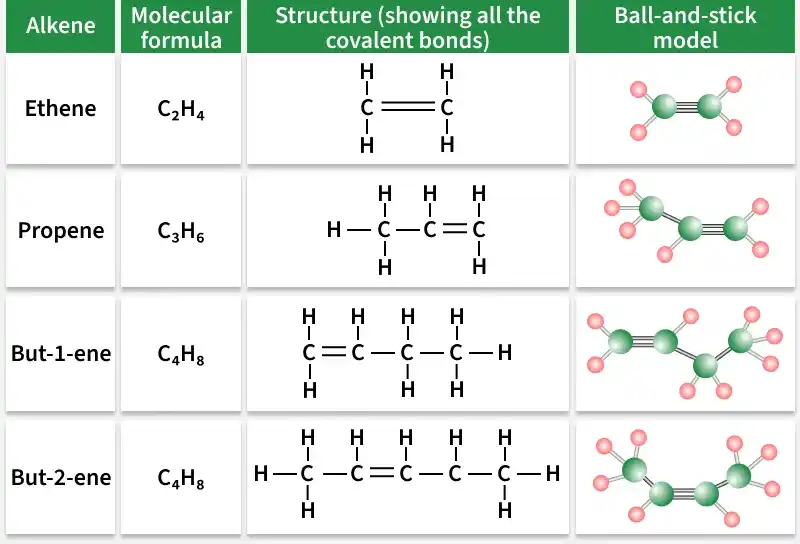
**Nomenclature of Alkenes
Alkenes are named according to the IUPAC system of nomenclature, similar to alkanes, but with special attention to the double bond.
- The longest carbon chain containing the double bond is selected as the parent chain.
- The chain is numbered from the end nearest to the double bond so that the double bond gets the lowest possible number.
- The position of the double bond is indicated by the number of the carbon where it begins.
- The suffix –ene is used instead of –ane (e.g., ethene, propene, but-1-ene).
- If more than one double bond is present, suffixes like –diene, –triene are used with proper numbering.
- Substituents (alkyl groups) are named and numbered in the usual way and written before the parent name in alphabetical order.
- In some cases, geometrical isomerism (cis–trans) is also indicated in the name when applicable.
| **Formula | **IUPAC name |
|---|---|
| C2H4 | Ethene |
| C3H6 | Propene |
| C4H8 | Butene |
| C5H10 | Pentene |
| C6H12 | Hexene |
| C7H14 | Heptene |
| C8H16 | Octene |
| C9H18 | Nonene |
| C10H20 | Decene |
Isomerism in Alkenes
Alkenes exhibit both structural isomerism and stereoisomerism due to the presence of the carbon–carbon double bond (C=C).
**1. Structural Isomerism
Structural isomerism occurs when compounds have the same molecular formula but different structural arrangements of atoms. In simple alkenes such as ethene and propene, only one structure is possible. However, alkenes containing four or more carbon atoms show structural isomerism.
Structural isomerism in alkenes includes:
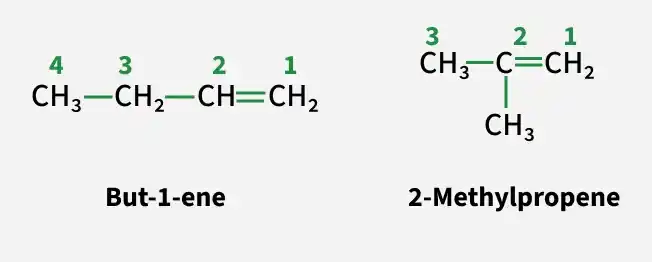
****(a) Chain Isomerism**
Chain isomerism arises due to different arrangements of the carbon skeleton (straight or branched chains).
The position of the double bond remains unchanged.
For example, C4H8:
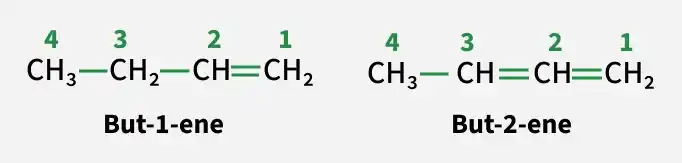
****(b) Position Isomerism**
Position isomerism occurs when the position of the double bond changes while the carbon chain remains the same.
2. Stereoisomerism (Geometrical Isomerism)
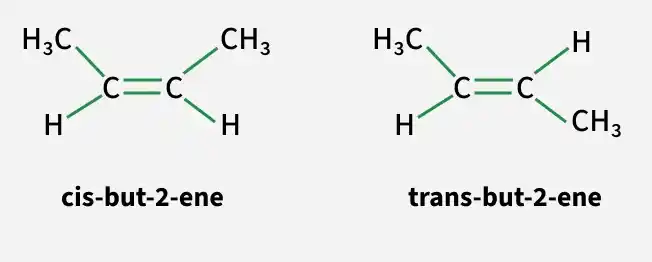
Stereoisomerism occurs when compounds have the same structural formula but differ in the spatial arrangement of atoms around the double bond. Geometrical isomerism arises because rotation around the C=C double bond is restricted. It occurs when each carbon of the double bond is attached to two different groups.
For example, but-2-ene shows geometrical isomerism:
- **Cis-isomer: Similar groups are present on the same side of the double bond.
- **Trans-isomer: Similar groups are present on opposite sides of the double bond.
Physical Properties of Alkenes
Alkenes show regular variation in their physical properties due to their non-polar nature and increase in molecular size along the homologous series. Their properties are quite similar to alkanes but are slightly affected by the presence of a double bond.
- **Nature (Non-polar character): Alkenes are generally non-polar molecules because the electronegativity difference between carbon and hydrogen is small. Hence, they have weak intermolecular forces (van der Waals forces).
- **Solubility: Alkenes are insoluble in water as they cannot form hydrogen bonds with water molecules. However, they are soluble in organic solvents like ether, benzene, and carbon tetrachloride.
- **Boiling Point: The boiling point of alkenes increases with increase in molecular mass due to stronger intermolecular forces. However, branching lowers the boiling point by decreasing surface area, similar to alkanes.
- **Melting Point: Melting points generally increase with molecular mass, but the trend is not very regular because it depends on how well the molecules pack in the solid state.
- **Physical State: Lower alkenes (C₂–C₄) are gases, middle members are liquids, and higher members are solids. This is due to increasing intermolecular forces with increasing size.
- **Colour and Odour: Alkenes are generally colourless. Some lower members may have a faint odour.
Chemical Properties of Alkenes
Alkenes are more reactive than alkanes due to the presence of a carbon–carbon double bond (C=C), which contains a weaker π-bond. This π-bond easily breaks, so alkenes mainly undergo addition reactions.
1. Addition Reactions
- **Hydrogenation (Addition of H 2 ): Alkenes react with hydrogen in the presence of catalysts like Ni, Pd, or Pt to form alkanes.
C_2H_4 + H_2 \xrightarrow{Ni/Pd/Pt} C_2H_6
- **Halogenation (Addition of X 2 ): Alkenes react with halogens like chlorine or bromine to form vicinal dihalides.
C_2H_4 + Br_2 \rightarrow C_2H_4Br_2
- **Hydrohalogenation (Addition of HX): Alkenes react with hydrogen halides (HCl, HBr, HI) to form alkyl halides. This follows Markovnikov’s rule: hydrogen adds to the carbon with more hydrogens.
CH_3-CH=CH_2 + HBr \rightarrow CH_3-CHBr-CH_3
- **Hydration (Addition of Water): In presence of acid catalyst, alkenes add water to form alcohols (follows Markovnikov’s rule).
C_2H_4 + H_2O \xrightarrow{H^+} C_2H_5OH
2. Oxidation Reactions
- Cold dilute KMnO4 (Baeyer’s test): Alkenes form glycols (vicinal diols) and the purple colour disappears.
- Ozonolysis: Alkenes react with ozone to break the double bond and form aldehydes or ketones.
3. Polymerisation
- Alkenes combine to form large molecules called polymers.
nCH_2=CH_2 \rightarrow (-CH_2-CH_2-)_n
Preparation of Alkenes
Alkenes are generally prepared by elimination reactions, in which small molecules like water or hydrogen halides are removed from saturated compounds.
**1. From Alcohols (Dehydration)
Alcohols on heating with concentrated acids like H₂SO₄ or over heated alumina lose a molecule of water to form alkenes.
- It is an elimination reaction.
- Higher temperature favours alkene formation.
C_2H_5OH \xrightarrow{conc.\ H_2SO_4,\ 443K} C_2H_4 + H_2O
**2. From Alkyl Halides (Dehydrohalogenation)
Alkyl halides on heating with alcoholic KOH eliminate hydrogen halide (HX) to form alkenes. Follows Saytzeff (Zaitsev) rule, more substituted alkene is the major product.
CH_3-CH_2Cl \xrightarrow{alc.\ KOH} CH_2=CH_2 + HCl
**3. From Vicinal Dihalides (Dehalogenation)
Vicinal dihalides react with zinc to eliminate halogen atoms and form alkenes.
CH_2Cl-CH_2Cl + Zn \rightarrow CH_2=CH_2 + ZnCl_2
**4. Partial Reduction of Alkynes
Alkynes can be partially reduced to alkenes using suitable catalysts.
C_2H_2 + H_2 \xrightarrow{Lindlar} C_2H_4
C_2H_2 \xrightarrow{Na/NH_3} C_2H_4